0,49 €
inkl. MwSt.
Sofort per Download lieferbar
0 °P sammeln

Andere Kunden interessierten sich auch für
") A Tract on Monetary Reform (eBook, ePUB)1,99 €
A Tract on Monetary Reform (eBook, ePUB)1,99 €") A Tract on Monetary Reform (eBook, ePUB)0,49 €
A Tract on Monetary Reform (eBook, ePUB)0,49 €") A Tract on Monetary Reform (eBook, ePUB)0,49 €
A Tract on Monetary Reform (eBook, ePUB)0,49 €") Globalizing Capital (eBook, ePUB)22,95 €
Globalizing Capital (eBook, ePUB)22,95 €") Between Debt and the Devil (eBook, ePUB)13,95 €
Between Debt and the Devil (eBook, ePUB)13,95 €") Between Debt and the Devil (eBook, ePUB)25,95 €
Between Debt and the Devil (eBook, ePUB)25,95 €") The Gold Standard: Theory, History, and Renaissance (eBook, ePUB)29,99 €
The Gold Standard: Theory, History, and Renaissance (eBook, ePUB)29,99 €





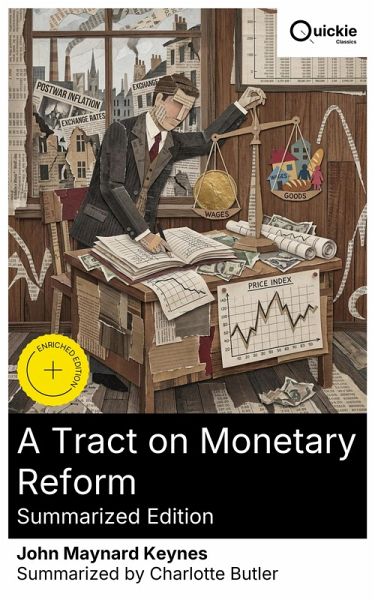
Published in 1923, A Tract on Monetary Reform is a lucid diagnosis of post-World War I monetary disorder and a manifesto for stabilizing the domestic price level. Combining crisp polemic with empirical care, Keynes dissects inflation and deflation as "arbitrary and inequitable" redistributions, reframes the quantity theory as a practical guide to policy, and urges a managed currency over mechanical fidelity to gold. He advances index-number stabilization and assigns central banks the duty of safeguarding the internal value of money, warning against restoring prewar parities; the lapidary reminder, "in the long run we are all dead," punctuates his impatience with purely long-run cures. Keynes wrote as a Cambridge economist and seasoned Treasury official, shaped by wartime finance and the Versailles aftermath. His close observation of European hyperinflations and British deflation, together with looming plans to return to gold, compelled a brisk, unsentimental treatise in which statistical reasoning, institutional detail, and policy design are inseparable. This book merits close reading by economists, historians, and policymakers concerned with inflation targeting, central bank mandates, and the perennial trade-offs of monetary regimes. Clear, compact, and prescient, it illuminates the foundations of modern monetary policy while remaining acutely relevant to today's dilemmas of price stability and financial credibility. Quickie Classics summarizes timeless works with precision, preserving the author's voice and keeping the prose clear, fast, and readable-distilled, never diluted. Enriched Edition extras: Introduction · Synopsis · Historical Context · Author Biography · Brief Analysis · 4 Reflection Q&As · Editorial Footnotes.
Dieser Download kann aus rechtlichen Gründen nur mit Rechnungsadresse in A, B, BG, CY, CZ, D, DK, EW, FIN, F, GR, H, IRL, I, LT, L, LR, M, NL, PL, P, R, S, SLO, SK ausgeliefert werden.