Sie sind bereits eingeloggt. Klicken Sie auf 2. tolino select Abo, um fortzufahren.
Bitte loggen Sie sich zunächst in Ihr Kundenkonto ein oder registrieren Sie sich bei bücher.de, um das eBook-Abo tolino select nutzen zu können.
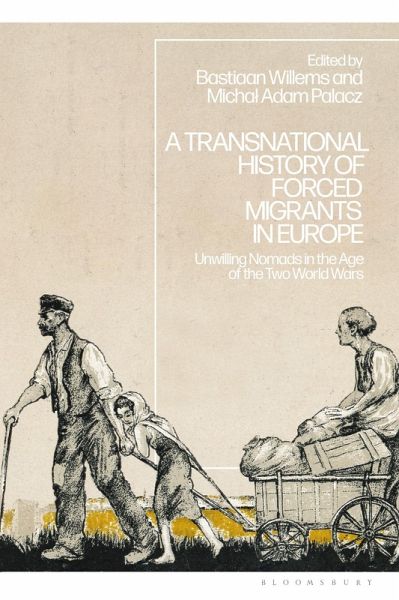
This book is a vital exploration of the harrowing stories of mass displacement that took place in the first half of the 20th century from the perspective of forced migrants themselves. The volume brings together 15 interrelated case studies which show how the deportation, evacuation and flight of millions of people as a result of the First World War intensified rather than alleviated ethnic conflicts which culminated in population transfers on an even larger scale during and immediately after the Second World War. While each chapter focuses on a different group of refugees and displaced…mehr
This book is a vital exploration of the harrowing stories of mass displacement that took place in the first half of the 20th century from the perspective of forced migrants themselves. The volume brings together 15 interrelated case studies which show how the deportation, evacuation and flight of millions of people as a result of the First World War intensified rather than alleviated ethnic conflicts which culminated in population transfers on an even larger scale during and immediately after the Second World War. While each chapter focuses on a different group of refugees and displaced persons, the text as a whole looks at the experience of forced migration as a complex set of evolving relationships with the receiving society, the homeland, the broader diaspora and other migrant communities living within the same host country. This innovative, four-dimensional model provides an overarching conceptual framework that binds the chapters together within the longer arc of European history. By going beyond the conventional narratives of national victimhood and (un)successful assimilation of refugees, A Transnational History of Forced Migrants in Europe reveals that identities of forced migrants in the first half of the 20th century were individualised, hybrid and constantly reconstructed in response to socioeconomic forces and political pressures. The case studies collected in this volume further suggest that age, gender, social class, educational level and the personal experiences of 'unwilling nomads' are more important to the understanding of forced migration history than ethnoreligious identities of victims and perpetrators.
Die Herstellerinformationen sind derzeit nicht verfügbar.
Autorenporträt
Bastiaan Willems is Lecturer in the History of War in 20th-Century Europe at Lancaster University, UK. He is the author of Violence in Defeat: The Wehrmacht on German Soil, 1944-1945 (2021) and co-editor of Reflections on Perpetration and Complicity under Nazism and Beyond: Compromised Identities? (forthcoming, Bloomsbury). Michal Adam Palacz is Postdoctoral Researcher in History at Oxford Brookes University, UK. He specializes in the transnational history of medicine and migration.
Inhaltsangabe
Foreword Andreas Kossert Introduction: Unwilling Nomads: A Four-Dimensional Model of Diaspora Bastiaan Willems (Lancaster University UK) and Michal Adam Palacz (Oxford Brooks University UK) Part I - Forced Migrants during the First World War 1. Population movement evacuation and internment in Habsburg Galicia during the First World War: Considering the four-dimensional model of diaspora Serhiy Choliy (Sikorsky Kyiv Polytechnic Institute Ukraine) 2. Humiliated and insulted: The multiple categories of Austro-Hungarian civilian internees 1914-17 Egor Lykov (ETH Zurich Switzerland) 3. Between Suffering and Displacement: The Case of the Istrian 'Evakuirci' Diego Han (University of Zagreb Croatia) Part II - Political Emigrants in the Interwar Era 4. Salvaging the 'unredeemed' in Italy: The Kingdom of Yugoslavia and the Julian March émigrés Miha Zobec (Slovenian Academy of Sciences and Arts Slovenia) 5. Ukrainian emigration in the Weimar Republic and its role in German foreign policy Veronika Weisheimer (European University Viadrina Frankfurt Germany) 6. Protecting the national identity of Russian emigrants and their children in interwar Eastern Europe Aleksandra Mikulenok (Russian State University of Justice Russia) Part III - People on the move in fascist Europe 7. Stefi Kiesler: A Librarian as 'Intellectual Refugee Service' Jill Meißner-Wolfbeisser (University of Vienna Austria) 8. The catalysts of 1938: European child evacuations as humanitarian innovation Chelsea Sambells (University of Huddersfield UK) 9. 'And Without a Hat!': Refugee women in the transit country Portugal after 1933 Katrin Sippel (Austrian Society for Exile Studies Austria) 10. Many Journeys of Exile: Spanish Republican Refugees in France 1939-1946 David Messenger (University of South Alabama USA) 11. Reclaimed for the Volk: Forced Migration and Assimilation in the Wartime Third Reich Bradley J. Nichols (University of Missouri USA) Part IV - Refugees and displaced persons and the Second World War 12. The surviving remnant: Subjectification and self-organization in the Jewish DP camp Bergen-Belsen 1945-8 Lennart Onken (Neuengamme Concentration Camp Memorial Hamburg Germany) 13. Resettling repatriating and 'rehabilitating' Polish displaced persons in British-occupied Germany 1945-51 Samantha K. Knapton (University of Nottingham UK) 14. Ethnopolitical humanitarianism: The post-war resettlement of 2 446 Danube Swabians to Brazil Cristian Cercel (Ruhr-University Bochum Germany) 15. Anti-communists communists and migrants in France 1917-53 Aaron Clift (University of Oxford UK) Conclusion: Polish Refugees and East Prussian Expellees: Applying the Four-Dimensional Model Bastiaan Willems (Lancaster University UK) and Michal Adam Palacz (Oxford Brooks University UK) Concluding Remarks Pertti Ahonen (University of Jyväskylä Finland) Index
Foreword Andreas Kossert Introduction: Unwilling Nomads: A Four-Dimensional Model of Diaspora Bastiaan Willems (Lancaster University UK) and Michal Adam Palacz (Oxford Brooks University UK) Part I - Forced Migrants during the First World War 1. Population movement evacuation and internment in Habsburg Galicia during the First World War: Considering the four-dimensional model of diaspora Serhiy Choliy (Sikorsky Kyiv Polytechnic Institute Ukraine) 2. Humiliated and insulted: The multiple categories of Austro-Hungarian civilian internees 1914-17 Egor Lykov (ETH Zurich Switzerland) 3. Between Suffering and Displacement: The Case of the Istrian 'Evakuirci' Diego Han (University of Zagreb Croatia) Part II - Political Emigrants in the Interwar Era 4. Salvaging the 'unredeemed' in Italy: The Kingdom of Yugoslavia and the Julian March émigrés Miha Zobec (Slovenian Academy of Sciences and Arts Slovenia) 5. Ukrainian emigration in the Weimar Republic and its role in German foreign policy Veronika Weisheimer (European University Viadrina Frankfurt Germany) 6. Protecting the national identity of Russian emigrants and their children in interwar Eastern Europe Aleksandra Mikulenok (Russian State University of Justice Russia) Part III - People on the move in fascist Europe 7. Stefi Kiesler: A Librarian as 'Intellectual Refugee Service' Jill Meißner-Wolfbeisser (University of Vienna Austria) 8. The catalysts of 1938: European child evacuations as humanitarian innovation Chelsea Sambells (University of Huddersfield UK) 9. 'And Without a Hat!': Refugee women in the transit country Portugal after 1933 Katrin Sippel (Austrian Society for Exile Studies Austria) 10. Many Journeys of Exile: Spanish Republican Refugees in France 1939-1946 David Messenger (University of South Alabama USA) 11. Reclaimed for the Volk: Forced Migration and Assimilation in the Wartime Third Reich Bradley J. Nichols (University of Missouri USA) Part IV - Refugees and displaced persons and the Second World War 12. The surviving remnant: Subjectification and self-organization in the Jewish DP camp Bergen-Belsen 1945-8 Lennart Onken (Neuengamme Concentration Camp Memorial Hamburg Germany) 13. Resettling repatriating and 'rehabilitating' Polish displaced persons in British-occupied Germany 1945-51 Samantha K. Knapton (University of Nottingham UK) 14. Ethnopolitical humanitarianism: The post-war resettlement of 2 446 Danube Swabians to Brazil Cristian Cercel (Ruhr-University Bochum Germany) 15. Anti-communists communists and migrants in France 1917-53 Aaron Clift (University of Oxford UK) Conclusion: Polish Refugees and East Prussian Expellees: Applying the Four-Dimensional Model Bastiaan Willems (Lancaster University UK) and Michal Adam Palacz (Oxford Brooks University UK) Concluding Remarks Pertti Ahonen (University of Jyväskylä Finland) Index
Es gelten unsere Allgemeinen Geschäftsbedingungen: www.buecher.de/agb
Impressum
www.buecher.de ist ein Internetauftritt der buecher.de internetstores GmbH
Geschäftsführung: Monica Sawhney | Roland Kölbl | Günter Hilger
Sitz der Gesellschaft: Batheyer Straße 115 - 117, 58099 Hagen
Postanschrift: Bürgermeister-Wegele-Str. 12, 86167 Augsburg
Amtsgericht Hagen HRB 13257
Steuernummer: 321/5800/1497
USt-IdNr: DE450055826