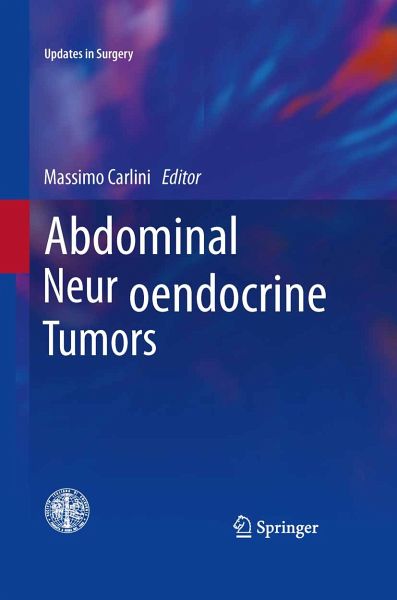
Abdominal Neuroendocrine Tumors (eBook, PDF)
Redaktion: Carlini, Massimo
72,95 €
72,95 €
inkl. MwSt.
Sofort per Download lieferbar

36 °P sammeln
72,95 €
Als Download kaufen
72,95 €
inkl. MwSt.
Sofort per Download lieferbar
36 °P sammeln
Jetzt verschenken
Alle Infos zum eBook verschenken
72,95 €
inkl. MwSt.
Sofort per Download lieferbar
Alle Infos zum eBook verschenken
36 °P sammeln

Abdominal Neuroendocrine Tumors (eBook, PDF)
Redaktion: Carlini, Massimo
- Format: PDF
- Merkliste
- Auf die Merkliste
- Bewerten Bewerten
- Teilen
- Produkt teilen
- Produkterinnerung
- Produkterinnerung

Bitte loggen Sie sich zunächst in Ihr Kundenkonto ein oder registrieren Sie sich bei
bücher.de, um das eBook-Abo tolino select nutzen zu können.
Hier können Sie sich einloggen
Sie sind bereits eingeloggt. Klicken Sie auf 2. tolino select Abo, um fortzufahren.

Bitte loggen Sie sich zunächst in Ihr Kundenkonto ein oder registrieren Sie sich bei bücher.de, um das eBook-Abo tolino select nutzen zu können.
Provides state of the art information on neuroendocrine tumors (NETs) and their management
Aids surgeons in making the right clinical decisions
Covers less well known, but nevertheless significant, aspects of abdominal NETs
Offers a valuable resource for researchers
- Geräte: PC
- ohne Kopierschutz
- eBook Hilfe
- Größe: 21.45MB
Andere Kunden interessierten sich auch für
Medullary Thyroid Cancer (eBook, PDF)88,95 €
Primary, Secondary and Tertiary Hyperparathyroidism (eBook, PDF)72,95 €
Endocrine and Neuroendocrine Surgery (eBook, PDF)120,95 €
Transsphenoidal Surgery (eBook, PDF)96,95 €
Abdominal Sepsis (eBook, PDF)80,95 €
Management of Thyroid Nodules and Differentiated Thyroid Cancer (eBook, PDF)72,95 €
Robotic Surgery for Abdominal Wall Hernia Repair (eBook, PDF)64,95 €-
-
-
Provides state of the art information on neuroendocrine tumors (NETs) and their management
Aids surgeons in making the right clinical decisions
Covers less well known, but nevertheless significant, aspects of abdominal NETs
Offers a valuable resource for researchers
Aids surgeons in making the right clinical decisions
Covers less well known, but nevertheless significant, aspects of abdominal NETs
Offers a valuable resource for researchers
Dieser Download kann aus rechtlichen Gründen nur mit Rechnungsadresse in A, B, BG, CY, CZ, D, DK, EW, E, FIN, F, GR, HR, H, IRL, I, LT, L, LR, M, NL, PL, P, R, S, SLO, SK ausgeliefert werden.
Produktdetails
- Produktdetails
- Verlag: Springer Milan
- Seitenzahl: 198
- Erscheinungstermin: 13. Oktober 2017
- Englisch
- ISBN-13: 9788847039551
- Artikelnr.: 52997290
- Verlag: Springer Milan
- Seitenzahl: 198
- Erscheinungstermin: 13. Oktober 2017
- Englisch
- ISBN-13: 9788847039551
- Artikelnr.: 52997290
- Herstellerkennzeichnung Die Herstellerinformationen sind derzeit nicht verfügbar.
Massimo Carlini is Director of the Department of General Surgery at the S. Eugenio Hospital in Rome. He graduated in Medicine and Surgery (cum laude) from the Sapienza University of Rome in 1982 and subsequently specialized in General Surgery, Oncologic Surgery, and Emergency Surgery. Adjunct Professor at the University of Rome, Italy and a Tutor and Teacher at the SIC and ACOI Special Schools of Minimally Invasive Surgery. He is a Councillor in the American College of Surgeons - Italy Chapter and in the Italian Society of Surgery. He is Vice President of the Roman Academy of Surgery and Regional Delegate in the Italian Society of Emergency Surgery too. Professor Carlini is the author of more than 200 scientific publications and more than 70 videos of open and minimally invasive surgical techniques. He has performed over 15.000 surgical procedures, mainly minimally invasive, for esophagogastric, hepatobiliary, pancreatic and colorectal diseases.
Foreword.- Preface.- 1 Anatomophysiology of the neuroendocrine system: Embryology, Anatomy - Histology - Citology, Physiology.- 2 Epidemiology: Risk factors.- 3 Classification: WHO (grading), site.- 4 Pathology: Anatomic pathology, Immunohistochemistry. - 5 Molecular biology: Molecular pathways, Oncogenes, Suppressor genes.- 6 Clinical presentations: Non functioning NETs.- 7 Clinical presentations: Hormone releasing NETs (Carcinoid syndrome, Insulinoma, Glucagonoma, VIPoma, Somatostatinoma, Others, GRFoma.- 8 MEN 1, MEN 2am, MEN 2b, and Others (TSC, VHL, NF1).- 9 Diagnosis: (Serum biomarkers, Endoscopy, Imaging (US, CT Scan, MRI, Angiography, Scintigraphy, PET).- 10 Staging: TNM.- 11 Surgical treatment: Gastric NETs, Duodenum NETs, Jejuno-ileal NETs, Colorectal NETs, Pancreatic NETs (Head, Body-tail), Adrenal NETs.- 12 Non surgical treatments: Chemotherapy, Hormonal syndrome treatment, Targeted therapies, IFN.- 13 Metastatic disease: Liver metastases (Surgery, RF ablation and cryoablation, Arterial chemoembolization).- 14 Systemic therapy (Somatostatina analogs, Alpha IFN, Cytotoxic chemotherapy, Peptide receptor radiotherapy, VEGF inhibitors, mTOR inhibitors.- 15 Flow-charts.