Philippe Picard, Claude Lefevre
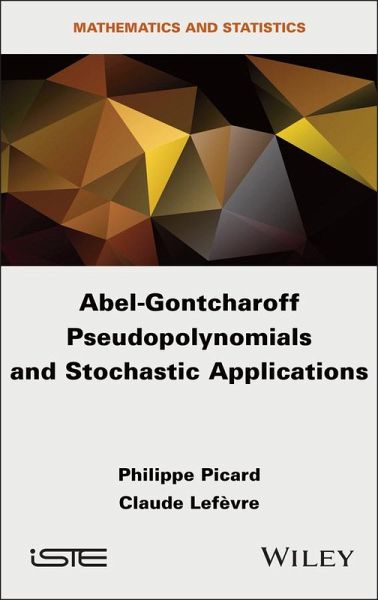
Abel-Gontcharoff Pseudopolynomials and Stochastic Applications (eBook, PDF)
142,99 €
142,99 €
inkl. MwSt.
Sofort per Download lieferbar

0 °P sammeln
142,99 €
Als Download kaufen
142,99 €
inkl. MwSt.
Sofort per Download lieferbar
0 °P sammeln
Jetzt verschenken
Alle Infos zum eBook verschenken
142,99 €
inkl. MwSt.
Sofort per Download lieferbar
Alle Infos zum eBook verschenken
0 °P sammeln

Philippe Picard, Claude Lefevre
Abel-Gontcharoff Pseudopolynomials and Stochastic Applications (eBook, PDF)
- Format: PDF
- Merkliste
- Auf die Merkliste
- Bewerten Bewerten
- Teilen
- Produkt teilen
- Produkterinnerung
- Produkterinnerung

Bitte loggen Sie sich zunächst in Ihr Kundenkonto ein oder registrieren Sie sich bei
bücher.de, um das eBook-Abo tolino select nutzen zu können.
Hier können Sie sich einloggen
Sie sind bereits eingeloggt. Klicken Sie auf 2. tolino select Abo, um fortzufahren.

Bitte loggen Sie sich zunächst in Ihr Kundenkonto ein oder registrieren Sie sich bei bücher.de, um das eBook-Abo tolino select nutzen zu können.
This book proposes a new mathematical methodology for addressing first passage problems, particularly in various classical stochastic models of applied probability. This approach is based on the so-called Abel-Gontcharoff (A-G) pseudopolynomials and the associated A-G expansions, which have been introduced and studied by the authors in recent years. These A-G expansions generalize the well-known Abel expansion, which allows us to extend the standard Taylor formula.
Abel-Gontcharoff Pseudopolynomials and Stochastic Applications starts by presenting an in-depth presentation of the general…mehr
- Geräte: PC
- mit Kopierschutz
- eBook Hilfe
- Größe: 2.38MB
Andere Kunden interessierten sich auch für
Yuliya MishuraTheory and Statistical Applications of Stochastic Processes (eBook, PDF)139,99 €
B. L. S. Prakasa RaoStatistical Inference for Fractional Diffusion Processes (eBook, PDF)92,99 €
Ensemble Classification Methods with Applications in R (eBook, PDF)114,99 €
Maksym LuzEstimation of Stochastic Processes with Stationary Increments and Cointegrated Sequences (eBook, PDF)139,99 €
Cuthbert DanielApplications of Statistics to Industrial Experimentation (eBook, PDF)259,99 €
Dmitri KorolioukAsymptotic and Analytic Methods in Stochastic Evolutionary Symptoms (eBook, PDF)130,99 €
Data Analysis and Applications 4 (eBook, PDF)139,99 €-
-
-
This book proposes a new mathematical methodology for addressing first passage problems, particularly in various classical stochastic models of applied probability. This approach is based on the so-called Abel-Gontcharoff (A-G) pseudopolynomials and the associated A-G expansions, which have been introduced and studied by the authors in recent years. These A-G expansions generalize the well-known Abel expansion, which allows us to extend the standard Taylor formula.
Abel-Gontcharoff Pseudopolynomials and Stochastic Applications starts by presenting an in-depth presentation of the general theory, and then moves onto stochastic applications of this theory, especially in biomathematics. Univariate and multivariate versions of the A-G pseudopolynomials, as well as extensions with randomized parameters, are discussed and illustrated for modeling, notably by highlighting families of martingales and using stopping time theorems. This book concludes by paving the way to a nonhomogeneous theory for first crossing problems.
Dieser Download kann aus rechtlichen Gründen nur mit Rechnungsadresse in D ausgeliefert werden.
Produktdetails
- Produktdetails
- Verlag: John Wiley & Sons
- Seitenzahl: 305
- Erscheinungstermin: 14. Oktober 2025
- Englisch
- ISBN-13: 9781394417964
- Artikelnr.: 75692922
- Verlag: John Wiley & Sons
- Seitenzahl: 305
- Erscheinungstermin: 14. Oktober 2025
- Englisch
- ISBN-13: 9781394417964
- Artikelnr.: 75692922
- Herstellerkennzeichnung Die Herstellerinformationen sind derzeit nicht verfügbar.
Philippe Picard is a mathematician and probabilist, and was Professor at the Université de Lyon, France (retired in 2000), where he was responsible for the training of actuaries. His research focuses on mathematical tools in genetics, epidemics and risk theory, such as martingales and polynomials.
Claude Lefèvre is a probabilist and statistician, and is Professor Emeritus at the Université Libre de Bruxelles, Belgium. His research focuses on applied probability models, in particular those related to epidemics, reliability, queueing and actuarial science.
Preface ix Chapter 1. Historical Abel-Gontcharoff Polynomials 1 1.1. Abel identity 1 1.2. Abel polynomials and expansions 2 1.3. Gontcharoff contribution 4 1.4. Increased recognition 8 1.5. A first meeting problem 10 1.6. A final epidemic outcome 13 1.7. A goodness-of-fit test 16 1.8. Extension to pseudopolynomials 19 Chapter 2. Abel-Gontcharoff Pseudopolynomials 21 2.1. General framework: D, E, F,
21 2.2. Copies
and standard families 24 2.3. An integration operator Iu 30 2.4. A-G pseudopolynomials Gn( U) 32 2.5. Expansions of A-G type 37 2.6. A shift operator Sa 42 2.7. A multiplication operator M
46 2.8. Shift invariance property 48 Chapter 3. General Theory and Explicit Results 55 3.1. Return to the shift invariance 55 3.2. The higher dimensional case 66 3.3. Calculation formulas for ¯Gn( U) 71 3.4. Geometric or affine form for U 80 3.5. Extension to special sequences ui = {ui,j} 87 3.6. When D is the set of integers 93 Chapter 4. Further Results and Properties 97 4.1. A related basic family E(b) 97 4.2. Upper and lower bounds for Gn( U) 102 4.3. Short visit to the A-G type series 111 4.4. Bilinear forms and biorthogonality 116 4.5. An alternative generalization 119 Chapter 5. Multi-index A-G Pseudopolynomials 129 5.1. Key definitions and expansions 129 5.2. Explicit formulas for Gn1,n2( U) 132 5.3. Multivariate case Gn1,n2( U(1), U(2)) 136 5.4. Integral multivariate representation 146 5.5. Special case of A-G polynomials 149 Chapter 6. Randomizing A-G Pseudopolynomials 153 6.1. How to integrate stochasticity? 153 6.2. With ui partial sums of i.i.d. variables 155 6.3. Multivariate additive extension 165 6.4. With ui partial products of i.i.d. variables 170 6.5. Multivariate multiplicative extension 173 6.6. Additive case for exponential functions 176 Chapter 7. First Meeting Level with a Lower Boundary 183 7.1. Return to a classical Poisson process 183 7.2. For a compound Poisson process 186 7.3. Related first passage problems 190 7.4. With the number of Poisson jumps 193 7.5. For a linear birth process with immigration 196 7.6. Extension allowing multiple births 201 7.7. For a nonlinear birth process 204 Chapter 8. Less Standard First Meeting Models 211 8.1. Compound Poisson process with a renewal process 211 8.2. Linear birth process with a renewal process 214 8.3. Nonlinear death process with a birth process 217 8.4. Binomial process with a lower boundary 221 8.5. For a compound binomial process 224 8.6. Compound binomial process with a renewal process 226 Chapter 9. Martingales and A-G Pseudopolynomials 229 9.1. Motivation via damage-type models 229 9.2. Unified treatment by A-G pseudopolynomials 232 9.3. Reed-Frost multipopulation epidemic 235 9.4. Nonlinear death process 237 9.5. Combined general and fatal epidemics 241 9.6. Time-dependent bivariate death process 246 Chapter 10. Towards a Non-homogeneous Theory 255 10.1. A non-stationary compound Poisson process 255 10.2. A compound Poisson random field 265 References 277 Index 281
21 2.2. Copies
and standard families 24 2.3. An integration operator Iu 30 2.4. A-G pseudopolynomials Gn( U) 32 2.5. Expansions of A-G type 37 2.6. A shift operator Sa 42 2.7. A multiplication operator M
46 2.8. Shift invariance property 48 Chapter 3. General Theory and Explicit Results 55 3.1. Return to the shift invariance 55 3.2. The higher dimensional case 66 3.3. Calculation formulas for ¯Gn( U) 71 3.4. Geometric or affine form for U 80 3.5. Extension to special sequences ui = {ui,j} 87 3.6. When D is the set of integers 93 Chapter 4. Further Results and Properties 97 4.1. A related basic family E(b) 97 4.2. Upper and lower bounds for Gn( U) 102 4.3. Short visit to the A-G type series 111 4.4. Bilinear forms and biorthogonality 116 4.5. An alternative generalization 119 Chapter 5. Multi-index A-G Pseudopolynomials 129 5.1. Key definitions and expansions 129 5.2. Explicit formulas for Gn1,n2( U) 132 5.3. Multivariate case Gn1,n2( U(1), U(2)) 136 5.4. Integral multivariate representation 146 5.5. Special case of A-G polynomials 149 Chapter 6. Randomizing A-G Pseudopolynomials 153 6.1. How to integrate stochasticity? 153 6.2. With ui partial sums of i.i.d. variables 155 6.3. Multivariate additive extension 165 6.4. With ui partial products of i.i.d. variables 170 6.5. Multivariate multiplicative extension 173 6.6. Additive case for exponential functions 176 Chapter 7. First Meeting Level with a Lower Boundary 183 7.1. Return to a classical Poisson process 183 7.2. For a compound Poisson process 186 7.3. Related first passage problems 190 7.4. With the number of Poisson jumps 193 7.5. For a linear birth process with immigration 196 7.6. Extension allowing multiple births 201 7.7. For a nonlinear birth process 204 Chapter 8. Less Standard First Meeting Models 211 8.1. Compound Poisson process with a renewal process 211 8.2. Linear birth process with a renewal process 214 8.3. Nonlinear death process with a birth process 217 8.4. Binomial process with a lower boundary 221 8.5. For a compound binomial process 224 8.6. Compound binomial process with a renewal process 226 Chapter 9. Martingales and A-G Pseudopolynomials 229 9.1. Motivation via damage-type models 229 9.2. Unified treatment by A-G pseudopolynomials 232 9.3. Reed-Frost multipopulation epidemic 235 9.4. Nonlinear death process 237 9.5. Combined general and fatal epidemics 241 9.6. Time-dependent bivariate death process 246 Chapter 10. Towards a Non-homogeneous Theory 255 10.1. A non-stationary compound Poisson process 255 10.2. A compound Poisson random field 265 References 277 Index 281
Preface ix Chapter 1. Historical Abel-Gontcharoff Polynomials 1 1.1. Abel identity 1 1.2. Abel polynomials and expansions 2 1.3. Gontcharoff contribution 4 1.4. Increased recognition 8 1.5. A first meeting problem 10 1.6. A final epidemic outcome 13 1.7. A goodness-of-fit test 16 1.8. Extension to pseudopolynomials 19 Chapter 2. Abel-Gontcharoff Pseudopolynomials 21 2.1. General framework: D, E, F,
21 2.2. Copies
and standard families 24 2.3. An integration operator Iu 30 2.4. A-G pseudopolynomials Gn( U) 32 2.5. Expansions of A-G type 37 2.6. A shift operator Sa 42 2.7. A multiplication operator M
46 2.8. Shift invariance property 48 Chapter 3. General Theory and Explicit Results 55 3.1. Return to the shift invariance 55 3.2. The higher dimensional case 66 3.3. Calculation formulas for ¯Gn( U) 71 3.4. Geometric or affine form for U 80 3.5. Extension to special sequences ui = {ui,j} 87 3.6. When D is the set of integers 93 Chapter 4. Further Results and Properties 97 4.1. A related basic family E(b) 97 4.2. Upper and lower bounds for Gn( U) 102 4.3. Short visit to the A-G type series 111 4.4. Bilinear forms and biorthogonality 116 4.5. An alternative generalization 119 Chapter 5. Multi-index A-G Pseudopolynomials 129 5.1. Key definitions and expansions 129 5.2. Explicit formulas for Gn1,n2( U) 132 5.3. Multivariate case Gn1,n2( U(1), U(2)) 136 5.4. Integral multivariate representation 146 5.5. Special case of A-G polynomials 149 Chapter 6. Randomizing A-G Pseudopolynomials 153 6.1. How to integrate stochasticity? 153 6.2. With ui partial sums of i.i.d. variables 155 6.3. Multivariate additive extension 165 6.4. With ui partial products of i.i.d. variables 170 6.5. Multivariate multiplicative extension 173 6.6. Additive case for exponential functions 176 Chapter 7. First Meeting Level with a Lower Boundary 183 7.1. Return to a classical Poisson process 183 7.2. For a compound Poisson process 186 7.3. Related first passage problems 190 7.4. With the number of Poisson jumps 193 7.5. For a linear birth process with immigration 196 7.6. Extension allowing multiple births 201 7.7. For a nonlinear birth process 204 Chapter 8. Less Standard First Meeting Models 211 8.1. Compound Poisson process with a renewal process 211 8.2. Linear birth process with a renewal process 214 8.3. Nonlinear death process with a birth process 217 8.4. Binomial process with a lower boundary 221 8.5. For a compound binomial process 224 8.6. Compound binomial process with a renewal process 226 Chapter 9. Martingales and A-G Pseudopolynomials 229 9.1. Motivation via damage-type models 229 9.2. Unified treatment by A-G pseudopolynomials 232 9.3. Reed-Frost multipopulation epidemic 235 9.4. Nonlinear death process 237 9.5. Combined general and fatal epidemics 241 9.6. Time-dependent bivariate death process 246 Chapter 10. Towards a Non-homogeneous Theory 255 10.1. A non-stationary compound Poisson process 255 10.2. A compound Poisson random field 265 References 277 Index 281
21 2.2. Copies
and standard families 24 2.3. An integration operator Iu 30 2.4. A-G pseudopolynomials Gn( U) 32 2.5. Expansions of A-G type 37 2.6. A shift operator Sa 42 2.7. A multiplication operator M
46 2.8. Shift invariance property 48 Chapter 3. General Theory and Explicit Results 55 3.1. Return to the shift invariance 55 3.2. The higher dimensional case 66 3.3. Calculation formulas for ¯Gn( U) 71 3.4. Geometric or affine form for U 80 3.5. Extension to special sequences ui = {ui,j} 87 3.6. When D is the set of integers 93 Chapter 4. Further Results and Properties 97 4.1. A related basic family E(b) 97 4.2. Upper and lower bounds for Gn( U) 102 4.3. Short visit to the A-G type series 111 4.4. Bilinear forms and biorthogonality 116 4.5. An alternative generalization 119 Chapter 5. Multi-index A-G Pseudopolynomials 129 5.1. Key definitions and expansions 129 5.2. Explicit formulas for Gn1,n2( U) 132 5.3. Multivariate case Gn1,n2( U(1), U(2)) 136 5.4. Integral multivariate representation 146 5.5. Special case of A-G polynomials 149 Chapter 6. Randomizing A-G Pseudopolynomials 153 6.1. How to integrate stochasticity? 153 6.2. With ui partial sums of i.i.d. variables 155 6.3. Multivariate additive extension 165 6.4. With ui partial products of i.i.d. variables 170 6.5. Multivariate multiplicative extension 173 6.6. Additive case for exponential functions 176 Chapter 7. First Meeting Level with a Lower Boundary 183 7.1. Return to a classical Poisson process 183 7.2. For a compound Poisson process 186 7.3. Related first passage problems 190 7.4. With the number of Poisson jumps 193 7.5. For a linear birth process with immigration 196 7.6. Extension allowing multiple births 201 7.7. For a nonlinear birth process 204 Chapter 8. Less Standard First Meeting Models 211 8.1. Compound Poisson process with a renewal process 211 8.2. Linear birth process with a renewal process 214 8.3. Nonlinear death process with a birth process 217 8.4. Binomial process with a lower boundary 221 8.5. For a compound binomial process 224 8.6. Compound binomial process with a renewal process 226 Chapter 9. Martingales and A-G Pseudopolynomials 229 9.1. Motivation via damage-type models 229 9.2. Unified treatment by A-G pseudopolynomials 232 9.3. Reed-Frost multipopulation epidemic 235 9.4. Nonlinear death process 237 9.5. Combined general and fatal epidemics 241 9.6. Time-dependent bivariate death process 246 Chapter 10. Towards a Non-homogeneous Theory 255 10.1. A non-stationary compound Poisson process 255 10.2. A compound Poisson random field 265 References 277 Index 281