Sie sind bereits eingeloggt. Klicken Sie auf 2. tolino select Abo, um fortzufahren.
Bitte loggen Sie sich zunächst in Ihr Kundenkonto ein oder registrieren Sie sich bei bücher.de, um das eBook-Abo tolino select nutzen zu können.
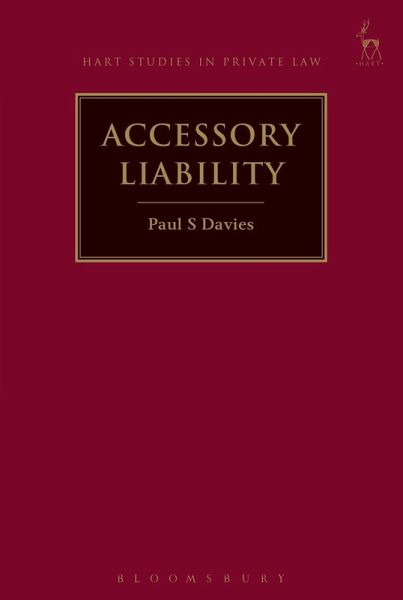
Accessory liability in the private law is of great importance. Claimants often bring claims against third parties who participate in wrongs. For example, the 'direct wrongdoer' may be insolvent, so a claimant might prefer a remedy against an accessory in order to obtain satisfactory redress. However, the law in this area has not received the attention it deserves. The criminal law recognises that any person who 'aids, abets, counsels or procures' any offence can be punished as an accessory, but the private law is more fragmented. One reason for this is a tendency to compartmentalise the law of…mehr
Accessory liability in the private law is of great importance. Claimants often bring claims against third parties who participate in wrongs. For example, the 'direct wrongdoer' may be insolvent, so a claimant might prefer a remedy against an accessory in order to obtain satisfactory redress. However, the law in this area has not received the attention it deserves. The criminal law recognises that any person who 'aids, abets, counsels or procures' any offence can be punished as an accessory, but the private law is more fragmented. One reason for this is a tendency to compartmentalise the law of obligations into discrete subjects, such as contract, trusts, tort and intellectual property. This book suggests that by looking across such boundaries in the private law, the nature and principles of accessory liability can be better understood and doctrinal confusion regarding the elements of liability, defences and remedies resolved. Winner of the Joint Second SLS Peter Birks Prize for Outstanding Legal Scholarship 2015.
Die Herstellerinformationen sind derzeit nicht verfügbar.
Autorenporträt
Paul S Davies is Professor of Commercial Law at UCL and a Barrister at Essex Court Chambers. He was previously a Fellow of Gonville and Caius College, Cambridge and St Catherine's College, Oxford. Paul has also worked at the Law Commission. He is the author of Accessory Liability (Hart Publishing, 2015; revised paperback edition, 2017), which won the main Inner Temple Book Prize in 2018, JC Smith's The Law of Contract (3rd ed, OUP, 2021), and a co-author of Equity and Trusts: Text, Cases and Materials (3rd ed, OUP, 2019 (with Graham Virgo)). Paul is also an editor of both Chitty on Contracts and Snell's Equity. In 2020 Paul was awarded a Philip Leverhulme Prize in Law.
Photo courtesy of Faculty of Law, University of Oxford.
Inhaltsangabe
1. Introduction I. What is Accessory Liability? II. Why is Accessory Liability Important? III. Doctrinal Difficulties in the Law of Obligations IV. Looking Across the Legal Landscape V. Approach of the Book 2. Fundamentals I. Principles Underpinning Accessory Liability II. Conduct Element III. Mental Element IV. Nature of Accessory Liability V. Distinguishing Accessory Liability 3. Crime I. Scope of Accessory Liability II. Primary Offence III. Conduct Element IV. Mental Element V. Defences VI. Nature of Liability VII. Rationales of Liability VIII. Conclusions 4. Equity I. Seeds of Confusion: The Effect of Barnes v Addy II. A New Start: Royal Brunei Airlines Sdn Bhd v Tan III. Primary Wrong: Breach of Contract IV. Conduct Element V. Mental Element VI. Explaining Accessory Liability VII. What Shape should Accessory Liability Take? 5. Contract I. The Leading Case: Lumley v Gye II. Accessory Liability Recognised: OBG Ltd v Allan III. Primary Wrong IV. Conduct Element V. Mental Element VI. Explaining Accessory Liability VII. Against Accessory Liability: Defending Breach of Contract VIII. What Shape should Accessory Liability Take? 6. Tort I. Mapping Accessory Liability in Tort Law II. Primary Wrong III. Conduct Element IV. Mental Element V. Explaining Liability VI. What Shape should Accessory Liability Take? 7. Defences I. Defences Available to the Primary Wrongdoer II. Justification III. Withdrawal IV. Limitation V. Conclusion 8. Remedies I. 'Secondary' Liability Exposed II. Compensation III. Gain-based Awards IV. Hypothetical Bargain Measure of Damages V. Contribution VI. Punitive Damages VII. Injunction VIII. Combining Remedies 9. Conclusions I. 'Knowing Assistance' II. A Standard Approach Across All Obligations III. The Nature of Accessory Liability IV. A Narrow But Coherent Law of Accessory Liability
1. Introduction I. What is Accessory Liability? II. Why is Accessory Liability Important? III. Doctrinal Difficulties in the Law of Obligations IV. Looking Across the Legal Landscape V. Approach of the Book 2. Fundamentals I. Principles Underpinning Accessory Liability II. Conduct Element III. Mental Element IV. Nature of Accessory Liability V. Distinguishing Accessory Liability 3. Crime I. Scope of Accessory Liability II. Primary Offence III. Conduct Element IV. Mental Element V. Defences VI. Nature of Liability VII. Rationales of Liability VIII. Conclusions 4. Equity I. Seeds of Confusion: The Effect of Barnes v Addy II. A New Start: Royal Brunei Airlines Sdn Bhd v Tan III. Primary Wrong: Breach of Contract IV. Conduct Element V. Mental Element VI. Explaining Accessory Liability VII. What Shape should Accessory Liability Take? 5. Contract I. The Leading Case: Lumley v Gye II. Accessory Liability Recognised: OBG Ltd v Allan III. Primary Wrong IV. Conduct Element V. Mental Element VI. Explaining Accessory Liability VII. Against Accessory Liability: Defending Breach of Contract VIII. What Shape should Accessory Liability Take? 6. Tort I. Mapping Accessory Liability in Tort Law II. Primary Wrong III. Conduct Element IV. Mental Element V. Explaining Liability VI. What Shape should Accessory Liability Take? 7. Defences I. Defences Available to the Primary Wrongdoer II. Justification III. Withdrawal IV. Limitation V. Conclusion 8. Remedies I. 'Secondary' Liability Exposed II. Compensation III. Gain-based Awards IV. Hypothetical Bargain Measure of Damages V. Contribution VI. Punitive Damages VII. Injunction VIII. Combining Remedies 9. Conclusions I. 'Knowing Assistance' II. A Standard Approach Across All Obligations III. The Nature of Accessory Liability IV. A Narrow But Coherent Law of Accessory Liability
Es gelten unsere Allgemeinen Geschäftsbedingungen: www.buecher.de/agb
Impressum
www.buecher.de ist ein Internetauftritt der buecher.de internetstores GmbH
Geschäftsführung: Monica Sawhney | Roland Kölbl | Günter Hilger
Sitz der Gesellschaft: Batheyer Straße 115 - 117, 58099 Hagen
Postanschrift: Bürgermeister-Wegele-Str. 12, 86167 Augsburg
Amtsgericht Hagen HRB 13257
Steuernummer: 321/5800/1497
USt-IdNr: DE450055826