Sie sind bereits eingeloggt. Klicken Sie auf 2. tolino select Abo, um fortzufahren.
Bitte loggen Sie sich zunächst in Ihr Kundenkonto ein oder registrieren Sie sich bei bücher.de, um das eBook-Abo tolino select nutzen zu können.
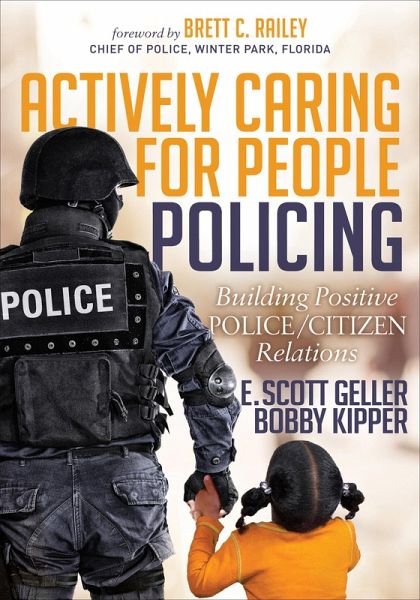
A revolutionary new approach to policing that puts people over punishment. Experts have struggled to define the term "police culture." For most, this label means a reactive approach to keeping people safe by using punitive consequences to punish or detain the perpetrators. The result: More attention is given to the negative, reactive side of policing than a positive, proactive approach to preventing crime by cultivating an interdependent culture of residents looking out for the safety, health, and well-being of each other. In Actively Caring for People Policing, authors E.Scott Geller and…mehr
A revolutionary new approach to policing that puts people over punishment. Experts have struggled to define the term "police culture." For most, this label means a reactive approach to keeping people safe by using punitive consequences to punish or detain the perpetrators. The result: More attention is given to the negative, reactive side of policing than a positive, proactive approach to preventing crime by cultivating an interdependent culture of residents looking out for the safety, health, and well-being of each other. In Actively Caring for People Policing, authors E.Scott Geller and Bobby Kipper show how police officers can play a critical and integral role in achieving such a community of compassion-an Actively Caring for People (AC4P) culture. With AC4P policing, consequences are used to increase the quantity and improve the quality of desired behavior. Police officers are educated about the rationale behind using more positive than negative consequences to manage behavior, and then they are trained on how to deliver positive consequences in ways that help to cultivate interpersonal trust and AC4P behavior among police officers and the citizens they serve. The result: humanistic behaviorism to enhance long-term positive relations between police officers and the citizens they serve, thereby preventing interpersonal conflict, violence, and harm.
Die Herstellerinformationen sind derzeit nicht verfügbar.
Autorenporträt
E. Scott Geller, Alumni Distinguished Professor at Virginia Tech is a senior partner of Safety Performance Solutions, Blacksburg, VA. He has authored or coauthored 33 books, 82 book chapters, 259 magazine articles, and more than 350 research articles addressing the development and evaluation of behavior-change interventions to improve quality of life. Dr. Geller is a Fellow of the American Psychological Association, the Association for Psychological Science, the Association for Behavior Analysis International, and the World Academy of Productivity and Quality Sciences. He has received Lifetime Achievement Awards from the American Psychological Foundation and the International Organizational Behavior Management Network.Bobby Kipper began his career with the Newport News Police Department in 1977. During his 25-year career he served in the areas of patrol, investigations, media relations, and as executive assistant to the Chief of Police. Following his decorated 25 years' service with the department, he served as the director of Virginia's Gang Reduction Program at the Office of the Attorney General. Bobby is the founder and director of the National Center for the Prevention of Community Violence. His expertise in the area of community and school violence prevention has been recognized by the White House, Congress, and a number of states across America. His best-selling book, No Colors: 100 Ways to Keep Gangs from Taking Away Our Communities, has been instrumental in developing gang reduction programs in communities across America.
Inhaltsangabe
The Initiation and Evolution of AC4P Policing From Principles to Applications Lesson 1: Employ More Positive Consequences Lesson 2: Benefit from Observational Learning Lesson 3: Improve with Behavioral Feedforward and Feedback Lesson 4: Use More Supportive than Corrective Feedback Lesson 5: Embrace and Practice Empathy Lesson 6: Distinguish between Managing Behavior and Leading People Lesson 7: Progress from Self-Actualization to Self-Transcendence AC4P Policing in Action AC4P Wristband Stories Wristband Stories from the Field
The Initiation and Evolution of AC4P Policing From Principles to Applications Lesson 1: Employ More Positive Consequences Lesson 2: Benefit from Observational Learning Lesson 3: Improve with Behavioral Feedforward and Feedback Lesson 4: Use More Supportive than Corrective Feedback Lesson 5: Embrace and Practice Empathy Lesson 6: Distinguish between Managing Behavior and Leading People Lesson 7: Progress from Self-Actualization to Self-Transcendence AC4P Policing in Action AC4P Wristband Stories Wristband Stories from the Field
Es gelten unsere Allgemeinen Geschäftsbedingungen: www.buecher.de/agb
Impressum
www.buecher.de ist ein Internetauftritt der buecher.de internetstores GmbH
Geschäftsführung: Monica Sawhney | Roland Kölbl | Günter Hilger
Sitz der Gesellschaft: Batheyer Straße 115 - 117, 58099 Hagen
Postanschrift: Bürgermeister-Wegele-Str. 12, 86167 Augsburg
Amtsgericht Hagen HRB 13257
Steuernummer: 321/5800/1497
USt-IdNr: DE450055826