175,95 €
175,95 €
inkl. MwSt.
Sofort per Download lieferbar

88 °P sammeln
175,95 €
Als Download kaufen
175,95 €
inkl. MwSt.
Sofort per Download lieferbar
88 °P sammeln
Jetzt verschenken
Alle Infos zum eBook verschenken
175,95 €
inkl. MwSt.
Sofort per Download lieferbar
Alle Infos zum eBook verschenken
88 °P sammeln

Andere Kunden interessierten sich auch für
") Acute Neuronal Injury (eBook, PDF)72,95 €
Acute Neuronal Injury (eBook, PDF)72,95 €") Neuronal Death by Accident or by Design (eBook, PDF)112,95 €
Neuronal Death by Accident or by Design (eBook, PDF)112,95 €") Animal Models of Acute Neurological Injury (eBook, PDF)112,95 €
Animal Models of Acute Neurological Injury (eBook, PDF)112,95 €") Plasticity in the Somatosensory System of Developing and Mature Mammals - The Effects of Injury to the Central and Peripheral Nervous System (eBook, PDF)72,95 €
Plasticity in the Somatosensory System of Developing and Mature Mammals - The Effects of Injury to the Central and Peripheral Nervous System (eBook, PDF)72,95 €") Cellular and Molecular Biology of Neuronal Development (eBook, PDF)40,95 €
Cellular and Molecular Biology of Neuronal Development (eBook, PDF)40,95 €") Transcriptional Regulation by Neuronal Activity (eBook, PDF)120,95 €
Transcriptional Regulation by Neuronal Activity (eBook, PDF)120,95 €") Molecular and Cellular Mechanisms of Neuronal Plasticity (eBook, PDF)112,95 €
Molecular and Cellular Mechanisms of Neuronal Plasticity (eBook, PDF)112,95 €
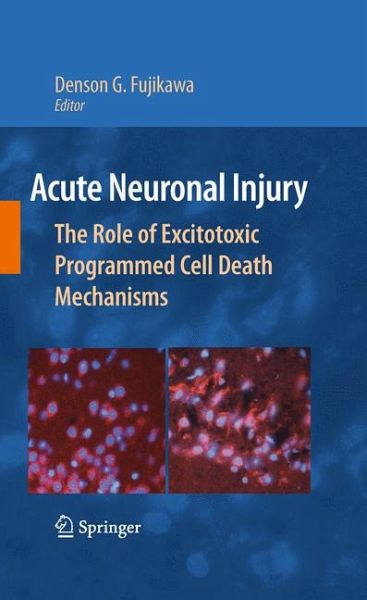
Denson G. Fujikawa 2+ In the early 1980s it was recognized that excessive Ca influx, presumably through 2+ 2+ voltage-gated Ca channels, with a resultant increase in intracellular Ca , was associated with neuronal death from cerebral ischemia, hypoglycemia, and status epilepticus (Siejö 1981). Calcium activation of phospholipases, with arachidonic acid accumulation and its oxidation, generating free radicals, was thought to be a potential mechanism by which neuronal damage occurs. In cerebral ischemia and 2+ hypoglycemia, energy failure was thought to be the reason for excessive Ca influx, whereas in status epilepticus it was thought that repetitive depolarizations were responsible (Siejö 1981). Meanwhile, John Olney found that monosodium glutamate, the food additive, when given to immature rats, was associated with neuronal degeneration in the arcuate nucleus of the hypothalamus, which lacks a blood-brain barrier (Olney 1969). He followed up this observation with a series of observations in the 1970s that administration of kainic acid, which we now know activates the GluR5-7 subtypes of glutamate receptor, and other glutamate analogues, caused not only post-synaptic cytoplasmic swelling, but also dark-cell degeneration of neurons, when viewed by electron microscopy (Olney 1971; Olney et al. 1974).
Dieser Download kann aus rechtlichen Gründen nur mit Rechnungsadresse in A, B, BG, CY, CZ, D, DK, EW, E, FIN, F, GR, HR, H, IRL, I, LT, L, LR, M, NL, PL, P, R, S, SLO, SK ausgeliefert werden.