55,95 €
55,95 €
inkl. MwSt.
Sofort per Download lieferbar

28 °P sammeln
55,95 €
Als Download kaufen
55,95 €
inkl. MwSt.
Sofort per Download lieferbar
28 °P sammeln
Jetzt verschenken
Alle Infos zum eBook verschenken
55,95 €
inkl. MwSt.
Sofort per Download lieferbar
Alle Infos zum eBook verschenken
28 °P sammeln

Andere Kunden interessierten sich auch für
") The Oxford Handbook of Adam Smith (eBook, PDF)24,95 €
The Oxford Handbook of Adam Smith (eBook, PDF)24,95 €") Justice and the Meritocratic State (eBook, PDF)0,00 €
Justice and the Meritocratic State (eBook, PDF)0,00 €") The Routledge Companion to Social and Political Philosophy (eBook, PDF)43,95 €
The Routledge Companion to Social and Political Philosophy (eBook, PDF)43,95 €") Unequivocal Justice (eBook, PDF)44,95 €
Unequivocal Justice (eBook, PDF)44,95 €") The Routledge Handbook of Libertarianism (eBook, PDF)46,95 €
The Routledge Handbook of Libertarianism (eBook, PDF)46,95 €") Why Not Capitalism? (eBook, PDF)31,95 €
Why Not Capitalism? (eBook, PDF)31,95 €") Re-Thinking Economics (eBook, PDF)55,95 €
Re-Thinking Economics (eBook, PDF)55,95 €







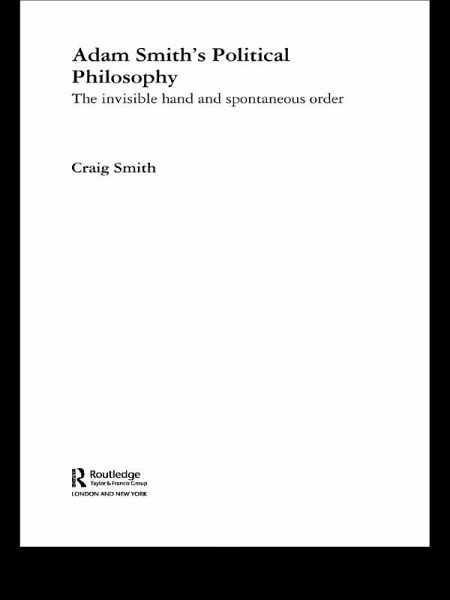
When Adam Smith published his celebrated writings on economics and moral philosophy he famously referred to the operation of an 'invisible hand'. Adam Smith's Political Philosophy makes visible this hand by examining its significance in Smith's political philosophy and relating it to similar concepts used by other philosophers, thus revealing a distinctive approach to social theory that stresses the importance of the unintended consequences of human action.
The first book to examine the history of Smith's political philosophy from this perspective, this work introduces greater conceptual clarity to the discussion of the invisible hand and the related notion of unintended order in the work of Smith, as well as in political theory more generally.
By examining the application of spontaneous order ideas in the work of Smith, Hume, Hayek and Popper, this important volume traces similarities in approach, and from these constructs a conceptual, composite model of an invisible hand argument. While setting out a clear framework of the idea of spontaneous order, the book also builds the case for using this as an explanatory social theory, with chapters on its application in the fields of science, moral philosophy, law and government.
The first book to examine the history of Smith's political philosophy from this perspective, this work introduces greater conceptual clarity to the discussion of the invisible hand and the related notion of unintended order in the work of Smith, as well as in political theory more generally.
By examining the application of spontaneous order ideas in the work of Smith, Hume, Hayek and Popper, this important volume traces similarities in approach, and from these constructs a conceptual, composite model of an invisible hand argument. While setting out a clear framework of the idea of spontaneous order, the book also builds the case for using this as an explanatory social theory, with chapters on its application in the fields of science, moral philosophy, law and government.
Dieser Download kann aus rechtlichen Gründen nur mit Rechnungsadresse in A, B, BG, CY, CZ, D, DK, EW, E, FIN, F, GR, HR, H, IRL, I, LT, L, LR, M, NL, PL, P, R, S, SLO, SK ausgeliefert werden.