Sollten wir den Preis dieses Artikels vor dem Erscheinungsdatum senken, werden wir dir den Artikel bei der Auslieferung automatisch zum günstigeren Preis berechnen.
Advanced Anti-Corrosive Materials (eBook, ePUB)
Redaktion: Kumar Verma, Dakeshwar; Khan, Fahmida; Berdimurodov, Elyor
Sie sind bereits eingeloggt. Klicken Sie auf 2. tolino select Abo, um fortzufahren.
Bitte loggen Sie sich zunächst in Ihr Kundenkonto ein oder registrieren Sie sich bei bücher.de, um das eBook-Abo tolino select nutzen zu können.
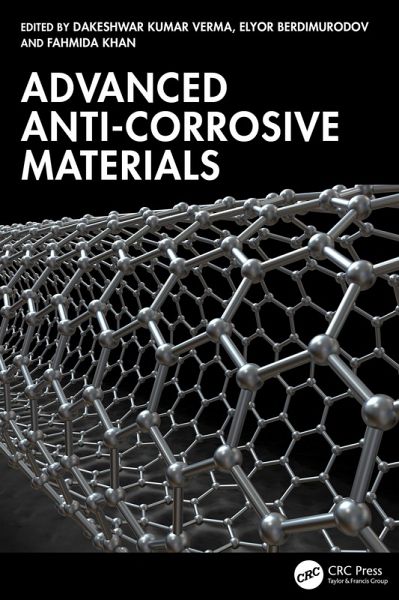
Advanced Anti-Corrosive Materials presents a comprehensive exploration of cutting-edge corrosion inhibition strategies using smart materials such as carbon allotropes, conducting polymers, and self-healing systems. This expertly edited volume offers an in-depth synthesis of both traditional and emerging approaches in corrosion science, serving as a modern guide for those working to enhance material durability and integrity. This book highlights the synthesis, structural characterization, and applications of advanced anticorrosive materials, with clearly organized chapters and updated…mehr
Advanced Anti-Corrosive Materials presents a comprehensive exploration of cutting-edge corrosion inhibition strategies using smart materials such as carbon allotropes, conducting polymers, and self-healing systems. This expertly edited volume offers an in-depth synthesis of both traditional and emerging approaches in corrosion science, serving as a modern guide for those working to enhance material durability and integrity.
This book highlights the synthesis, structural characterization, and applications of advanced anticorrosive materials, with clearly organized chapters and updated references. It features novel developments in carbon quantum dots, conducting polymer nanocomposites, and self-healing coatings, as well as the commercialization aspects of industrial inhibitors. Readers will benefit from the systematic presentation and real-world applicability of corrosion mitigation technologies.
This resource is tailored for advanced undergraduate and graduate students in chemistry, materials science, and chemical engineering, as well as researchers and professionals in academia and industry seeking to understand or develop next-generation corrosion prevention strategies.
Dieser Download kann aus rechtlichen Gründen nur mit Rechnungsadresse in A, B, BG, CY, CZ, D, DK, EW, E, FIN, F, GR, HR, H, IRL, I, LT, L, LR, M, NL, PL, P, R, S, SLO, SK ausgeliefert werden.
Die Herstellerinformationen sind derzeit nicht verfügbar.
Autorenporträt
Dakeshwar Kumar Verma holds a Ph.D. degree and is an Assistant Professor of Chemistry at Govt. Digvijay Autonomous Postgraduate College in Rajnandgaon, Chhattisgarh, India. Driven by a profound passion for scientific exploration, his research focuses primarily on preparing and designing organic compounds for diverse applications. With an impressive track record, Dr. Verma has authored/co-authored 70 research papers/review articles, and 38 book chapters. He has one design patent and two published patents under IPR, INDIA. He serves as a reviewer for over 50 high-impact journals. A testament to his academic influence, Dr. Verma has taken lead editor on editorial responsibilities for 22 published books and 7 upcoming books slated to be published by renowned interntional Publishers. With a cumulative citation count of over 3300, an h-index of 32, and an i-10 index of 52, Dr. Verma's impact is evident through the recognition and relevance of his work in the scientific community. In addition one research scholar from National Institute of Technology Raipur completed her Ph.D under his co-supervision and 2 research scholars form Govt. Digvijay Autonomous Postgraduate College in Rajnandgaon, Chhattisgarh submitted their Ph.D thesis recently. Above 30 students of M.Sc chemistry completed their project under his guidance. Last month he got 50 lakh for project from DST, Dehli. Berdimurodov Elyor is an Associate professor at the National University of Uzbekistan and Akfa University. He was enrolled in the Ph.D. program at Tianjin University and the National University of Uzbekistan. He was a researcher at Tianjin University, Karshi State University, and Changchun Applied Chemistry Institute (Chinese Academy of Science). He was a participant in several international and domestic study and research programs (Chinese Government Scholarships, Chinese Great belt program, National Fundamental, and practical grants). He has published around 50 articles in Scopus and Web of Science journals. H index is 30 in Scopus, 25 in Web of Science, and 32 (i-10 index of 50) in Google Scholar. He has contributed over 20 book chapters and participated in over 15 international conferences in China, India, and other developed countries. Dr. Berdimurodov has served as the editor for 5 books, including scientific monographs and handbooks in his research areas. His research areas are corrosion science, electrochemistry, quantum chemistry, material science, green chemistry and nanochemistry. Fahmida Khan is a Professor at Department of Chemistry, National Institute of Technology Raipur, Raipur, Chhattisgarh 492010, INDIA. Her main research interests include Organic Chemistry/Analytical Chemistry, Nuclear Chemistry, Environmental Chemistry, Nanotechnology & Luminescence/Drug designing & DNA binding. She has published around 60 articles in Scopus and Web of Science journals. h-index is 19 in i1o index is 35 with total citations of 1216 Google Scholar. She has contributed over 6 book chapters and participated in over 30 international conferences in China, Russian, UK, India, and other developed countries. She has successfully guided more than 12 research scholars.
Inhaltsangabe
Editor biographies List of contributorsChapter 1 Corrosion: fundamental aspects, economic impact, and its mitigation Fatma Azra Haspolat, Hülya Kübra Kiliç, Gamze Tüzün, and Burak TÜZÜNTüzün Chapter 2 Carbon allotropes: important properties, synthesis methods, characterization, and applicationsPragnesh Dave and Lakha Chopda Chapter 3 Carbon quantum dots (CQDs) and their composites as anti-corrosive materialsHalil ¿brahim Çetintä and Burak Tüzün Chapter 4 Conducting polymers: fundamental aspects, properties, synthesis, and structural elucidation M. Rbaa, A. Bouabbadi, R. Hsissou, M. Oubaaqa, A. Bekhta, B. Tüzün, E. Berdimurodov, B. Lakhrissi, and A. Zarrouk Chapter 5 Polyaniline, polypyrrole, and polythiophene as anticorrosive materials Shokoh Parham, Hadi Sarvari, and David J. Edwards >corrosive materials B Gpal Krishna, Sanjay Tiwari, Dhriti Sundar Ghosh, and M Jagannadha Rao Chapter 7 Copolymers, multilayer conducting polymers, and doped conducting polymers as anti-corrosive materials Rakesh Kumar Sahu and Veenu Chandraker Chapter 8 Computational modelling of conducting polymers used as anti-corrosive materials Omar Dagdag, Rajesh Haldhar, Abhinay Thakur, Elyor Berdimurodov, and Hansang Kim Chapter 9 Micro/nano containers as self-healing anti-corrosion materials Amir Hossein Mostafatabar, Amir Hossein JafariMofidabadi, and Ali Dehghani Chapter 10 Nanostructured carbon allotropes as self-healing anti-corrosive coating Amir Hossein JafariMofidabadi and Ali Dehghani Chapter 11 Functionalized carbon dots as self-healing anti-corrosive materials Swati Sahu and Sanjay Tiwari Chapter 12 Industrial anti-corrosive materials: current challenges, future prospects, and ideal substitutes Hüseyin Fatih Çetinkaya, Serap Çetinkaya, and Burak Tüzün
Editor biographies List of contributorsChapter 1 Corrosion: fundamental aspects, economic impact, and its mitigation Fatma Azra Haspolat, Hülya Kübra Kiliç, Gamze Tüzün, and Burak TÜZÜNTüzün Chapter 2 Carbon allotropes: important properties, synthesis methods, characterization, and applicationsPragnesh Dave and Lakha Chopda Chapter 3 Carbon quantum dots (CQDs) and their composites as anti-corrosive materialsHalil ¿brahim Çetintä and Burak Tüzün Chapter 4 Conducting polymers: fundamental aspects, properties, synthesis, and structural elucidation M. Rbaa, A. Bouabbadi, R. Hsissou, M. Oubaaqa, A. Bekhta, B. Tüzün, E. Berdimurodov, B. Lakhrissi, and A. Zarrouk Chapter 5 Polyaniline, polypyrrole, and polythiophene as anticorrosive materials Shokoh Parham, Hadi Sarvari, and David J. Edwards >corrosive materials B Gpal Krishna, Sanjay Tiwari, Dhriti Sundar Ghosh, and M Jagannadha Rao Chapter 7 Copolymers, multilayer conducting polymers, and doped conducting polymers as anti-corrosive materials Rakesh Kumar Sahu and Veenu Chandraker Chapter 8 Computational modelling of conducting polymers used as anti-corrosive materials Omar Dagdag, Rajesh Haldhar, Abhinay Thakur, Elyor Berdimurodov, and Hansang Kim Chapter 9 Micro/nano containers as self-healing anti-corrosion materials Amir Hossein Mostafatabar, Amir Hossein JafariMofidabadi, and Ali Dehghani Chapter 10 Nanostructured carbon allotropes as self-healing anti-corrosive coating Amir Hossein JafariMofidabadi and Ali Dehghani Chapter 11 Functionalized carbon dots as self-healing anti-corrosive materials Swati Sahu and Sanjay Tiwari Chapter 12 Industrial anti-corrosive materials: current challenges, future prospects, and ideal substitutes Hüseyin Fatih Çetinkaya, Serap Çetinkaya, and Burak Tüzün
Es gelten unsere Allgemeinen Geschäftsbedingungen: www.buecher.de/agb
Impressum
www.buecher.de ist ein Internetauftritt der buecher.de internetstores GmbH
Geschäftsführung: Monica Sawhney | Roland Kölbl | Günter Hilger
Sitz der Gesellschaft: Batheyer Straße 115 - 117, 58099 Hagen
Postanschrift: Bürgermeister-Wegele-Str. 12, 86167 Augsburg
Amtsgericht Hagen HRB 13257
Steuernummer: 321/5800/1497
USt-IdNr: DE450055826