24,95 €
inkl. MwSt.
Sofort per Download lieferbar
12 °P sammeln

Andere Kunden interessierten sich auch für
") Autonomous navigation and path planning for agricultural robots (eBook, PDF)24,95 €
Autonomous navigation and path planning for agricultural robots (eBook, PDF)24,95 €") Advances in agricultural unmanned aerial vehicles: focus on sensing applications (eBook, PDF)24,95 €
Advances in agricultural unmanned aerial vehicles: focus on sensing applications (eBook, PDF)24,95 €") Advances in machine learning for agricultural robots (eBook, PDF)24,95 €
Advances in machine learning for agricultural robots (eBook, PDF)24,95 €") Advances in grasping techniques in agricultural robots (eBook, PDF)24,95 €
Advances in grasping techniques in agricultural robots (eBook, PDF)24,95 €") Advances in local perception for orchard robotics (eBook, PDF)24,95 €
Advances in local perception for orchard robotics (eBook, PDF)24,95 €") Advances in human-robot collaboration in agricultural robotics (eBook, PDF)24,95 €
Advances in human-robot collaboration in agricultural robotics (eBook, PDF)24,95 €") Regulatory frameworks and standards for agricultural robotics in the European Union (eBook, PDF)24,95 €
Regulatory frameworks and standards for agricultural robotics in the European Union (eBook, PDF)24,95 €


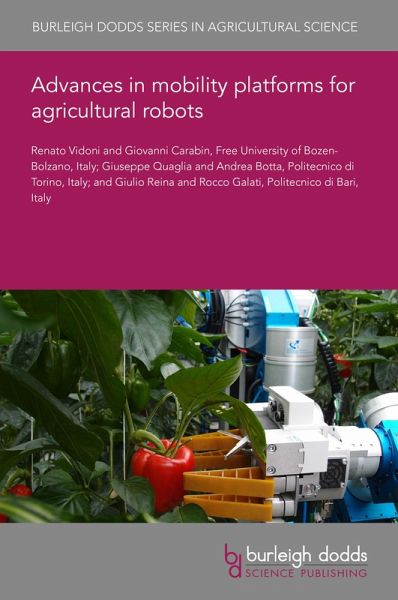
Agricultural robotics is one of the most challenging research areas in robotics given the complex challenges posed by terrain, crop and environmental conditions. This chapter reviews the use of (unmanned) ground robots in agriculture, focusing on the main different solutions in terms of mobility and kinematic architecture. The chapter discusses ways of classifying mobility platforms based on criteria such as size, type of locomotion, suspension system or chassis/frame design and coupling. It then reviews wheeled, tracked and legged mobile robots as well as hybrid solutions. In each case, the chapter assesses different solutions and their pros and cons. Two case studies demonstrate design and operational challenges. The chapter concludes by outlining future trends in researching mobility solutions in agricultural robotics.
Dieser Download kann aus rechtlichen Gründen nur mit Rechnungsadresse in A, D ausgeliefert werden.