73,95 €
73,95 €
inkl. MwSt.
Sofort per Download lieferbar

37 °P sammeln
73,95 €
Als Download kaufen
73,95 €
inkl. MwSt.
Sofort per Download lieferbar
37 °P sammeln
Jetzt verschenken
Alle Infos zum eBook verschenken
73,95 €
inkl. MwSt.
Sofort per Download lieferbar
Alle Infos zum eBook verschenken
37 °P sammeln

Andere Kunden interessierten sich auch für
") Drugs of Abuse and Addiction (eBook, ePUB)177,95 €
Drugs of Abuse and Addiction (eBook, ePUB)177,95 €") Medication Treatments for Nicotine Dependence (eBook, ePUB)216,95 €
Medication Treatments for Nicotine Dependence (eBook, ePUB)216,95 €") Psychoneuroimmunology, Stress, and Infection (eBook, ePUB)392,95 €
Psychoneuroimmunology, Stress, and Infection (eBook, ePUB)392,95 €") Neurobiology of Brain Disorders (eBook, ePUB)73,95 €
Neurobiology of Brain Disorders (eBook, ePUB)73,95 €") Maldynia (eBook, ePUB)63,95 €
Maldynia (eBook, ePUB)63,95 €") Neurobiology of Aggression and Rage (eBook, ePUB)52,95 €
Neurobiology of Aggression and Rage (eBook, ePUB)52,95 €") Consciousness Reconnected (eBook, ePUB)22,95 €
Consciousness Reconnected (eBook, ePUB)22,95 €





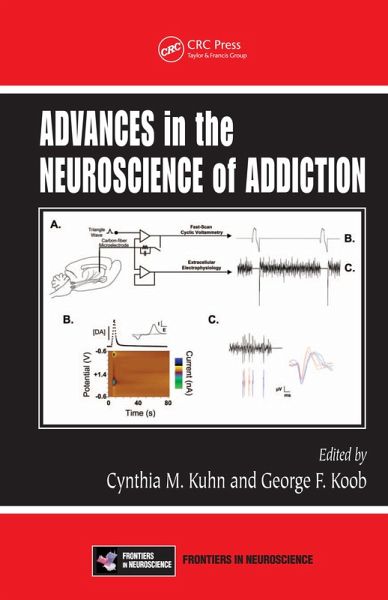
Understanding the phenomenon of long-lasting vulnerability to addiction is essential to developing successful treatments. Written by an international team of authorities in their respective fields, Advances in the Neuroscience of Addiction provides an excellent overview of the available and emerging approaches used to investigate the biologic mechanisms of drug addiction. It also delineates the promising research discoveries being made in relapse prevention.
The book begins with current animal models of addiction, which mimic the state of humans entering treatment: recently-abstinent animals that receive common triggers for relapse (classical conditioning, stress, and neuroadaptive dysregulation). Coverage then shifts to the use of electrophysiologic approaches, which enable researchers to characterize the discharge patterns of single neurons during drug self-administration. After exploring advances in voltammetry and enzyme-linked biosensors for measuring glutamate, the book discusses the theoretical background and results of neuroimaging studies related to neuronal networks that are activated by drug-specific cues. It then describes modern genetic approaches to manipulate target proteins that influence addictive behavior.
The book rounds out its coverage by illustrating how a neuroeconomic approach can inform studies of reward processing in general and addiction in particular. It is a comprehensive introduction to the methodologies of the field for students and beginning researchers and an essential reference source for established investigators.
The book begins with current animal models of addiction, which mimic the state of humans entering treatment: recently-abstinent animals that receive common triggers for relapse (classical conditioning, stress, and neuroadaptive dysregulation). Coverage then shifts to the use of electrophysiologic approaches, which enable researchers to characterize the discharge patterns of single neurons during drug self-administration. After exploring advances in voltammetry and enzyme-linked biosensors for measuring glutamate, the book discusses the theoretical background and results of neuroimaging studies related to neuronal networks that are activated by drug-specific cues. It then describes modern genetic approaches to manipulate target proteins that influence addictive behavior.
The book rounds out its coverage by illustrating how a neuroeconomic approach can inform studies of reward processing in general and addiction in particular. It is a comprehensive introduction to the methodologies of the field for students and beginning researchers and an essential reference source for established investigators.
Dieser Download kann aus rechtlichen Gründen nur mit Rechnungsadresse in A, B, BG, CY, CZ, D, DK, EW, E, FIN, F, GR, HR, H, IRL, I, LT, L, LR, M, NL, PL, P, R, S, SLO, SK ausgeliefert werden.