18,95 €
18,95 €
inkl. MwSt.
Sofort per Download lieferbar

9 °P sammeln
18,95 €
Als Download kaufen
18,95 €
inkl. MwSt.
Sofort per Download lieferbar
9 °P sammeln
Jetzt verschenken
Alle Infos zum eBook verschenken
18,95 €
inkl. MwSt.
Sofort per Download lieferbar
Alle Infos zum eBook verschenken
9 °P sammeln

Andere Kunden interessierten sich auch für
") Cultural Theory in the Films of Alfred Hitchcock (eBook, ePUB)26,95 €
Cultural Theory in the Films of Alfred Hitchcock (eBook, ePUB)26,95 €") Immigration Cinema in the New Europe (eBook, ePUB)26,95 €
Immigration Cinema in the New Europe (eBook, ePUB)26,95 €") The cinema of Pedro Almodóvar (eBook, ePUB)77,95 €
The cinema of Pedro Almodóvar (eBook, ePUB)77,95 €") Inclusion in New Danish Cinema (eBook, ePUB)28,95 €
Inclusion in New Danish Cinema (eBook, ePUB)28,95 €") Smartphone Cinema (eBook, ePUB)35,95 €
Smartphone Cinema (eBook, ePUB)35,95 €") Iranian Cinema in a Global Context (eBook, ePUB)49,95 €
Iranian Cinema in a Global Context (eBook, ePUB)49,95 €") Israeli Bourekas Films (eBook, ePUB)22,95 €
Israeli Bourekas Films (eBook, ePUB)22,95 €





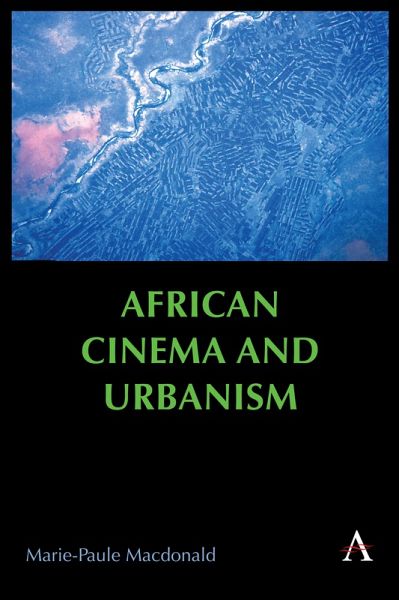
The changing nature of African landscapes, from rural to urbanized spaces, has been a pre-occupation of African media producers since the beginnings of the African film industry in the 1960s. In the six chapters in the book, the authors bring together several examples of African documentary and fiction screen media that present, evaluate and criticize urban and rural landscapes, and the rural and urban dynamic of development, in relation to contemporary issues, from biodiversity, sustainability and deforestation, to inequity, women's rights, political instability, to climate change-related themes of water and food supply, security and sovereignty. These works, comprising multi-platform cinema, streamed moving images and especially documentaries, depict the situations and open the door to rethinking and eventually to the possibilities of proposals responding to the situations portrayed. Screen media convey important visual information regarding the urban and rural built environments in Africa, relative to numerous geographic zones projected for major change and development over the next 30 years. Rapid spontaneous urban development will characterize the landscape of the African continent up until 2050, and urbanization has taken many forms, primarily unplanned. Yet, urban centres and cities have an important cultural weight since they often represent both a remnant of colonization (as colonial metropoles) and an opportunity for cultural place-making and belonging. Furthermore, African cities also serve as sites of negotiation because they are cultural melting pots offering the possibility to navigate and create identities that could not be created in rural areas.
A main goal of this book is to contribute to critical discourse and to knowledge resources to assess, critique and propose directions in contemporary urban and settlement development, in the face of rapid spontaneous urbanization of landscapes in a context of climate change and housing need. The book aims to study, track, set out and present options for landscapes and cities in Africa that are intrinsic to African culture via documentary and narrative cinema, incorporating diverse platforms of screen media. We use the term "African screen media'' to denote media presentation on various formats and platforms. This is also born out of our recognition of the fact that the term "African cinema" assumes a certain homogeneity throughout a continent of 53 countries, and that "the idea of an African cinema" has evolved with many critics to "African Cinemas" and even to the now widely used term that many scholars of African media prefer, "African screen media" (Dovey 2009, 2). This term also addresses the multiple platforms and formats representing the atomization and fracturing of distribution in contemporary streaming.
This work brings together theories and practices from the disciplines of urbanism, architecture and African cinema studies to examine some examples of how African artists are bringing attention to issues of urban precarity, climate change, survival and growth, and creativity on the continent. Theoretical references include Felwine Sarr's theory of 'Afrotopias' or 'Afrotopos' whereby the continent is a site of creative potential. Another theoretical influence with significant impact is the term "Black urbanism" as used by AbdouMaliq Simone for contemporary African cities. An alternative to modernist Western urbanism, this concept is structured around informality, creativity and improvisation.
A main goal of this book is to contribute to critical discourse and to knowledge resources to assess, critique and propose directions in contemporary urban and settlement development, in the face of rapid spontaneous urbanization of landscapes in a context of climate change and housing need. The book aims to study, track, set out and present options for landscapes and cities in Africa that are intrinsic to African culture via documentary and narrative cinema, incorporating diverse platforms of screen media. We use the term "African screen media'' to denote media presentation on various formats and platforms. This is also born out of our recognition of the fact that the term "African cinema" assumes a certain homogeneity throughout a continent of 53 countries, and that "the idea of an African cinema" has evolved with many critics to "African Cinemas" and even to the now widely used term that many scholars of African media prefer, "African screen media" (Dovey 2009, 2). This term also addresses the multiple platforms and formats representing the atomization and fracturing of distribution in contemporary streaming.
This work brings together theories and practices from the disciplines of urbanism, architecture and African cinema studies to examine some examples of how African artists are bringing attention to issues of urban precarity, climate change, survival and growth, and creativity on the continent. Theoretical references include Felwine Sarr's theory of 'Afrotopias' or 'Afrotopos' whereby the continent is a site of creative potential. Another theoretical influence with significant impact is the term "Black urbanism" as used by AbdouMaliq Simone for contemporary African cities. An alternative to modernist Western urbanism, this concept is structured around informality, creativity and improvisation.
Dieser Download kann aus rechtlichen Gründen nur mit Rechnungsadresse in A, D ausgeliefert werden.