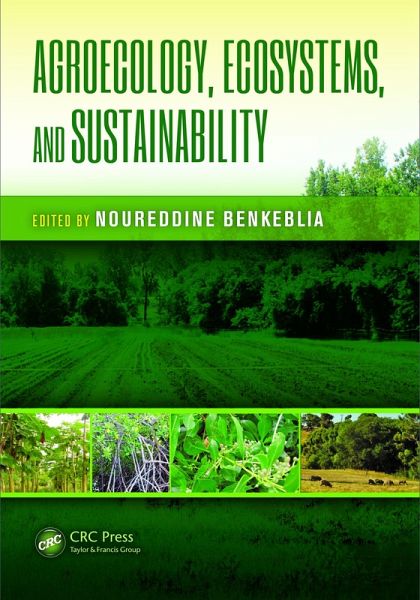
Agroecology, Ecosystems, and Sustainability (eBook, PDF)
Redaktion: Benkeblia, Noureddine
51,95 €
51,95 €
inkl. MwSt.
Sofort per Download lieferbar

26 °P sammeln

51,95 €
Als Download kaufen
51,95 €
inkl. MwSt.
Sofort per Download lieferbar
26 °P sammeln
Jetzt verschenken
Alle Infos zum eBook verschenken
51,95 €
inkl. MwSt.
Sofort per Download lieferbar
Alle Infos zum eBook verschenken
26 °P sammeln
Agroecology, Ecosystems, and Sustainability (eBook, PDF)
Redaktion: Benkeblia, Noureddine
- Format: PDF
- Merkliste
- Auf die Merkliste
- Bewerten Bewerten
- Teilen
- Produkt teilen
- Produkterinnerung
- Produkterinnerung

Bitte loggen Sie sich zunächst in Ihr Kundenkonto ein oder registrieren Sie sich bei
bücher.de, um das eBook-Abo tolino select nutzen zu können.
Hier können Sie sich einloggen
Sie sind bereits eingeloggt. Klicken Sie auf 2. tolino select Abo, um fortzufahren.

Bitte loggen Sie sich zunächst in Ihr Kundenkonto ein oder registrieren Sie sich bei bücher.de, um das eBook-Abo tolino select nutzen zu können.
We hear a lot about how agriculture affects climate change and other environmental issues, but we hear little about how these issues affect agriculture. When we look at both sides of the issues, we can develop better solutions for sustainable agriculture without adversely affecting the environment. Agroecology, Ecosystems, and Sustainability explor
- Geräte: PC
- mit Kopierschutz
- eBook Hilfe
- Größe: 30.85MB
Andere Kunden interessierten sich auch für
Soil Amendments for Sustainability (eBook, PDF)216,95 €
Nand Kumar FageriaThe Use of Nutrients in Crop Plants (eBook, PDF)63,95 €
Nand Kumar FageriaThe Role of Plant Roots in Crop Production (eBook, PDF)63,95 €
Anthony E. HallCrop Responses to Environment (eBook, PDF)47,95 €
Sukanta Kumar SarangiAgroecology and Integrated Farming System (eBook, PDF)52,95 €
Robert E. FarmerSeed Ecophysiology of Temperate and Boreal Zone Forest Trees (eBook, PDF)157,95 €
Handbook of Cucurbits (eBook, PDF)47,95 €-
-
-
We hear a lot about how agriculture affects climate change and other environmental issues, but we hear little about how these issues affect agriculture. When we look at both sides of the issues, we can develop better solutions for sustainable agriculture without adversely affecting the environment. Agroecology, Ecosystems, and Sustainability explor
Dieser Download kann aus rechtlichen Gründen nur mit Rechnungsadresse in A, B, BG, CY, CZ, D, DK, EW, E, FIN, F, GR, HR, H, IRL, I, LT, L, LR, M, NL, PL, P, R, S, SLO, SK ausgeliefert werden.
Produktdetails
- Produktdetails
- Verlag: Taylor & Francis eBooks
- Seitenzahl: 393
- Erscheinungstermin: 20. November 2014
- Englisch
- ISBN-13: 9781482233025
- Artikelnr.: 42368295
- Verlag: Taylor & Francis eBooks
- Seitenzahl: 393
- Erscheinungstermin: 20. November 2014
- Englisch
- ISBN-13: 9781482233025
- Artikelnr.: 42368295
- Herstellerkennzeichnung Die Herstellerinformationen sind derzeit nicht verfügbar.
Dr. Noureddine Benkeblia is a Professor of Crop Science involved in food science focusing on food-plants biochemistry and physiology. His work is mainly devoted to the pre- and postharvest metabolism in crops. Few years ago, he introduced the new concept of systems biology -Metabolomics- to investigate the mechanisms of biosynthesis and accumulation of fructans in Liliaceous plants. Prof. Benkeblia, first received his BSc, MPhil and Doctor in Food Sciences from the Institut National Agronomique (Algeria), and Doctor in Agriculture (PhD) from Kagoshima University (Japan). After few years teaching in Algeria, He joined INRA, Avignon (France) as Postdoctoral Scientist from 2000. From 2002 to 2007, he worked as a Visiting Professor at the University of Rakuno Gakuen, Ebetsu (Japan), and Research Associate at Hokaido University. Prof. Benkeblia joined the Department of Life Sciences, the University of the West Indies (Jamaica) in 2008, continuing his work on the physiology, the biochemistry and metabolomics of fructan-containing plants in Jamaica. He also works on the postharvest physiology and biochemistry of local fruits. Prof. N. Benkeblia published over 150 papers, over 37 books and book chapters, and was recipient of many awards among them the UWI-Award of the "Most Outstanding Research" in 2011 and 2013.
Management of Microorganisms in Relation to Plant Nutrition and Health.
Soil Biogeochemistry: Up-Scaling From the Molecular to the Ecosystem Level
(Using Terra Preta and Biochar as a Case Study). Carbon Capture and Use
(CCU) as Alternative to Carbon Capture and Storage (CCS). Proteomics
Potential and Contribution toward Developing Sustainable Agriculture.
Forest Agro-Ecosystems - Taking in Productivity and Soils. The Application
of Modern Agro-Ecology in Mangrove Forest Restoration. The Food Systems
Approach in Agroecology: New topics, Concepts, Applications. Removing
Linguistic Barrier When Accessing to Learning Resources in Agroecology.
Experiential Learning through Open-Ended Case Studies: Future Agroecology
Education. Cropping Systems and Underground Biodiversity. Agroforestry
Adaptation and Mitigation Options for Smallholder Farmers Vulnerable to
Climate Change. Applying the Concepts of Agroecology to Food Systems in the
Appalachian Region of the United States: theory Versus Practical
Realities". Shifting Cultivation in the Atlantic Rainforest (Brazil): A
View From Agroecology. the Impacts of Large-Scale Agricultural
intensification on Birds associated With Agricultural and Grassland
Habitats. The Paradox of Arable Weeds: Diversity, Conservation and
Ecosystem Services of the Unwanted. Agricultural Biodiversity's Role in
Agroecology for Strengthening Social-Ecological Resilience and For Poverty
Alleviation.
Soil Biogeochemistry: Up-Scaling From the Molecular to the Ecosystem Level
(Using Terra Preta and Biochar as a Case Study). Carbon Capture and Use
(CCU) as Alternative to Carbon Capture and Storage (CCS). Proteomics
Potential and Contribution toward Developing Sustainable Agriculture.
Forest Agro-Ecosystems - Taking in Productivity and Soils. The Application
of Modern Agro-Ecology in Mangrove Forest Restoration. The Food Systems
Approach in Agroecology: New topics, Concepts, Applications. Removing
Linguistic Barrier When Accessing to Learning Resources in Agroecology.
Experiential Learning through Open-Ended Case Studies: Future Agroecology
Education. Cropping Systems and Underground Biodiversity. Agroforestry
Adaptation and Mitigation Options for Smallholder Farmers Vulnerable to
Climate Change. Applying the Concepts of Agroecology to Food Systems in the
Appalachian Region of the United States: theory Versus Practical
Realities". Shifting Cultivation in the Atlantic Rainforest (Brazil): A
View From Agroecology. the Impacts of Large-Scale Agricultural
intensification on Birds associated With Agricultural and Grassland
Habitats. The Paradox of Arable Weeds: Diversity, Conservation and
Ecosystem Services of the Unwanted. Agricultural Biodiversity's Role in
Agroecology for Strengthening Social-Ecological Resilience and For Poverty
Alleviation.
Management of Microorganisms in Relation to Plant Nutrition and Health.
Soil Biogeochemistry: Up-Scaling From the Molecular to the Ecosystem Level
(Using Terra Preta and Biochar as a Case Study). Carbon Capture and Use
(CCU) as Alternative to Carbon Capture and Storage (CCS). Proteomics
Potential and Contribution toward Developing Sustainable Agriculture.
Forest Agro-Ecosystems - Taking in Productivity and Soils. The Application
of Modern Agro-Ecology in Mangrove Forest Restoration. The Food Systems
Approach in Agroecology: New topics, Concepts, Applications. Removing
Linguistic Barrier When Accessing to Learning Resources in Agroecology.
Experiential Learning through Open-Ended Case Studies: Future Agroecology
Education. Cropping Systems and Underground Biodiversity. Agroforestry
Adaptation and Mitigation Options for Smallholder Farmers Vulnerable to
Climate Change. Applying the Concepts of Agroecology to Food Systems in the
Appalachian Region of the United States: theory Versus Practical
Realities". Shifting Cultivation in the Atlantic Rainforest (Brazil): A
View From Agroecology. the Impacts of Large-Scale Agricultural
intensification on Birds associated With Agricultural and Grassland
Habitats. The Paradox of Arable Weeds: Diversity, Conservation and
Ecosystem Services of the Unwanted. Agricultural Biodiversity's Role in
Agroecology for Strengthening Social-Ecological Resilience and For Poverty
Alleviation.
Soil Biogeochemistry: Up-Scaling From the Molecular to the Ecosystem Level
(Using Terra Preta and Biochar as a Case Study). Carbon Capture and Use
(CCU) as Alternative to Carbon Capture and Storage (CCS). Proteomics
Potential and Contribution toward Developing Sustainable Agriculture.
Forest Agro-Ecosystems - Taking in Productivity and Soils. The Application
of Modern Agro-Ecology in Mangrove Forest Restoration. The Food Systems
Approach in Agroecology: New topics, Concepts, Applications. Removing
Linguistic Barrier When Accessing to Learning Resources in Agroecology.
Experiential Learning through Open-Ended Case Studies: Future Agroecology
Education. Cropping Systems and Underground Biodiversity. Agroforestry
Adaptation and Mitigation Options for Smallholder Farmers Vulnerable to
Climate Change. Applying the Concepts of Agroecology to Food Systems in the
Appalachian Region of the United States: theory Versus Practical
Realities". Shifting Cultivation in the Atlantic Rainforest (Brazil): A
View From Agroecology. the Impacts of Large-Scale Agricultural
intensification on Birds associated With Agricultural and Grassland
Habitats. The Paradox of Arable Weeds: Diversity, Conservation and
Ecosystem Services of the Unwanted. Agricultural Biodiversity's Role in
Agroecology for Strengthening Social-Ecological Resilience and For Poverty
Alleviation.