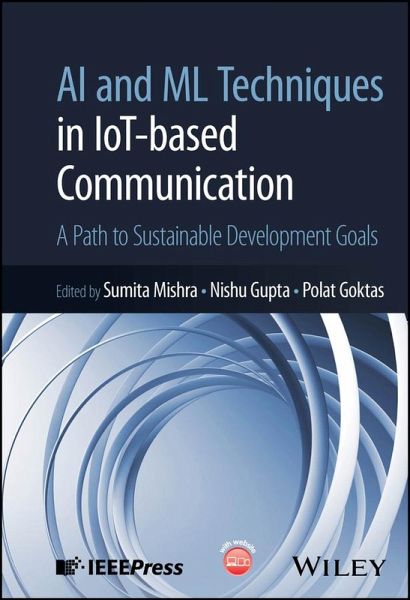
AI and ML Techniques in IoT-based Communication (eBook, ePUB)
A Path to Sustainable Development Goals
Redaktion: Mishra, Sumita; Goktas, Polat; Gupta, Nishu
115,99 €
115,99 €
inkl. MwSt.
Sofort per Download lieferbar

0 °P sammeln
115,99 €
Als Download kaufen
115,99 €
inkl. MwSt.
Sofort per Download lieferbar
0 °P sammeln
Jetzt verschenken
Alle Infos zum eBook verschenken
115,99 €
inkl. MwSt.
Sofort per Download lieferbar
Alle Infos zum eBook verschenken
0 °P sammeln

AI and ML Techniques in IoT-based Communication (eBook, ePUB)
A Path to Sustainable Development Goals
Redaktion: Mishra, Sumita; Goktas, Polat; Gupta, Nishu
- Format: ePub
- Merkliste
- Auf die Merkliste
- Bewerten Bewerten
- Teilen
- Produkt teilen
- Produkterinnerung
- Produkterinnerung

Bitte loggen Sie sich zunächst in Ihr Kundenkonto ein oder registrieren Sie sich bei
bücher.de, um das eBook-Abo tolino select nutzen zu können.
Hier können Sie sich einloggen
Sie sind bereits eingeloggt. Klicken Sie auf 2. tolino select Abo, um fortzufahren.

Bitte loggen Sie sich zunächst in Ihr Kundenkonto ein oder registrieren Sie sich bei bücher.de, um das eBook-Abo tolino select nutzen zu können.
An insightful and up-to-date discussion of how to use contemporary IoT and AI technology to advance sustainable development initiatives
In AI and ML Techniques in IoT-based Communication: A Path to Sustainable Development Goals, a team of distinguished editors presents an astute discussion of the importance of connected devices and intelligent algorithms in the generation of innovative solutions to global challenges. The book explains how to exploit the synergy between Internet of Things (IoT) and artificial intelligence (AI) technologies to further the United Nations' Sustainable…mehr
- Geräte: eReader
- mit Kopierschutz
- eBook Hilfe
- Größe: 7.55MB
Andere Kunden interessierten sich auch für
From AI to Autonomous and Connected Vehicles (eBook, ePUB)139,99 €
Elisa FarriHBR Guide to Generative AI for Managers (eBook, ePUB)12,95 €
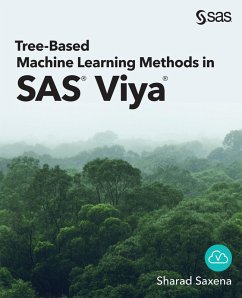
Sharad SaxenaTree-Based Machine Learning Methods in SAS Viya (eBook, ePUB)33,95 €
Animesh MukherjeeAI and Ethics (eBook, ePUB)47,95 €
Michael L. LittmanCode to Joy (eBook, ePUB)15,95 €
Harvard Business ReviewHBR's 10 Must Reads on AI (with bonus article "How to Win with Machine Learning" by Ajay Agrawal, Joshua Gans, and Avi Goldfarb) (eBook, ePUB)13,95 €
Danish Ali BajwaMoral Algorithms Navigating the Ethics of AI (eBook, ePUB)5,99 €-
-
-
An insightful and up-to-date discussion of how to use contemporary IoT and AI technology to advance sustainable development initiatives
In AI and ML Techniques in IoT-based Communication: A Path to Sustainable Development Goals, a team of distinguished editors presents an astute discussion of the importance of connected devices and intelligent algorithms in the generation of innovative solutions to global challenges. The book explains how to exploit the synergy between Internet of Things (IoT) and artificial intelligence (AI) technologies to further the United Nations' Sustainable Development Goals (SDGs).
Readers will learn how to enable smarter, data-driven approaches to difficult global problems, including climate change, inadequate health care delivery, and energy inefficiency. Expert contributors explore emerging trends, potential pitfalls, and likely future developments in IoT, AI, and machine learning (ML) in sustainable development.
Additional topics include:
Perfect for academics, researchers, industry practitioners, and policymakers with an interest in IoT, AI, ML, and their applications to sustainable development, AI and ML Techniques in IoT-based Communication will also benefit professionals working at non-profit and non-governmental organizations focused on advancing sustainable development initiatives.
In AI and ML Techniques in IoT-based Communication: A Path to Sustainable Development Goals, a team of distinguished editors presents an astute discussion of the importance of connected devices and intelligent algorithms in the generation of innovative solutions to global challenges. The book explains how to exploit the synergy between Internet of Things (IoT) and artificial intelligence (AI) technologies to further the United Nations' Sustainable Development Goals (SDGs).
Readers will learn how to enable smarter, data-driven approaches to difficult global problems, including climate change, inadequate health care delivery, and energy inefficiency. Expert contributors explore emerging trends, potential pitfalls, and likely future developments in IoT, AI, and machine learning (ML) in sustainable development.
Additional topics include:
- A thorough introduction to IoT communication protocols and standards relevant to sustainable development
- Comprehensive explorations of artificial intelligence and machine learning techniques for enhancing IoT-based communication
- Practical discussions of water resource and energy management, sustainable agriculture, and sustainable transportation and logistics
- Complete treatments of AI-driven communication optimization for sustainability
Perfect for academics, researchers, industry practitioners, and policymakers with an interest in IoT, AI, ML, and their applications to sustainable development, AI and ML Techniques in IoT-based Communication will also benefit professionals working at non-profit and non-governmental organizations focused on advancing sustainable development initiatives.
Dieser Download kann aus rechtlichen Gründen nur mit Rechnungsadresse in D ausgeliefert werden.
Produktdetails
- Produktdetails
- Verlag: John Wiley & Sons
- Seitenzahl: 668
- Erscheinungstermin: 20. November 2025
- Englisch
- ISBN-13: 9781394337248
- Artikelnr.: 75961543
- Verlag: John Wiley & Sons
- Seitenzahl: 668
- Erscheinungstermin: 20. November 2025
- Englisch
- ISBN-13: 9781394337248
- Artikelnr.: 75961543
- Herstellerkennzeichnung Die Herstellerinformationen sind derzeit nicht verfügbar.
Sumita Mishra, PhD, is an Assistant Professor in the Electronics and Communication Engineering Department at the Amity School of Engineering and Technology, Amity University Uttar Pradesh, Lucknow Campus, India. Nishu Gupta, PhD, is a Senior Scientist in the Future Communication Networks research unit at the VTT Technical Research Centre of Finland Ltd., Oulu, Finland. Polat Goktas, PhD, is an Assistant Professor at the Faculty of Engineering and Natural Sciences, Sabanc¿ University, Turkey.
Preface xxv
About the Editors xxvii
Acknowledgments xxix
About the Companion Website xxxiii
Part I Fundamentals of IoT, AI, and ML for Sustainable Development 1
1 Introduction to IoT, AI, and ML in Sustainable Communication 3
Shumukh Alharrani, Amani Ibraheem, and Polat Goktas
1.1 Introduction 3
1.2 Foundational Principles of IoT, AI, and ML 4
1.3 Synergistic Integration of IoT, AI, and ML for Sustainable
Communication Systems 10
1.4 Challenges in Implementation 14
1.5 Emerging Trends and Future Perspectives 17
1.6 Conclusion 21
2 AI/ML Techniques for Enhancing IoT-based Communication 33
Kushagra Agrawal, Muhammet Anil Yagiz, and Polat Goktas
2.1 Introduction 33
2.2 Background and Fundamentals 35
2.3 AI/ML Techniques for Enhancing IoT Communication 40
2.4 Architectures Integrating AI/ML in IoT Communication 46
2.5 Challenges, Limitations, and Open Issues 49
2.6 Conclusion 51
3 IoT and AI in Sustainable Agriculture 59
Pankaj P. Tasgaonkar, Srushti Khomane, Komal Suryawanshi, and Shachi Kokare
3.1 Introduction 59
3.2 Fruit Quality Monitoring 60
3.3 Crop Growth Monitoring Using IoT 64
3.4 Case Study 69
3.5 Drones in Agriculture 69
3.6 Benefits of ICT in Agriculture 72
3.7 Blockchain in Agriculture 72
3.8 Summary 74
4 AI and IoT-based Robust and Resilient Healthcare Services 77
Shilpi, Sachin Kumar, Sudhanshu Tyagi, and Sumita Mishra
4.1 Introduction 77
4.2 Role of IoT in Predictive Healthcare 81
4.3 Improved Decision-making and Treatment Planning 83
4.4 Personalized Healthcare 84
4.5 Remote Diagnostics and Efficient Resource Allocation 85
4.6 Benefits 87
4.7 Applications in Specific Areas 89
4.8 Challenges and Opportunities 90
4.9 Conclusion 92
Part II Practical Applications of IoT and AI in Key Sectors Including Smart
Infrastructure and Industrial Applications 95
5 Applications and Impact of Artificial Intelligence in the Field of
Agriculture, Education, Healthcare, and Administration 97
Virender Kumar and Mohammad Derawi
5.1 Introduction 97
5.2 Application of AI in Several Fields of Agriculture 99
5.3 AI in Education 103
5.4 AI in the Field of Healthcare 106
5.5 AI in the Field of Administration and Governance 110
5.6 Results and Discussion 114
5.7 Conclusion 115
6 IoT-based Communication in Smart Cities for SDGs: Enhancing Urban
Resilience Through Human-centric Hypernetwork Models 119
Yuhan Zheng and Zeyu Zhao
6.1 Introduction 119
6.2 Literature Review 121
6.3 Methodology 122
6.4 Results 127
6.5 Discussion 137
6.6 Conclusion 141
7 Industrial IoT and Sustainable Development 147
Keshav Gupta, Nishu Gupta, and Polat Goktas
7.1 Foundations of Industrial Internet of Things in the Context of
Sustainable Development 147
7.2 Smart Manufacturing and Resource Efficiency 148
7.3 Data-driven Decision-making and Environmental Monitoring 156
7.4 Cybersecurity, Ethics, and Governance in Sustainable IIoT Systems 162
7.5 Future Outlook: Scalable and Resilient IIoT Ecosystems for 2030 and
Beyond 165
7.6 Conclusion 166
8 Energy Management and Smart Grid Communication 179
Polat Goktas and Shaibu Ibrahim
8.1 Introduction to Smart Grids and Sustainable Energy Management 179
8.2 Role of IoT in Smart Grid Communication 181
8.3 ML for Predictive Energy Management 187
8.4 AI-enabled Optimization in Grid Operations and Load Balancing 192
8.5 Challenges, Opportunities, and Future Outlook 196
8.6 Conclusion 201
9 Urban Environmental Sensing for Sustainable Development: A Focus on Air
Quality, Temperature, and Humidity 213
Pankaj P. Tasgaonkar, Siddhant Kamlaskar, Tarun Dhote, and Aditya Chougule
9.1 Introduction 213
9.2 Flowchart 215
9.3 Methodology 216
9.4 Pollution and Their Impacts 217
9.5 Hardware Setup 220
9.6 Different Types of Communication Interfaces 222
9.7 Ways to Encounter the Problem 225
9.8 Summary 228
Part III Security, Privacy, and Ethical Aspects 231
10 IoT Security and Privacy in Sustainable Communication 233
Polat Goktas and Sumita Mishra
10.1 Introduction: The Intersection of Security, Privacy, and Sustainable
IoT Communication 233
10.2 Artificial Intelligence and Machine Learning-enabled Security
Mechanisms in IoT Networks 234
10.3 Privacy-preserving Frameworks and Data Governance in Sustainable IoT
243
10.4 Energy-aware and Resource-efficient Security Protocols 250
10.5 Future Directions and Ethical Considerations in IoT Security for
Sustainability 252
10.6 Conclusion 255
11 Machine Learning-empowered Physical Layer Security Techniques Toward 6G
Wireless Communication 267
Aditya Verma, Sumita Mishra, Sachin Kumar, and Jyoti Grover
11.1 Introduction 267
11.2 6G Technologies: Security and Privacy Issues 270
11.3 The Role of ML in PLS for 6G 273
11.4 AI-driven Extensions for PLS in 6G 278
11.5 Applications of ML-powered PLS in 6G 281
11.6 Open Challenges and Future Directions in ML-empowered PLS for 6G 285
11.7 Conclusion 289
12 Justice in IoT and AI for Sustainable Development 293
George Belsian, Hrishikesh Tamhane, Binesh Asok Kumar, and Geraldine
Shirley Nicholas
12.1 Introduction 293
12.2 Foundations and Ethical Frameworks 294
12.3 Ethical Governance and Implementation 302
12.4 Security Architecture and Privacy 310
12.5 Resource Justice and Equitable Access 320
12.6 Regulatory Frameworks and Compliance 330
12.7 Implementation Roadmap 334
Part IV Future Directions and Innovations 341
13 Advances, Challenges, and Future Directions in IoT Architectures for
Smart Environments: A Comprehensive Review 343
Manuel J.C.S. Reis, Carlos Serôdio, and Nishu Gupta
13.1 Introduction 343
13.2 Scalability and Interoperability 345
13.3 Energy Efficiency 349
13.4 Data Privacy and Security 353
13.5 Real-time Data Processing and Analytics 355
13.6 Edge Computing and Fog Computing Integration 357
13.7 Context Awareness and Adaptability 358
13.8 Standardization 362
13.9 Network Management and Optimization 364
13.10 Conclusion 367
14 Future Trends and Innovations in IoT-based Communication Through AI/ML
for SDG 375
Shriram K. Vasudevan, Sini Raj Pulari, and Subashri V.
14.1 Introduction 375
14.2 Role of AI/ML in IoT-based Communication 376
14.3 Emerging Trends in IoT-based Communication Through AI/ML 380
14.4 Challenges and Ethical Considerations 381
14.5 Future Directions and Innovations 382
4.6 Conclusion 382
Index 385
About the Editors xxvii
Acknowledgments xxix
About the Companion Website xxxiii
Part I Fundamentals of IoT, AI, and ML for Sustainable Development 1
1 Introduction to IoT, AI, and ML in Sustainable Communication 3
Shumukh Alharrani, Amani Ibraheem, and Polat Goktas
1.1 Introduction 3
1.2 Foundational Principles of IoT, AI, and ML 4
1.3 Synergistic Integration of IoT, AI, and ML for Sustainable
Communication Systems 10
1.4 Challenges in Implementation 14
1.5 Emerging Trends and Future Perspectives 17
1.6 Conclusion 21
2 AI/ML Techniques for Enhancing IoT-based Communication 33
Kushagra Agrawal, Muhammet Anil Yagiz, and Polat Goktas
2.1 Introduction 33
2.2 Background and Fundamentals 35
2.3 AI/ML Techniques for Enhancing IoT Communication 40
2.4 Architectures Integrating AI/ML in IoT Communication 46
2.5 Challenges, Limitations, and Open Issues 49
2.6 Conclusion 51
3 IoT and AI in Sustainable Agriculture 59
Pankaj P. Tasgaonkar, Srushti Khomane, Komal Suryawanshi, and Shachi Kokare
3.1 Introduction 59
3.2 Fruit Quality Monitoring 60
3.3 Crop Growth Monitoring Using IoT 64
3.4 Case Study 69
3.5 Drones in Agriculture 69
3.6 Benefits of ICT in Agriculture 72
3.7 Blockchain in Agriculture 72
3.8 Summary 74
4 AI and IoT-based Robust and Resilient Healthcare Services 77
Shilpi, Sachin Kumar, Sudhanshu Tyagi, and Sumita Mishra
4.1 Introduction 77
4.2 Role of IoT in Predictive Healthcare 81
4.3 Improved Decision-making and Treatment Planning 83
4.4 Personalized Healthcare 84
4.5 Remote Diagnostics and Efficient Resource Allocation 85
4.6 Benefits 87
4.7 Applications in Specific Areas 89
4.8 Challenges and Opportunities 90
4.9 Conclusion 92
Part II Practical Applications of IoT and AI in Key Sectors Including Smart
Infrastructure and Industrial Applications 95
5 Applications and Impact of Artificial Intelligence in the Field of
Agriculture, Education, Healthcare, and Administration 97
Virender Kumar and Mohammad Derawi
5.1 Introduction 97
5.2 Application of AI in Several Fields of Agriculture 99
5.3 AI in Education 103
5.4 AI in the Field of Healthcare 106
5.5 AI in the Field of Administration and Governance 110
5.6 Results and Discussion 114
5.7 Conclusion 115
6 IoT-based Communication in Smart Cities for SDGs: Enhancing Urban
Resilience Through Human-centric Hypernetwork Models 119
Yuhan Zheng and Zeyu Zhao
6.1 Introduction 119
6.2 Literature Review 121
6.3 Methodology 122
6.4 Results 127
6.5 Discussion 137
6.6 Conclusion 141
7 Industrial IoT and Sustainable Development 147
Keshav Gupta, Nishu Gupta, and Polat Goktas
7.1 Foundations of Industrial Internet of Things in the Context of
Sustainable Development 147
7.2 Smart Manufacturing and Resource Efficiency 148
7.3 Data-driven Decision-making and Environmental Monitoring 156
7.4 Cybersecurity, Ethics, and Governance in Sustainable IIoT Systems 162
7.5 Future Outlook: Scalable and Resilient IIoT Ecosystems for 2030 and
Beyond 165
7.6 Conclusion 166
8 Energy Management and Smart Grid Communication 179
Polat Goktas and Shaibu Ibrahim
8.1 Introduction to Smart Grids and Sustainable Energy Management 179
8.2 Role of IoT in Smart Grid Communication 181
8.3 ML for Predictive Energy Management 187
8.4 AI-enabled Optimization in Grid Operations and Load Balancing 192
8.5 Challenges, Opportunities, and Future Outlook 196
8.6 Conclusion 201
9 Urban Environmental Sensing for Sustainable Development: A Focus on Air
Quality, Temperature, and Humidity 213
Pankaj P. Tasgaonkar, Siddhant Kamlaskar, Tarun Dhote, and Aditya Chougule
9.1 Introduction 213
9.2 Flowchart 215
9.3 Methodology 216
9.4 Pollution and Their Impacts 217
9.5 Hardware Setup 220
9.6 Different Types of Communication Interfaces 222
9.7 Ways to Encounter the Problem 225
9.8 Summary 228
Part III Security, Privacy, and Ethical Aspects 231
10 IoT Security and Privacy in Sustainable Communication 233
Polat Goktas and Sumita Mishra
10.1 Introduction: The Intersection of Security, Privacy, and Sustainable
IoT Communication 233
10.2 Artificial Intelligence and Machine Learning-enabled Security
Mechanisms in IoT Networks 234
10.3 Privacy-preserving Frameworks and Data Governance in Sustainable IoT
243
10.4 Energy-aware and Resource-efficient Security Protocols 250
10.5 Future Directions and Ethical Considerations in IoT Security for
Sustainability 252
10.6 Conclusion 255
11 Machine Learning-empowered Physical Layer Security Techniques Toward 6G
Wireless Communication 267
Aditya Verma, Sumita Mishra, Sachin Kumar, and Jyoti Grover
11.1 Introduction 267
11.2 6G Technologies: Security and Privacy Issues 270
11.3 The Role of ML in PLS for 6G 273
11.4 AI-driven Extensions for PLS in 6G 278
11.5 Applications of ML-powered PLS in 6G 281
11.6 Open Challenges and Future Directions in ML-empowered PLS for 6G 285
11.7 Conclusion 289
12 Justice in IoT and AI for Sustainable Development 293
George Belsian, Hrishikesh Tamhane, Binesh Asok Kumar, and Geraldine
Shirley Nicholas
12.1 Introduction 293
12.2 Foundations and Ethical Frameworks 294
12.3 Ethical Governance and Implementation 302
12.4 Security Architecture and Privacy 310
12.5 Resource Justice and Equitable Access 320
12.6 Regulatory Frameworks and Compliance 330
12.7 Implementation Roadmap 334
Part IV Future Directions and Innovations 341
13 Advances, Challenges, and Future Directions in IoT Architectures for
Smart Environments: A Comprehensive Review 343
Manuel J.C.S. Reis, Carlos Serôdio, and Nishu Gupta
13.1 Introduction 343
13.2 Scalability and Interoperability 345
13.3 Energy Efficiency 349
13.4 Data Privacy and Security 353
13.5 Real-time Data Processing and Analytics 355
13.6 Edge Computing and Fog Computing Integration 357
13.7 Context Awareness and Adaptability 358
13.8 Standardization 362
13.9 Network Management and Optimization 364
13.10 Conclusion 367
14 Future Trends and Innovations in IoT-based Communication Through AI/ML
for SDG 375
Shriram K. Vasudevan, Sini Raj Pulari, and Subashri V.
14.1 Introduction 375
14.2 Role of AI/ML in IoT-based Communication 376
14.3 Emerging Trends in IoT-based Communication Through AI/ML 380
14.4 Challenges and Ethical Considerations 381
14.5 Future Directions and Innovations 382
4.6 Conclusion 382
Index 385
Preface xxv
About the Editors xxvii
Acknowledgments xxix
About the Companion Website xxxiii
Part I Fundamentals of IoT, AI, and ML for Sustainable Development 1
1 Introduction to IoT, AI, and ML in Sustainable Communication 3
Shumukh Alharrani, Amani Ibraheem, and Polat Goktas
1.1 Introduction 3
1.2 Foundational Principles of IoT, AI, and ML 4
1.3 Synergistic Integration of IoT, AI, and ML for Sustainable
Communication Systems 10
1.4 Challenges in Implementation 14
1.5 Emerging Trends and Future Perspectives 17
1.6 Conclusion 21
2 AI/ML Techniques for Enhancing IoT-based Communication 33
Kushagra Agrawal, Muhammet Anil Yagiz, and Polat Goktas
2.1 Introduction 33
2.2 Background and Fundamentals 35
2.3 AI/ML Techniques for Enhancing IoT Communication 40
2.4 Architectures Integrating AI/ML in IoT Communication 46
2.5 Challenges, Limitations, and Open Issues 49
2.6 Conclusion 51
3 IoT and AI in Sustainable Agriculture 59
Pankaj P. Tasgaonkar, Srushti Khomane, Komal Suryawanshi, and Shachi Kokare
3.1 Introduction 59
3.2 Fruit Quality Monitoring 60
3.3 Crop Growth Monitoring Using IoT 64
3.4 Case Study 69
3.5 Drones in Agriculture 69
3.6 Benefits of ICT in Agriculture 72
3.7 Blockchain in Agriculture 72
3.8 Summary 74
4 AI and IoT-based Robust and Resilient Healthcare Services 77
Shilpi, Sachin Kumar, Sudhanshu Tyagi, and Sumita Mishra
4.1 Introduction 77
4.2 Role of IoT in Predictive Healthcare 81
4.3 Improved Decision-making and Treatment Planning 83
4.4 Personalized Healthcare 84
4.5 Remote Diagnostics and Efficient Resource Allocation 85
4.6 Benefits 87
4.7 Applications in Specific Areas 89
4.8 Challenges and Opportunities 90
4.9 Conclusion 92
Part II Practical Applications of IoT and AI in Key Sectors Including Smart
Infrastructure and Industrial Applications 95
5 Applications and Impact of Artificial Intelligence in the Field of
Agriculture, Education, Healthcare, and Administration 97
Virender Kumar and Mohammad Derawi
5.1 Introduction 97
5.2 Application of AI in Several Fields of Agriculture 99
5.3 AI in Education 103
5.4 AI in the Field of Healthcare 106
5.5 AI in the Field of Administration and Governance 110
5.6 Results and Discussion 114
5.7 Conclusion 115
6 IoT-based Communication in Smart Cities for SDGs: Enhancing Urban
Resilience Through Human-centric Hypernetwork Models 119
Yuhan Zheng and Zeyu Zhao
6.1 Introduction 119
6.2 Literature Review 121
6.3 Methodology 122
6.4 Results 127
6.5 Discussion 137
6.6 Conclusion 141
7 Industrial IoT and Sustainable Development 147
Keshav Gupta, Nishu Gupta, and Polat Goktas
7.1 Foundations of Industrial Internet of Things in the Context of
Sustainable Development 147
7.2 Smart Manufacturing and Resource Efficiency 148
7.3 Data-driven Decision-making and Environmental Monitoring 156
7.4 Cybersecurity, Ethics, and Governance in Sustainable IIoT Systems 162
7.5 Future Outlook: Scalable and Resilient IIoT Ecosystems for 2030 and
Beyond 165
7.6 Conclusion 166
8 Energy Management and Smart Grid Communication 179
Polat Goktas and Shaibu Ibrahim
8.1 Introduction to Smart Grids and Sustainable Energy Management 179
8.2 Role of IoT in Smart Grid Communication 181
8.3 ML for Predictive Energy Management 187
8.4 AI-enabled Optimization in Grid Operations and Load Balancing 192
8.5 Challenges, Opportunities, and Future Outlook 196
8.6 Conclusion 201
9 Urban Environmental Sensing for Sustainable Development: A Focus on Air
Quality, Temperature, and Humidity 213
Pankaj P. Tasgaonkar, Siddhant Kamlaskar, Tarun Dhote, and Aditya Chougule
9.1 Introduction 213
9.2 Flowchart 215
9.3 Methodology 216
9.4 Pollution and Their Impacts 217
9.5 Hardware Setup 220
9.6 Different Types of Communication Interfaces 222
9.7 Ways to Encounter the Problem 225
9.8 Summary 228
Part III Security, Privacy, and Ethical Aspects 231
10 IoT Security and Privacy in Sustainable Communication 233
Polat Goktas and Sumita Mishra
10.1 Introduction: The Intersection of Security, Privacy, and Sustainable
IoT Communication 233
10.2 Artificial Intelligence and Machine Learning-enabled Security
Mechanisms in IoT Networks 234
10.3 Privacy-preserving Frameworks and Data Governance in Sustainable IoT
243
10.4 Energy-aware and Resource-efficient Security Protocols 250
10.5 Future Directions and Ethical Considerations in IoT Security for
Sustainability 252
10.6 Conclusion 255
11 Machine Learning-empowered Physical Layer Security Techniques Toward 6G
Wireless Communication 267
Aditya Verma, Sumita Mishra, Sachin Kumar, and Jyoti Grover
11.1 Introduction 267
11.2 6G Technologies: Security and Privacy Issues 270
11.3 The Role of ML in PLS for 6G 273
11.4 AI-driven Extensions for PLS in 6G 278
11.5 Applications of ML-powered PLS in 6G 281
11.6 Open Challenges and Future Directions in ML-empowered PLS for 6G 285
11.7 Conclusion 289
12 Justice in IoT and AI for Sustainable Development 293
George Belsian, Hrishikesh Tamhane, Binesh Asok Kumar, and Geraldine
Shirley Nicholas
12.1 Introduction 293
12.2 Foundations and Ethical Frameworks 294
12.3 Ethical Governance and Implementation 302
12.4 Security Architecture and Privacy 310
12.5 Resource Justice and Equitable Access 320
12.6 Regulatory Frameworks and Compliance 330
12.7 Implementation Roadmap 334
Part IV Future Directions and Innovations 341
13 Advances, Challenges, and Future Directions in IoT Architectures for
Smart Environments: A Comprehensive Review 343
Manuel J.C.S. Reis, Carlos Serôdio, and Nishu Gupta
13.1 Introduction 343
13.2 Scalability and Interoperability 345
13.3 Energy Efficiency 349
13.4 Data Privacy and Security 353
13.5 Real-time Data Processing and Analytics 355
13.6 Edge Computing and Fog Computing Integration 357
13.7 Context Awareness and Adaptability 358
13.8 Standardization 362
13.9 Network Management and Optimization 364
13.10 Conclusion 367
14 Future Trends and Innovations in IoT-based Communication Through AI/ML
for SDG 375
Shriram K. Vasudevan, Sini Raj Pulari, and Subashri V.
14.1 Introduction 375
14.2 Role of AI/ML in IoT-based Communication 376
14.3 Emerging Trends in IoT-based Communication Through AI/ML 380
14.4 Challenges and Ethical Considerations 381
14.5 Future Directions and Innovations 382
4.6 Conclusion 382
Index 385
About the Editors xxvii
Acknowledgments xxix
About the Companion Website xxxiii
Part I Fundamentals of IoT, AI, and ML for Sustainable Development 1
1 Introduction to IoT, AI, and ML in Sustainable Communication 3
Shumukh Alharrani, Amani Ibraheem, and Polat Goktas
1.1 Introduction 3
1.2 Foundational Principles of IoT, AI, and ML 4
1.3 Synergistic Integration of IoT, AI, and ML for Sustainable
Communication Systems 10
1.4 Challenges in Implementation 14
1.5 Emerging Trends and Future Perspectives 17
1.6 Conclusion 21
2 AI/ML Techniques for Enhancing IoT-based Communication 33
Kushagra Agrawal, Muhammet Anil Yagiz, and Polat Goktas
2.1 Introduction 33
2.2 Background and Fundamentals 35
2.3 AI/ML Techniques for Enhancing IoT Communication 40
2.4 Architectures Integrating AI/ML in IoT Communication 46
2.5 Challenges, Limitations, and Open Issues 49
2.6 Conclusion 51
3 IoT and AI in Sustainable Agriculture 59
Pankaj P. Tasgaonkar, Srushti Khomane, Komal Suryawanshi, and Shachi Kokare
3.1 Introduction 59
3.2 Fruit Quality Monitoring 60
3.3 Crop Growth Monitoring Using IoT 64
3.4 Case Study 69
3.5 Drones in Agriculture 69
3.6 Benefits of ICT in Agriculture 72
3.7 Blockchain in Agriculture 72
3.8 Summary 74
4 AI and IoT-based Robust and Resilient Healthcare Services 77
Shilpi, Sachin Kumar, Sudhanshu Tyagi, and Sumita Mishra
4.1 Introduction 77
4.2 Role of IoT in Predictive Healthcare 81
4.3 Improved Decision-making and Treatment Planning 83
4.4 Personalized Healthcare 84
4.5 Remote Diagnostics and Efficient Resource Allocation 85
4.6 Benefits 87
4.7 Applications in Specific Areas 89
4.8 Challenges and Opportunities 90
4.9 Conclusion 92
Part II Practical Applications of IoT and AI in Key Sectors Including Smart
Infrastructure and Industrial Applications 95
5 Applications and Impact of Artificial Intelligence in the Field of
Agriculture, Education, Healthcare, and Administration 97
Virender Kumar and Mohammad Derawi
5.1 Introduction 97
5.2 Application of AI in Several Fields of Agriculture 99
5.3 AI in Education 103
5.4 AI in the Field of Healthcare 106
5.5 AI in the Field of Administration and Governance 110
5.6 Results and Discussion 114
5.7 Conclusion 115
6 IoT-based Communication in Smart Cities for SDGs: Enhancing Urban
Resilience Through Human-centric Hypernetwork Models 119
Yuhan Zheng and Zeyu Zhao
6.1 Introduction 119
6.2 Literature Review 121
6.3 Methodology 122
6.4 Results 127
6.5 Discussion 137
6.6 Conclusion 141
7 Industrial IoT and Sustainable Development 147
Keshav Gupta, Nishu Gupta, and Polat Goktas
7.1 Foundations of Industrial Internet of Things in the Context of
Sustainable Development 147
7.2 Smart Manufacturing and Resource Efficiency 148
7.3 Data-driven Decision-making and Environmental Monitoring 156
7.4 Cybersecurity, Ethics, and Governance in Sustainable IIoT Systems 162
7.5 Future Outlook: Scalable and Resilient IIoT Ecosystems for 2030 and
Beyond 165
7.6 Conclusion 166
8 Energy Management and Smart Grid Communication 179
Polat Goktas and Shaibu Ibrahim
8.1 Introduction to Smart Grids and Sustainable Energy Management 179
8.2 Role of IoT in Smart Grid Communication 181
8.3 ML for Predictive Energy Management 187
8.4 AI-enabled Optimization in Grid Operations and Load Balancing 192
8.5 Challenges, Opportunities, and Future Outlook 196
8.6 Conclusion 201
9 Urban Environmental Sensing for Sustainable Development: A Focus on Air
Quality, Temperature, and Humidity 213
Pankaj P. Tasgaonkar, Siddhant Kamlaskar, Tarun Dhote, and Aditya Chougule
9.1 Introduction 213
9.2 Flowchart 215
9.3 Methodology 216
9.4 Pollution and Their Impacts 217
9.5 Hardware Setup 220
9.6 Different Types of Communication Interfaces 222
9.7 Ways to Encounter the Problem 225
9.8 Summary 228
Part III Security, Privacy, and Ethical Aspects 231
10 IoT Security and Privacy in Sustainable Communication 233
Polat Goktas and Sumita Mishra
10.1 Introduction: The Intersection of Security, Privacy, and Sustainable
IoT Communication 233
10.2 Artificial Intelligence and Machine Learning-enabled Security
Mechanisms in IoT Networks 234
10.3 Privacy-preserving Frameworks and Data Governance in Sustainable IoT
243
10.4 Energy-aware and Resource-efficient Security Protocols 250
10.5 Future Directions and Ethical Considerations in IoT Security for
Sustainability 252
10.6 Conclusion 255
11 Machine Learning-empowered Physical Layer Security Techniques Toward 6G
Wireless Communication 267
Aditya Verma, Sumita Mishra, Sachin Kumar, and Jyoti Grover
11.1 Introduction 267
11.2 6G Technologies: Security and Privacy Issues 270
11.3 The Role of ML in PLS for 6G 273
11.4 AI-driven Extensions for PLS in 6G 278
11.5 Applications of ML-powered PLS in 6G 281
11.6 Open Challenges and Future Directions in ML-empowered PLS for 6G 285
11.7 Conclusion 289
12 Justice in IoT and AI for Sustainable Development 293
George Belsian, Hrishikesh Tamhane, Binesh Asok Kumar, and Geraldine
Shirley Nicholas
12.1 Introduction 293
12.2 Foundations and Ethical Frameworks 294
12.3 Ethical Governance and Implementation 302
12.4 Security Architecture and Privacy 310
12.5 Resource Justice and Equitable Access 320
12.6 Regulatory Frameworks and Compliance 330
12.7 Implementation Roadmap 334
Part IV Future Directions and Innovations 341
13 Advances, Challenges, and Future Directions in IoT Architectures for
Smart Environments: A Comprehensive Review 343
Manuel J.C.S. Reis, Carlos Serôdio, and Nishu Gupta
13.1 Introduction 343
13.2 Scalability and Interoperability 345
13.3 Energy Efficiency 349
13.4 Data Privacy and Security 353
13.5 Real-time Data Processing and Analytics 355
13.6 Edge Computing and Fog Computing Integration 357
13.7 Context Awareness and Adaptability 358
13.8 Standardization 362
13.9 Network Management and Optimization 364
13.10 Conclusion 367
14 Future Trends and Innovations in IoT-based Communication Through AI/ML
for SDG 375
Shriram K. Vasudevan, Sini Raj Pulari, and Subashri V.
14.1 Introduction 375
14.2 Role of AI/ML in IoT-based Communication 376
14.3 Emerging Trends in IoT-based Communication Through AI/ML 380
14.4 Challenges and Ethical Considerations 381
14.5 Future Directions and Innovations 382
4.6 Conclusion 382
Index 385