Ajay Pratap, Yashwant Singh Patel, Ram Narayan Yadav, Ali Ahmadian, Ashok Kumar Yadav
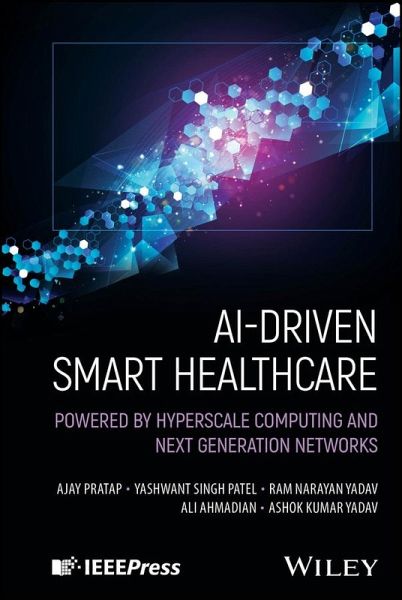
AI-Driven Smart Healthcare (eBook, ePUB)
Powered by Hyperscale Computing and Next Generation Networks
107,99 €
inkl. MwSt.
Sofort per Download lieferbar

0 °P sammeln
Ajay Pratap, Yashwant Singh Patel, Ram Narayan Yadav, Ali Ahmadian, Ashok Kumar Yadav
AI-Driven Smart Healthcare (eBook, ePUB)
Powered by Hyperscale Computing and Next Generation Networks
- Format: ePub
- Merkliste
- Auf die Merkliste
- Bewerten Bewerten
- Teilen
- Produkt teilen
- Produkterinnerung
- Produkterinnerung

Bitte loggen Sie sich zunächst in Ihr Kundenkonto ein oder registrieren Sie sich bei
bücher.de, um das eBook-Abo tolino select nutzen zu können.
Hier können Sie sich einloggen
Hier können Sie sich einloggen
Sie sind bereits eingeloggt. Klicken Sie auf 2. tolino select Abo, um fortzufahren.
Bitte loggen Sie sich zunächst in Ihr Kundenkonto ein oder registrieren Sie sich bei bücher.de, um das eBook-Abo tolino select nutzen zu können.
Reimagine the future of healthcare with a deep dive into hyperscale computing and distributed networks
In AI-Driven Smart Healthcare: Powered by Hyperscale Computing and Next Generation Networks, a team of distinguished researchers delivers an insightful and practical discussion of the healthcare applications of artificial intelligence and fog-enabled next-generation networks. The book provides practical insights and methodologies for the design, development, and deployment of these technologies throughout the healthcare industry.
Readers will explore key areas of recent advancement,…mehr
- Geräte: eReader
- mit Kopierschutz
- eBook Hilfe
- Größe: 11.69MB
Andere Kunden interessierten sich auch für
") Ajay PratapAI-Driven Smart Healthcare (eBook, PDF)107,99 €
Ajay PratapAI-Driven Smart Healthcare (eBook, PDF)107,99 €") Ronald M. RazmiAI Doctor (eBook, ePUB)41,99 €
Ronald M. RazmiAI Doctor (eBook, ePUB)41,99 €") Smart Hospitals (eBook, ePUB)168,99 €
Smart Hospitals (eBook, ePUB)168,99 €") AI and IoT Technology and Applications for Smart Healthcare Systems (eBook, ePUB)139,95 €
AI and IoT Technology and Applications for Smart Healthcare Systems (eBook, ePUB)139,95 €") AI-Driven Innovations in Healthcare (eBook, ePUB)45,95 €
AI-Driven Innovations in Healthcare (eBook, ePUB)45,95 €") Smart and Secure Internet of Healthcare Things (eBook, ePUB)47,95 €
Smart and Secure Internet of Healthcare Things (eBook, ePUB)47,95 €") Medical Analytics for Clinical and Healthcare Applications (eBook, ePUB)168,99 €
Medical Analytics for Clinical and Healthcare Applications (eBook, ePUB)168,99 €-
-
-





Reimagine the future of healthcare with a deep dive into hyperscale computing and distributed networks
In AI-Driven Smart Healthcare: Powered by Hyperscale Computing and Next Generation Networks, a team of distinguished researchers delivers an insightful and practical discussion of the healthcare applications of artificial intelligence and fog-enabled next-generation networks. The book provides practical insights and methodologies for the design, development, and deployment of these technologies throughout the healthcare industry.
Readers will explore key areas of recent advancement, including the Internet of Things, fog computing, artificial intelligence, machine learning, serverless computing, and blockchain in a way that allows them to assess the feasibility and scalability of a variety of technological healthcare solutions.
The book also includes:
Perfect for researchers, practitioners, and other healthcare stakeholders, AI-Driven Smart Healthcare will also benefit technologists, educators, hospital administrators, and other professionals with an interest in the application of the latest technologies to recurrent and significant issues in the field of healthcare.
In AI-Driven Smart Healthcare: Powered by Hyperscale Computing and Next Generation Networks, a team of distinguished researchers delivers an insightful and practical discussion of the healthcare applications of artificial intelligence and fog-enabled next-generation networks. The book provides practical insights and methodologies for the design, development, and deployment of these technologies throughout the healthcare industry.
Readers will explore key areas of recent advancement, including the Internet of Things, fog computing, artificial intelligence, machine learning, serverless computing, and blockchain in a way that allows them to assess the feasibility and scalability of a variety of technological healthcare solutions.
The book also includes:
- A thorough introduction to the integration of AI and fog computing into smart healthcare systems
- Comprehensive explorations of how these technologies enhance healthcare delivery, with examples like remote patient monitoring and advanced diagnostic models
- Practical discussions of the advantages, challenges, and potential solutions associated with AI and fog computing
- An interdisciplinary focus for professionals working at the intersection of AI, machine learning, fog computing, and healthcare
Perfect for researchers, practitioners, and other healthcare stakeholders, AI-Driven Smart Healthcare will also benefit technologists, educators, hospital administrators, and other professionals with an interest in the application of the latest technologies to recurrent and significant issues in the field of healthcare.
Dieser Download kann aus rechtlichen Gründen nur mit Rechnungsadresse in D ausgeliefert werden.
Produktdetails
- Produktdetails
- Verlag: Wiley
- Seitenzahl: 537
- Erscheinungstermin: 20. November 2025
- Englisch
- ISBN-13: 9781394297047
- Artikelnr.: 75961501
- Verlag: Wiley
- Seitenzahl: 537
- Erscheinungstermin: 20. November 2025
- Englisch
- ISBN-13: 9781394297047
- Artikelnr.: 75961501
- Herstellerkennzeichnung Die Herstellerinformationen sind derzeit nicht verfügbar.
Ajay Pratap is an Assistant Professor in the Department of Computer Science and Engineering at the Indian Institute of Technology (BHU), Varanasi, India.
Yashwant Singh Patel is a Postdoctoral Fellow in the Department of Computing Science in Umeå University, Sweden and an Assistant Professor with the Computer Science and Engineering Department (CSED) at Thapar Institute of Engineering & Technology, Punjab, India.
Ram Narayan Yadav is an Assistant Professor in the Electrical and Computer Science Engineering department at the Institute of Infrastructure Technology Research and Management in Ahmedabad, India.
Ali Ahmadian is a Senior Research Scientist at the Decisions Lab, Mediterranean University of Reggio Calabria, Italy and an Adjunct Professor with the Faculty of Engineering and Natural Sciences, Istanbul Okan University, Istanbul, Turkey.
Ashok Kumar Yadav is an Assistant Professor in the Department of Information Technology at the Rajkiya Engineering College in Azamgarh, Uttar Pradesh, India.
Yashwant Singh Patel is a Postdoctoral Fellow in the Department of Computing Science in Umeå University, Sweden and an Assistant Professor with the Computer Science and Engineering Department (CSED) at Thapar Institute of Engineering & Technology, Punjab, India.
Ram Narayan Yadav is an Assistant Professor in the Electrical and Computer Science Engineering department at the Institute of Infrastructure Technology Research and Management in Ahmedabad, India.
Ali Ahmadian is a Senior Research Scientist at the Decisions Lab, Mediterranean University of Reggio Calabria, Italy and an Adjunct Professor with the Faculty of Engineering and Natural Sciences, Istanbul Okan University, Istanbul, Turkey.
Ashok Kumar Yadav is an Assistant Professor in the Department of Information Technology at the Rajkiya Engineering College in Azamgarh, Uttar Pradesh, India.
Notes on Contributors xv
Preface xvii
Acknowledgments xix
List of Abbreviations xxi
Introduction xxv
1 Internet of Things, Edge, Fog, and Data Analytics in Smart Healthcare:
Introduction, Benefits, and Challenges 1
1.1 Introduction 1
1.2 Use of Edge and Fog Computing for Healthcare Applications 3
1.2.1 Role of Edge Computing in Resource Management 7
1.3 Data Analytics in Healthcare Applications 8
1.3.1 Components of BDA 9
1.4 BDA Applications 10
1.4.1 Challenge in Utilization of Big Data in Healthcare 11
1.5 Use Case Scenarios 13
1.5.1 Use of Data Analysis for Forecasting TB Prevalence Rates 13
1.5.2 Skin Aging Estimation 14
1.5.3 Other Use Cases in Smart Healthcare 16
1.6 Current Challenges and Future Directions 17
1.7 Future Direction: Opening Up Health Data for Research 19
1.8 Conclusion 20
References 21
2 Hyperscale Computing Paradigm in Healthcare 29
2.1 Introduction 29
2.2 The Evolution of Computing in Healthcare 30
2.2.1 Early Era of Digitalization 30
2.2.2 Transition to Cloud Computing 31
2.3 What Is Hyperscale Cloud? 32
2.4 Components of Hyperscale Computing 32
2.4.1 Distributed Systems 32
2.4.2 Cloud Infrastructure 34
2.4.3 Load Balancers 35
2.4.4 Storage Systems 36
2.4.5 Networking and Interconnectivity 36
2.4.6 Compute Resources 36
2.4.7 Automation and Orchestration 37
2.4.8 Security and Compliance 37
2.5 Challenges of Hyperscale Computing in Healthcare 37
2.6 Hyperscale Data Centers 39
2.6.1 Key Components of a Hyperscale Data Center 39
2.7 Tech Giants Playing a Role in Hyperscaling 40
2.8 Public Versus Private Hyperscale Clouds in Healthcare 42
2.9 Depth and Future of Hyperscale Computing in Healthcare 42
2.9.1 Integration of Connected Healthcare and Hyperscale Cloud 44
2.10 Case Studies of Hyperscale Computing in Healthcare 45
References 47
3 Containerized Internet of Medical Things and Serverless Computing for
Smart Healthcare Systems 49
3.1 Wireless Technologies Empowering Internet of Medical Things 49
3.2 IoMT and Its Role in Modern Healthcare 50
3.3 Importance of Containerization 52
3.3.1 Benefits of Containerization 52
3.3.2 Use Cases of Containerization 53
3.4 Serverless Computing: Concept and Overview 54
3.4.1 Features of Serverless Computing 55
3.5 Complementing Containerization for Healthcare Applications 55
3.6 Real-world Use Cases 57
3.7 Future Directions in Containerized IoMT and Serverless Healthcare 58
3.8 Conclusion 58
References 59
4 Kubernetes Enabled Resource Management Architecture for Secure Innovation
in Healthcare 61
4.1 Overview of Kubernetes and Its Role in Healthcare 61
4.2 Key Features of Kubernetes 62
4.3 Key Kubernetes Concepts 63
4.4 Kubernetes Control Plane and Nodes 64
4.5 Kubernetes Resource Management 65
4.6 Benefits of Kubernetes for the Healthcare Industry 66
4.7 Use Cases of Cloud-native and Kubernetes in Healthcare 67
4.8 Kubernetes as a Solution 68
4.9 Conclusion 70
References 71
5 Exploring Artificial Intelligence (AI) and Machine Learning (ML) for
Performance and Predictive Analysis of Various Diseases Using
Health-related Data 73
5.1 Introduction 73
5.2 Challenges in Healthcare 75
5.3 Significance of AI and ML in Healthcare 76
5.3.1 Early Diagnosis and Disease Detection 76
5.3.2 Personalized Medicine 77
5.3.3 Improving Clinical Decision Support 77
5.3.4 Reducing Administrative Burden 77
5.3.5 Predicting and Managing Disease Outbreaks 77
5.3.6 Enhancing Drug Discovery and Development 77
5.4 Application of AI/ML in Healthcare System 78
5.4.1 Prognosis 79
5.4.2 Diagnosis 80
5.4.3 Treatment 80
5.4.4 Clinical Workflows 80
5.5 Major Development Phases of AI/ML-based Healthcare Systems 81
5.5.1 Use Case Specification 83
5.5.2 Data Access and Anonymization 83
5.5.3 Data Annotation 83
5.5.4 Model Development 83
5.5.5 Model Testing and Auditing 84
5.5.6 Multi-site Verification and Validation 84
5.5.7 Regulatory Approvals 84
5.5.8 Clinical Integration 84
5.5.9 User Acceptance 85
5.5.10 Real-world Surveillance 85
5.6 Secure, Private, and Robust AI/ML-based Healthcare: Challenges 85
5.6.1 Vulnerabilities in Data Collection 85
5.6.2 Vulnerabilities Due to Data Annotation 86
5.6.3 Vulnerabilities in Model Training 86
5.6.4 Vulnerabilities in Deployment Phase 87
5.6.5 Vulnerabilities in Testing Phase 87
5.7 Use Case: Diabetes 87
5.7.1 Predictive Analysis in Disease Management 89
5.7.2 Performance Analysis in Healthcare 89
5.8 Challenges and Future Directions 93
5.9 Conclusion 93
References 98
6 Algorithmic Frameworks for Cost Minimization in Criticality Aware Mobile
Healthcare System 101
6.1 Introduction 101
6.2 Related Works 102
6.3 System Model 104
6.3.1 Data Criticality Index 106
6.4 Problem Definition 108
6.4.1 Auction Process 108
6.4.2 LDPU Perspective 110
6.4.3 CSP Perspective 110
6.4.4 Mechanism Perspective 110
6.4.5 Impact of Selfishness 111
6.5 Proposed Auction Mechanism 111
6.5.1 Cheating Detection Process at LDPU 112
6.5.2 Decision Process at CSP 113
6.5.3 Cheating Detection Process at CSP 113
6.5.4 Decision Process at LDPU 114
6.5.5 An Illustrative Example 114
6.6 Analysis of Proposed Mechanism 117
6.6.1 Truthful Analysis at LDPU Side 117
6.6.2 Truthful Analysis at CSP Side 118
6.7 Performance Study 120
6.8 Conclusion 124
References 124
7 Utility-aware Edge Computing System for Remote Health Monitoring 127
7.1 Introduction 127
7.2 Related Works 129
7.3 System Model and Problem Formulation 131
7.3.1 Reputation Scheme 132
7.4 Proposed Auction Model 136
7.4.1 Auction Details 139
7.5 Analysis of Proposed Auction Model 142
7.6 Performance Evaluation 143
7.6.1 Individual Rationality 144
7.6.2 Budget Balance 145
7.6.3 Utilities of Model Owners and Users 146
7.7 Conclusion 148
References 148
8 Fog Computing-based WBAN and IoT Framework for Prediction of Various
Diseases Using Big Data Analytics 151
8.1 Introduction 151
8.2 The Role of Fog Computing in Healthcare 153
8.3 Big Data Analytics in Healthcare 153
8.4 Wireless Body Area Networks in Healthcare 155
8.5 Framework Design 156
8.6 Disease Prediction Use Case for Healthcare 158
8.7 Conclusion 163
References 163
9 Disease Spread Detection and Controlling with Fog-based Model in Wireless
Body Area Networks 167
9.1 Compartmental Model 169
9.1.1 Applications of Compartmental Models 171
9.1.2 Contact-based Models 172
9.2 Simulation Tools 174
9.3 Other Environmental Factors to Control Spread of Disease 177
9.4 AI- and ML-based Health Prediction Approaches 178
9.5 Conclusion 180
References 180
10 Optimized Doctor Recommendation System Using Machine Learning Approach
185
10.1 Introduction 185
10.2 Related Works 187
10.3 System Model 190
10.3.1 Selection Factor of Doctor 191
10.3.2 Expertise Score of Doctor 192
10.3.3 Expected Reward of Doctor 192
10.3.4 Satisfaction Level of Patient 194
10.3.5 Problem Formulation 194
10.4 Proposed Approach 195
10.4.1 Calculate Expertise Score 196
10.4.2 Recommend an Ordered Assortment 198
10.4.3 Update Doctor's Information 199
10.5 Performance Study 201
10.6 Conclusion and Future Work 204
References 205
11 UAV-enabled Smart Healthcare Application for Next-generation Wireless
Networks 209
11.1 Introduction 209
11.1.1 Motivation 209
11.2 Related Works 211
11.3 System Model 213
11.3.1 System Components 214
11.3.2 Cost Model 215
11.3.3 Revenue Model 221
11.3.4 Objective Function 222
11.4 Federated Deep Reinforcement Learning 223
11.4.1 Deep Reinforcement Learning 223
11.4.2 Federated Advantage Actor Critic 226
11.4.3 Federated Proximal Policy Optimization 227
11.4.4 Proposed Solution 227
11.5 A Direction for Performance Study 230
11.6 Conclusion 232
11.6.1 Challenges 233
11.6.2 Future Work 234
References 235
12 A Road Map for Personalized Medicine: Challenges and Innovations 239
12.1 Introduction 239
12.2 Use of Genome Data to Develop Personalized Medicine 243
12.2.1 Genetic Biomarkers 244
12.2.2 Biochemical Biomarkers 244
12.3 Use of Medical Imaging Data to Develop Personalized Medicine 245
12.4 Use of AI and ML in Drug Development in Personalized Medicine 247
12.4.1 AI Applications in Pharmacogenomics 248
12.4.2 Use of ML Models for Predicting Drug Responses 249
12.4.3 Use of Deep Learning Models for Analyzing Genomic Data 250
12.4.4 Use of AI and ML in Computational Modeling in Personalized Medicine
250
12.5 Use of Digital Twin for Personalized Medicine 251
12.6 Current Challenges and Future Directions 253
References 255
13 Delay-sensitive, Privacy-preserving Blockchain-enabled Fog-assisted
Framework for Smart Healthcare 263
13.1 Introduction 263
13.2 Related Work 265
13.3 System Model 267
13.3.1 Founding Phase 268
13.3.2 Bidding Phase 269
13.3.3 Calculation 270
13.4 Problem Formulation 271
13.4.1 Criticality of the Data 271
13.4.2 Data Transmission Cost 272
13.4.3 Reputation Mechanism 272
13.4.4 Profit of the Miners 276
13.4.5 Profit Calculation for Patients 277
13.4.6 Profit Calculation for Companies 277
13.5 Proposed Solution 278
13.5.1 Genetic Algorithm 278
13.5.2 Problem Representation 280
13.5.3 Problem Encoding 281
13.5.4 Fitness Function 282
13.5.5 Stopping Criteria 283
13.5.6 Implementation Details 283
13.6 Experimental Results 286
13.6.1 Dataset 286
13.6.2 Test and Results 288
13.7 Conclusion 294
Appendix 13.A 294
13.a.1 NP-hard Problems 294
13.a.2 0/1 Knapsack Problem 294
13.a.3 NP-hard Proof 295
References 296
A Research Discussion, Tools, and Use Cases 299
A. 1 Artificial Intelligence in Smart Healthcare 299
A. 2 Research Trends in AI for Healthcare 300
A. 3 Use Cases of AI in Smart Healthcare 300
A. 4 Key Tools and Frameworks for AI-driven Healthcare 309
A. 5 Challenges and Limitations in AI-driven Healthcare 312
A. 6 Conclusion 313
References 314
Index 319
Preface xvii
Acknowledgments xix
List of Abbreviations xxi
Introduction xxv
1 Internet of Things, Edge, Fog, and Data Analytics in Smart Healthcare:
Introduction, Benefits, and Challenges 1
1.1 Introduction 1
1.2 Use of Edge and Fog Computing for Healthcare Applications 3
1.2.1 Role of Edge Computing in Resource Management 7
1.3 Data Analytics in Healthcare Applications 8
1.3.1 Components of BDA 9
1.4 BDA Applications 10
1.4.1 Challenge in Utilization of Big Data in Healthcare 11
1.5 Use Case Scenarios 13
1.5.1 Use of Data Analysis for Forecasting TB Prevalence Rates 13
1.5.2 Skin Aging Estimation 14
1.5.3 Other Use Cases in Smart Healthcare 16
1.6 Current Challenges and Future Directions 17
1.7 Future Direction: Opening Up Health Data for Research 19
1.8 Conclusion 20
References 21
2 Hyperscale Computing Paradigm in Healthcare 29
2.1 Introduction 29
2.2 The Evolution of Computing in Healthcare 30
2.2.1 Early Era of Digitalization 30
2.2.2 Transition to Cloud Computing 31
2.3 What Is Hyperscale Cloud? 32
2.4 Components of Hyperscale Computing 32
2.4.1 Distributed Systems 32
2.4.2 Cloud Infrastructure 34
2.4.3 Load Balancers 35
2.4.4 Storage Systems 36
2.4.5 Networking and Interconnectivity 36
2.4.6 Compute Resources 36
2.4.7 Automation and Orchestration 37
2.4.8 Security and Compliance 37
2.5 Challenges of Hyperscale Computing in Healthcare 37
2.6 Hyperscale Data Centers 39
2.6.1 Key Components of a Hyperscale Data Center 39
2.7 Tech Giants Playing a Role in Hyperscaling 40
2.8 Public Versus Private Hyperscale Clouds in Healthcare 42
2.9 Depth and Future of Hyperscale Computing in Healthcare 42
2.9.1 Integration of Connected Healthcare and Hyperscale Cloud 44
2.10 Case Studies of Hyperscale Computing in Healthcare 45
References 47
3 Containerized Internet of Medical Things and Serverless Computing for
Smart Healthcare Systems 49
3.1 Wireless Technologies Empowering Internet of Medical Things 49
3.2 IoMT and Its Role in Modern Healthcare 50
3.3 Importance of Containerization 52
3.3.1 Benefits of Containerization 52
3.3.2 Use Cases of Containerization 53
3.4 Serverless Computing: Concept and Overview 54
3.4.1 Features of Serverless Computing 55
3.5 Complementing Containerization for Healthcare Applications 55
3.6 Real-world Use Cases 57
3.7 Future Directions in Containerized IoMT and Serverless Healthcare 58
3.8 Conclusion 58
References 59
4 Kubernetes Enabled Resource Management Architecture for Secure Innovation
in Healthcare 61
4.1 Overview of Kubernetes and Its Role in Healthcare 61
4.2 Key Features of Kubernetes 62
4.3 Key Kubernetes Concepts 63
4.4 Kubernetes Control Plane and Nodes 64
4.5 Kubernetes Resource Management 65
4.6 Benefits of Kubernetes for the Healthcare Industry 66
4.7 Use Cases of Cloud-native and Kubernetes in Healthcare 67
4.8 Kubernetes as a Solution 68
4.9 Conclusion 70
References 71
5 Exploring Artificial Intelligence (AI) and Machine Learning (ML) for
Performance and Predictive Analysis of Various Diseases Using
Health-related Data 73
5.1 Introduction 73
5.2 Challenges in Healthcare 75
5.3 Significance of AI and ML in Healthcare 76
5.3.1 Early Diagnosis and Disease Detection 76
5.3.2 Personalized Medicine 77
5.3.3 Improving Clinical Decision Support 77
5.3.4 Reducing Administrative Burden 77
5.3.5 Predicting and Managing Disease Outbreaks 77
5.3.6 Enhancing Drug Discovery and Development 77
5.4 Application of AI/ML in Healthcare System 78
5.4.1 Prognosis 79
5.4.2 Diagnosis 80
5.4.3 Treatment 80
5.4.4 Clinical Workflows 80
5.5 Major Development Phases of AI/ML-based Healthcare Systems 81
5.5.1 Use Case Specification 83
5.5.2 Data Access and Anonymization 83
5.5.3 Data Annotation 83
5.5.4 Model Development 83
5.5.5 Model Testing and Auditing 84
5.5.6 Multi-site Verification and Validation 84
5.5.7 Regulatory Approvals 84
5.5.8 Clinical Integration 84
5.5.9 User Acceptance 85
5.5.10 Real-world Surveillance 85
5.6 Secure, Private, and Robust AI/ML-based Healthcare: Challenges 85
5.6.1 Vulnerabilities in Data Collection 85
5.6.2 Vulnerabilities Due to Data Annotation 86
5.6.3 Vulnerabilities in Model Training 86
5.6.4 Vulnerabilities in Deployment Phase 87
5.6.5 Vulnerabilities in Testing Phase 87
5.7 Use Case: Diabetes 87
5.7.1 Predictive Analysis in Disease Management 89
5.7.2 Performance Analysis in Healthcare 89
5.8 Challenges and Future Directions 93
5.9 Conclusion 93
References 98
6 Algorithmic Frameworks for Cost Minimization in Criticality Aware Mobile
Healthcare System 101
6.1 Introduction 101
6.2 Related Works 102
6.3 System Model 104
6.3.1 Data Criticality Index 106
6.4 Problem Definition 108
6.4.1 Auction Process 108
6.4.2 LDPU Perspective 110
6.4.3 CSP Perspective 110
6.4.4 Mechanism Perspective 110
6.4.5 Impact of Selfishness 111
6.5 Proposed Auction Mechanism 111
6.5.1 Cheating Detection Process at LDPU 112
6.5.2 Decision Process at CSP 113
6.5.3 Cheating Detection Process at CSP 113
6.5.4 Decision Process at LDPU 114
6.5.5 An Illustrative Example 114
6.6 Analysis of Proposed Mechanism 117
6.6.1 Truthful Analysis at LDPU Side 117
6.6.2 Truthful Analysis at CSP Side 118
6.7 Performance Study 120
6.8 Conclusion 124
References 124
7 Utility-aware Edge Computing System for Remote Health Monitoring 127
7.1 Introduction 127
7.2 Related Works 129
7.3 System Model and Problem Formulation 131
7.3.1 Reputation Scheme 132
7.4 Proposed Auction Model 136
7.4.1 Auction Details 139
7.5 Analysis of Proposed Auction Model 142
7.6 Performance Evaluation 143
7.6.1 Individual Rationality 144
7.6.2 Budget Balance 145
7.6.3 Utilities of Model Owners and Users 146
7.7 Conclusion 148
References 148
8 Fog Computing-based WBAN and IoT Framework for Prediction of Various
Diseases Using Big Data Analytics 151
8.1 Introduction 151
8.2 The Role of Fog Computing in Healthcare 153
8.3 Big Data Analytics in Healthcare 153
8.4 Wireless Body Area Networks in Healthcare 155
8.5 Framework Design 156
8.6 Disease Prediction Use Case for Healthcare 158
8.7 Conclusion 163
References 163
9 Disease Spread Detection and Controlling with Fog-based Model in Wireless
Body Area Networks 167
9.1 Compartmental Model 169
9.1.1 Applications of Compartmental Models 171
9.1.2 Contact-based Models 172
9.2 Simulation Tools 174
9.3 Other Environmental Factors to Control Spread of Disease 177
9.4 AI- and ML-based Health Prediction Approaches 178
9.5 Conclusion 180
References 180
10 Optimized Doctor Recommendation System Using Machine Learning Approach
185
10.1 Introduction 185
10.2 Related Works 187
10.3 System Model 190
10.3.1 Selection Factor of Doctor 191
10.3.2 Expertise Score of Doctor 192
10.3.3 Expected Reward of Doctor 192
10.3.4 Satisfaction Level of Patient 194
10.3.5 Problem Formulation 194
10.4 Proposed Approach 195
10.4.1 Calculate Expertise Score 196
10.4.2 Recommend an Ordered Assortment 198
10.4.3 Update Doctor's Information 199
10.5 Performance Study 201
10.6 Conclusion and Future Work 204
References 205
11 UAV-enabled Smart Healthcare Application for Next-generation Wireless
Networks 209
11.1 Introduction 209
11.1.1 Motivation 209
11.2 Related Works 211
11.3 System Model 213
11.3.1 System Components 214
11.3.2 Cost Model 215
11.3.3 Revenue Model 221
11.3.4 Objective Function 222
11.4 Federated Deep Reinforcement Learning 223
11.4.1 Deep Reinforcement Learning 223
11.4.2 Federated Advantage Actor Critic 226
11.4.3 Federated Proximal Policy Optimization 227
11.4.4 Proposed Solution 227
11.5 A Direction for Performance Study 230
11.6 Conclusion 232
11.6.1 Challenges 233
11.6.2 Future Work 234
References 235
12 A Road Map for Personalized Medicine: Challenges and Innovations 239
12.1 Introduction 239
12.2 Use of Genome Data to Develop Personalized Medicine 243
12.2.1 Genetic Biomarkers 244
12.2.2 Biochemical Biomarkers 244
12.3 Use of Medical Imaging Data to Develop Personalized Medicine 245
12.4 Use of AI and ML in Drug Development in Personalized Medicine 247
12.4.1 AI Applications in Pharmacogenomics 248
12.4.2 Use of ML Models for Predicting Drug Responses 249
12.4.3 Use of Deep Learning Models for Analyzing Genomic Data 250
12.4.4 Use of AI and ML in Computational Modeling in Personalized Medicine
250
12.5 Use of Digital Twin for Personalized Medicine 251
12.6 Current Challenges and Future Directions 253
References 255
13 Delay-sensitive, Privacy-preserving Blockchain-enabled Fog-assisted
Framework for Smart Healthcare 263
13.1 Introduction 263
13.2 Related Work 265
13.3 System Model 267
13.3.1 Founding Phase 268
13.3.2 Bidding Phase 269
13.3.3 Calculation 270
13.4 Problem Formulation 271
13.4.1 Criticality of the Data 271
13.4.2 Data Transmission Cost 272
13.4.3 Reputation Mechanism 272
13.4.4 Profit of the Miners 276
13.4.5 Profit Calculation for Patients 277
13.4.6 Profit Calculation for Companies 277
13.5 Proposed Solution 278
13.5.1 Genetic Algorithm 278
13.5.2 Problem Representation 280
13.5.3 Problem Encoding 281
13.5.4 Fitness Function 282
13.5.5 Stopping Criteria 283
13.5.6 Implementation Details 283
13.6 Experimental Results 286
13.6.1 Dataset 286
13.6.2 Test and Results 288
13.7 Conclusion 294
Appendix 13.A 294
13.a.1 NP-hard Problems 294
13.a.2 0/1 Knapsack Problem 294
13.a.3 NP-hard Proof 295
References 296
A Research Discussion, Tools, and Use Cases 299
A. 1 Artificial Intelligence in Smart Healthcare 299
A. 2 Research Trends in AI for Healthcare 300
A. 3 Use Cases of AI in Smart Healthcare 300
A. 4 Key Tools and Frameworks for AI-driven Healthcare 309
A. 5 Challenges and Limitations in AI-driven Healthcare 312
A. 6 Conclusion 313
References 314
Index 319
Notes on Contributors xv
Preface xvii
Acknowledgments xix
List of Abbreviations xxi
Introduction xxv
1 Internet of Things, Edge, Fog, and Data Analytics in Smart Healthcare:
Introduction, Benefits, and Challenges 1
1.1 Introduction 1
1.2 Use of Edge and Fog Computing for Healthcare Applications 3
1.2.1 Role of Edge Computing in Resource Management 7
1.3 Data Analytics in Healthcare Applications 8
1.3.1 Components of BDA 9
1.4 BDA Applications 10
1.4.1 Challenge in Utilization of Big Data in Healthcare 11
1.5 Use Case Scenarios 13
1.5.1 Use of Data Analysis for Forecasting TB Prevalence Rates 13
1.5.2 Skin Aging Estimation 14
1.5.3 Other Use Cases in Smart Healthcare 16
1.6 Current Challenges and Future Directions 17
1.7 Future Direction: Opening Up Health Data for Research 19
1.8 Conclusion 20
References 21
2 Hyperscale Computing Paradigm in Healthcare 29
2.1 Introduction 29
2.2 The Evolution of Computing in Healthcare 30
2.2.1 Early Era of Digitalization 30
2.2.2 Transition to Cloud Computing 31
2.3 What Is Hyperscale Cloud? 32
2.4 Components of Hyperscale Computing 32
2.4.1 Distributed Systems 32
2.4.2 Cloud Infrastructure 34
2.4.3 Load Balancers 35
2.4.4 Storage Systems 36
2.4.5 Networking and Interconnectivity 36
2.4.6 Compute Resources 36
2.4.7 Automation and Orchestration 37
2.4.8 Security and Compliance 37
2.5 Challenges of Hyperscale Computing in Healthcare 37
2.6 Hyperscale Data Centers 39
2.6.1 Key Components of a Hyperscale Data Center 39
2.7 Tech Giants Playing a Role in Hyperscaling 40
2.8 Public Versus Private Hyperscale Clouds in Healthcare 42
2.9 Depth and Future of Hyperscale Computing in Healthcare 42
2.9.1 Integration of Connected Healthcare and Hyperscale Cloud 44
2.10 Case Studies of Hyperscale Computing in Healthcare 45
References 47
3 Containerized Internet of Medical Things and Serverless Computing for
Smart Healthcare Systems 49
3.1 Wireless Technologies Empowering Internet of Medical Things 49
3.2 IoMT and Its Role in Modern Healthcare 50
3.3 Importance of Containerization 52
3.3.1 Benefits of Containerization 52
3.3.2 Use Cases of Containerization 53
3.4 Serverless Computing: Concept and Overview 54
3.4.1 Features of Serverless Computing 55
3.5 Complementing Containerization for Healthcare Applications 55
3.6 Real-world Use Cases 57
3.7 Future Directions in Containerized IoMT and Serverless Healthcare 58
3.8 Conclusion 58
References 59
4 Kubernetes Enabled Resource Management Architecture for Secure Innovation
in Healthcare 61
4.1 Overview of Kubernetes and Its Role in Healthcare 61
4.2 Key Features of Kubernetes 62
4.3 Key Kubernetes Concepts 63
4.4 Kubernetes Control Plane and Nodes 64
4.5 Kubernetes Resource Management 65
4.6 Benefits of Kubernetes for the Healthcare Industry 66
4.7 Use Cases of Cloud-native and Kubernetes in Healthcare 67
4.8 Kubernetes as a Solution 68
4.9 Conclusion 70
References 71
5 Exploring Artificial Intelligence (AI) and Machine Learning (ML) for
Performance and Predictive Analysis of Various Diseases Using
Health-related Data 73
5.1 Introduction 73
5.2 Challenges in Healthcare 75
5.3 Significance of AI and ML in Healthcare 76
5.3.1 Early Diagnosis and Disease Detection 76
5.3.2 Personalized Medicine 77
5.3.3 Improving Clinical Decision Support 77
5.3.4 Reducing Administrative Burden 77
5.3.5 Predicting and Managing Disease Outbreaks 77
5.3.6 Enhancing Drug Discovery and Development 77
5.4 Application of AI/ML in Healthcare System 78
5.4.1 Prognosis 79
5.4.2 Diagnosis 80
5.4.3 Treatment 80
5.4.4 Clinical Workflows 80
5.5 Major Development Phases of AI/ML-based Healthcare Systems 81
5.5.1 Use Case Specification 83
5.5.2 Data Access and Anonymization 83
5.5.3 Data Annotation 83
5.5.4 Model Development 83
5.5.5 Model Testing and Auditing 84
5.5.6 Multi-site Verification and Validation 84
5.5.7 Regulatory Approvals 84
5.5.8 Clinical Integration 84
5.5.9 User Acceptance 85
5.5.10 Real-world Surveillance 85
5.6 Secure, Private, and Robust AI/ML-based Healthcare: Challenges 85
5.6.1 Vulnerabilities in Data Collection 85
5.6.2 Vulnerabilities Due to Data Annotation 86
5.6.3 Vulnerabilities in Model Training 86
5.6.4 Vulnerabilities in Deployment Phase 87
5.6.5 Vulnerabilities in Testing Phase 87
5.7 Use Case: Diabetes 87
5.7.1 Predictive Analysis in Disease Management 89
5.7.2 Performance Analysis in Healthcare 89
5.8 Challenges and Future Directions 93
5.9 Conclusion 93
References 98
6 Algorithmic Frameworks for Cost Minimization in Criticality Aware Mobile
Healthcare System 101
6.1 Introduction 101
6.2 Related Works 102
6.3 System Model 104
6.3.1 Data Criticality Index 106
6.4 Problem Definition 108
6.4.1 Auction Process 108
6.4.2 LDPU Perspective 110
6.4.3 CSP Perspective 110
6.4.4 Mechanism Perspective 110
6.4.5 Impact of Selfishness 111
6.5 Proposed Auction Mechanism 111
6.5.1 Cheating Detection Process at LDPU 112
6.5.2 Decision Process at CSP 113
6.5.3 Cheating Detection Process at CSP 113
6.5.4 Decision Process at LDPU 114
6.5.5 An Illustrative Example 114
6.6 Analysis of Proposed Mechanism 117
6.6.1 Truthful Analysis at LDPU Side 117
6.6.2 Truthful Analysis at CSP Side 118
6.7 Performance Study 120
6.8 Conclusion 124
References 124
7 Utility-aware Edge Computing System for Remote Health Monitoring 127
7.1 Introduction 127
7.2 Related Works 129
7.3 System Model and Problem Formulation 131
7.3.1 Reputation Scheme 132
7.4 Proposed Auction Model 136
7.4.1 Auction Details 139
7.5 Analysis of Proposed Auction Model 142
7.6 Performance Evaluation 143
7.6.1 Individual Rationality 144
7.6.2 Budget Balance 145
7.6.3 Utilities of Model Owners and Users 146
7.7 Conclusion 148
References 148
8 Fog Computing-based WBAN and IoT Framework for Prediction of Various
Diseases Using Big Data Analytics 151
8.1 Introduction 151
8.2 The Role of Fog Computing in Healthcare 153
8.3 Big Data Analytics in Healthcare 153
8.4 Wireless Body Area Networks in Healthcare 155
8.5 Framework Design 156
8.6 Disease Prediction Use Case for Healthcare 158
8.7 Conclusion 163
References 163
9 Disease Spread Detection and Controlling with Fog-based Model in Wireless
Body Area Networks 167
9.1 Compartmental Model 169
9.1.1 Applications of Compartmental Models 171
9.1.2 Contact-based Models 172
9.2 Simulation Tools 174
9.3 Other Environmental Factors to Control Spread of Disease 177
9.4 AI- and ML-based Health Prediction Approaches 178
9.5 Conclusion 180
References 180
10 Optimized Doctor Recommendation System Using Machine Learning Approach
185
10.1 Introduction 185
10.2 Related Works 187
10.3 System Model 190
10.3.1 Selection Factor of Doctor 191
10.3.2 Expertise Score of Doctor 192
10.3.3 Expected Reward of Doctor 192
10.3.4 Satisfaction Level of Patient 194
10.3.5 Problem Formulation 194
10.4 Proposed Approach 195
10.4.1 Calculate Expertise Score 196
10.4.2 Recommend an Ordered Assortment 198
10.4.3 Update Doctor's Information 199
10.5 Performance Study 201
10.6 Conclusion and Future Work 204
References 205
11 UAV-enabled Smart Healthcare Application for Next-generation Wireless
Networks 209
11.1 Introduction 209
11.1.1 Motivation 209
11.2 Related Works 211
11.3 System Model 213
11.3.1 System Components 214
11.3.2 Cost Model 215
11.3.3 Revenue Model 221
11.3.4 Objective Function 222
11.4 Federated Deep Reinforcement Learning 223
11.4.1 Deep Reinforcement Learning 223
11.4.2 Federated Advantage Actor Critic 226
11.4.3 Federated Proximal Policy Optimization 227
11.4.4 Proposed Solution 227
11.5 A Direction for Performance Study 230
11.6 Conclusion 232
11.6.1 Challenges 233
11.6.2 Future Work 234
References 235
12 A Road Map for Personalized Medicine: Challenges and Innovations 239
12.1 Introduction 239
12.2 Use of Genome Data to Develop Personalized Medicine 243
12.2.1 Genetic Biomarkers 244
12.2.2 Biochemical Biomarkers 244
12.3 Use of Medical Imaging Data to Develop Personalized Medicine 245
12.4 Use of AI and ML in Drug Development in Personalized Medicine 247
12.4.1 AI Applications in Pharmacogenomics 248
12.4.2 Use of ML Models for Predicting Drug Responses 249
12.4.3 Use of Deep Learning Models for Analyzing Genomic Data 250
12.4.4 Use of AI and ML in Computational Modeling in Personalized Medicine
250
12.5 Use of Digital Twin for Personalized Medicine 251
12.6 Current Challenges and Future Directions 253
References 255
13 Delay-sensitive, Privacy-preserving Blockchain-enabled Fog-assisted
Framework for Smart Healthcare 263
13.1 Introduction 263
13.2 Related Work 265
13.3 System Model 267
13.3.1 Founding Phase 268
13.3.2 Bidding Phase 269
13.3.3 Calculation 270
13.4 Problem Formulation 271
13.4.1 Criticality of the Data 271
13.4.2 Data Transmission Cost 272
13.4.3 Reputation Mechanism 272
13.4.4 Profit of the Miners 276
13.4.5 Profit Calculation for Patients 277
13.4.6 Profit Calculation for Companies 277
13.5 Proposed Solution 278
13.5.1 Genetic Algorithm 278
13.5.2 Problem Representation 280
13.5.3 Problem Encoding 281
13.5.4 Fitness Function 282
13.5.5 Stopping Criteria 283
13.5.6 Implementation Details 283
13.6 Experimental Results 286
13.6.1 Dataset 286
13.6.2 Test and Results 288
13.7 Conclusion 294
Appendix 13.A 294
13.a.1 NP-hard Problems 294
13.a.2 0/1 Knapsack Problem 294
13.a.3 NP-hard Proof 295
References 296
A Research Discussion, Tools, and Use Cases 299
A. 1 Artificial Intelligence in Smart Healthcare 299
A. 2 Research Trends in AI for Healthcare 300
A. 3 Use Cases of AI in Smart Healthcare 300
A. 4 Key Tools and Frameworks for AI-driven Healthcare 309
A. 5 Challenges and Limitations in AI-driven Healthcare 312
A. 6 Conclusion 313
References 314
Index 319
Preface xvii
Acknowledgments xix
List of Abbreviations xxi
Introduction xxv
1 Internet of Things, Edge, Fog, and Data Analytics in Smart Healthcare:
Introduction, Benefits, and Challenges 1
1.1 Introduction 1
1.2 Use of Edge and Fog Computing for Healthcare Applications 3
1.2.1 Role of Edge Computing in Resource Management 7
1.3 Data Analytics in Healthcare Applications 8
1.3.1 Components of BDA 9
1.4 BDA Applications 10
1.4.1 Challenge in Utilization of Big Data in Healthcare 11
1.5 Use Case Scenarios 13
1.5.1 Use of Data Analysis for Forecasting TB Prevalence Rates 13
1.5.2 Skin Aging Estimation 14
1.5.3 Other Use Cases in Smart Healthcare 16
1.6 Current Challenges and Future Directions 17
1.7 Future Direction: Opening Up Health Data for Research 19
1.8 Conclusion 20
References 21
2 Hyperscale Computing Paradigm in Healthcare 29
2.1 Introduction 29
2.2 The Evolution of Computing in Healthcare 30
2.2.1 Early Era of Digitalization 30
2.2.2 Transition to Cloud Computing 31
2.3 What Is Hyperscale Cloud? 32
2.4 Components of Hyperscale Computing 32
2.4.1 Distributed Systems 32
2.4.2 Cloud Infrastructure 34
2.4.3 Load Balancers 35
2.4.4 Storage Systems 36
2.4.5 Networking and Interconnectivity 36
2.4.6 Compute Resources 36
2.4.7 Automation and Orchestration 37
2.4.8 Security and Compliance 37
2.5 Challenges of Hyperscale Computing in Healthcare 37
2.6 Hyperscale Data Centers 39
2.6.1 Key Components of a Hyperscale Data Center 39
2.7 Tech Giants Playing a Role in Hyperscaling 40
2.8 Public Versus Private Hyperscale Clouds in Healthcare 42
2.9 Depth and Future of Hyperscale Computing in Healthcare 42
2.9.1 Integration of Connected Healthcare and Hyperscale Cloud 44
2.10 Case Studies of Hyperscale Computing in Healthcare 45
References 47
3 Containerized Internet of Medical Things and Serverless Computing for
Smart Healthcare Systems 49
3.1 Wireless Technologies Empowering Internet of Medical Things 49
3.2 IoMT and Its Role in Modern Healthcare 50
3.3 Importance of Containerization 52
3.3.1 Benefits of Containerization 52
3.3.2 Use Cases of Containerization 53
3.4 Serverless Computing: Concept and Overview 54
3.4.1 Features of Serverless Computing 55
3.5 Complementing Containerization for Healthcare Applications 55
3.6 Real-world Use Cases 57
3.7 Future Directions in Containerized IoMT and Serverless Healthcare 58
3.8 Conclusion 58
References 59
4 Kubernetes Enabled Resource Management Architecture for Secure Innovation
in Healthcare 61
4.1 Overview of Kubernetes and Its Role in Healthcare 61
4.2 Key Features of Kubernetes 62
4.3 Key Kubernetes Concepts 63
4.4 Kubernetes Control Plane and Nodes 64
4.5 Kubernetes Resource Management 65
4.6 Benefits of Kubernetes for the Healthcare Industry 66
4.7 Use Cases of Cloud-native and Kubernetes in Healthcare 67
4.8 Kubernetes as a Solution 68
4.9 Conclusion 70
References 71
5 Exploring Artificial Intelligence (AI) and Machine Learning (ML) for
Performance and Predictive Analysis of Various Diseases Using
Health-related Data 73
5.1 Introduction 73
5.2 Challenges in Healthcare 75
5.3 Significance of AI and ML in Healthcare 76
5.3.1 Early Diagnosis and Disease Detection 76
5.3.2 Personalized Medicine 77
5.3.3 Improving Clinical Decision Support 77
5.3.4 Reducing Administrative Burden 77
5.3.5 Predicting and Managing Disease Outbreaks 77
5.3.6 Enhancing Drug Discovery and Development 77
5.4 Application of AI/ML in Healthcare System 78
5.4.1 Prognosis 79
5.4.2 Diagnosis 80
5.4.3 Treatment 80
5.4.4 Clinical Workflows 80
5.5 Major Development Phases of AI/ML-based Healthcare Systems 81
5.5.1 Use Case Specification 83
5.5.2 Data Access and Anonymization 83
5.5.3 Data Annotation 83
5.5.4 Model Development 83
5.5.5 Model Testing and Auditing 84
5.5.6 Multi-site Verification and Validation 84
5.5.7 Regulatory Approvals 84
5.5.8 Clinical Integration 84
5.5.9 User Acceptance 85
5.5.10 Real-world Surveillance 85
5.6 Secure, Private, and Robust AI/ML-based Healthcare: Challenges 85
5.6.1 Vulnerabilities in Data Collection 85
5.6.2 Vulnerabilities Due to Data Annotation 86
5.6.3 Vulnerabilities in Model Training 86
5.6.4 Vulnerabilities in Deployment Phase 87
5.6.5 Vulnerabilities in Testing Phase 87
5.7 Use Case: Diabetes 87
5.7.1 Predictive Analysis in Disease Management 89
5.7.2 Performance Analysis in Healthcare 89
5.8 Challenges and Future Directions 93
5.9 Conclusion 93
References 98
6 Algorithmic Frameworks for Cost Minimization in Criticality Aware Mobile
Healthcare System 101
6.1 Introduction 101
6.2 Related Works 102
6.3 System Model 104
6.3.1 Data Criticality Index 106
6.4 Problem Definition 108
6.4.1 Auction Process 108
6.4.2 LDPU Perspective 110
6.4.3 CSP Perspective 110
6.4.4 Mechanism Perspective 110
6.4.5 Impact of Selfishness 111
6.5 Proposed Auction Mechanism 111
6.5.1 Cheating Detection Process at LDPU 112
6.5.2 Decision Process at CSP 113
6.5.3 Cheating Detection Process at CSP 113
6.5.4 Decision Process at LDPU 114
6.5.5 An Illustrative Example 114
6.6 Analysis of Proposed Mechanism 117
6.6.1 Truthful Analysis at LDPU Side 117
6.6.2 Truthful Analysis at CSP Side 118
6.7 Performance Study 120
6.8 Conclusion 124
References 124
7 Utility-aware Edge Computing System for Remote Health Monitoring 127
7.1 Introduction 127
7.2 Related Works 129
7.3 System Model and Problem Formulation 131
7.3.1 Reputation Scheme 132
7.4 Proposed Auction Model 136
7.4.1 Auction Details 139
7.5 Analysis of Proposed Auction Model 142
7.6 Performance Evaluation 143
7.6.1 Individual Rationality 144
7.6.2 Budget Balance 145
7.6.3 Utilities of Model Owners and Users 146
7.7 Conclusion 148
References 148
8 Fog Computing-based WBAN and IoT Framework for Prediction of Various
Diseases Using Big Data Analytics 151
8.1 Introduction 151
8.2 The Role of Fog Computing in Healthcare 153
8.3 Big Data Analytics in Healthcare 153
8.4 Wireless Body Area Networks in Healthcare 155
8.5 Framework Design 156
8.6 Disease Prediction Use Case for Healthcare 158
8.7 Conclusion 163
References 163
9 Disease Spread Detection and Controlling with Fog-based Model in Wireless
Body Area Networks 167
9.1 Compartmental Model 169
9.1.1 Applications of Compartmental Models 171
9.1.2 Contact-based Models 172
9.2 Simulation Tools 174
9.3 Other Environmental Factors to Control Spread of Disease 177
9.4 AI- and ML-based Health Prediction Approaches 178
9.5 Conclusion 180
References 180
10 Optimized Doctor Recommendation System Using Machine Learning Approach
185
10.1 Introduction 185
10.2 Related Works 187
10.3 System Model 190
10.3.1 Selection Factor of Doctor 191
10.3.2 Expertise Score of Doctor 192
10.3.3 Expected Reward of Doctor 192
10.3.4 Satisfaction Level of Patient 194
10.3.5 Problem Formulation 194
10.4 Proposed Approach 195
10.4.1 Calculate Expertise Score 196
10.4.2 Recommend an Ordered Assortment 198
10.4.3 Update Doctor's Information 199
10.5 Performance Study 201
10.6 Conclusion and Future Work 204
References 205
11 UAV-enabled Smart Healthcare Application for Next-generation Wireless
Networks 209
11.1 Introduction 209
11.1.1 Motivation 209
11.2 Related Works 211
11.3 System Model 213
11.3.1 System Components 214
11.3.2 Cost Model 215
11.3.3 Revenue Model 221
11.3.4 Objective Function 222
11.4 Federated Deep Reinforcement Learning 223
11.4.1 Deep Reinforcement Learning 223
11.4.2 Federated Advantage Actor Critic 226
11.4.3 Federated Proximal Policy Optimization 227
11.4.4 Proposed Solution 227
11.5 A Direction for Performance Study 230
11.6 Conclusion 232
11.6.1 Challenges 233
11.6.2 Future Work 234
References 235
12 A Road Map for Personalized Medicine: Challenges and Innovations 239
12.1 Introduction 239
12.2 Use of Genome Data to Develop Personalized Medicine 243
12.2.1 Genetic Biomarkers 244
12.2.2 Biochemical Biomarkers 244
12.3 Use of Medical Imaging Data to Develop Personalized Medicine 245
12.4 Use of AI and ML in Drug Development in Personalized Medicine 247
12.4.1 AI Applications in Pharmacogenomics 248
12.4.2 Use of ML Models for Predicting Drug Responses 249
12.4.3 Use of Deep Learning Models for Analyzing Genomic Data 250
12.4.4 Use of AI and ML in Computational Modeling in Personalized Medicine
250
12.5 Use of Digital Twin for Personalized Medicine 251
12.6 Current Challenges and Future Directions 253
References 255
13 Delay-sensitive, Privacy-preserving Blockchain-enabled Fog-assisted
Framework for Smart Healthcare 263
13.1 Introduction 263
13.2 Related Work 265
13.3 System Model 267
13.3.1 Founding Phase 268
13.3.2 Bidding Phase 269
13.3.3 Calculation 270
13.4 Problem Formulation 271
13.4.1 Criticality of the Data 271
13.4.2 Data Transmission Cost 272
13.4.3 Reputation Mechanism 272
13.4.4 Profit of the Miners 276
13.4.5 Profit Calculation for Patients 277
13.4.6 Profit Calculation for Companies 277
13.5 Proposed Solution 278
13.5.1 Genetic Algorithm 278
13.5.2 Problem Representation 280
13.5.3 Problem Encoding 281
13.5.4 Fitness Function 282
13.5.5 Stopping Criteria 283
13.5.6 Implementation Details 283
13.6 Experimental Results 286
13.6.1 Dataset 286
13.6.2 Test and Results 288
13.7 Conclusion 294
Appendix 13.A 294
13.a.1 NP-hard Problems 294
13.a.2 0/1 Knapsack Problem 294
13.a.3 NP-hard Proof 295
References 296
A Research Discussion, Tools, and Use Cases 299
A. 1 Artificial Intelligence in Smart Healthcare 299
A. 2 Research Trends in AI for Healthcare 300
A. 3 Use Cases of AI in Smart Healthcare 300
A. 4 Key Tools and Frameworks for AI-driven Healthcare 309
A. 5 Challenges and Limitations in AI-driven Healthcare 312
A. 6 Conclusion 313
References 314
Index 319