1,99 €
inkl. MwSt.
Sofort per Download lieferbar
0 °P sammeln

Andere Kunden interessierten sich auch für
") The Complete Herbal (eBook, ePUB)1,99 €
The Complete Herbal (eBook, ePUB)1,99 €") La Santé par le grand air (eBook, ePUB)1,99 €
La Santé par le grand air (eBook, ePUB)1,99 €") Conservation de la santé (eBook, ePUB)1,99 €
Conservation de la santé (eBook, ePUB)1,99 €") Doctrine of Homeopathy - The Art of Healing (eBook, ePUB)1,99 €
Doctrine of Homeopathy - The Art of Healing (eBook, ePUB)1,99 €") A Newly Discovered System of Electrical Medication (eBook, ePUB)0,49 €
A Newly Discovered System of Electrical Medication (eBook, ePUB)0,49 €") Technic and Practice of Chiropractic (eBook, ePUB)1,99 €
Technic and Practice of Chiropractic (eBook, ePUB)1,99 €") The Virtue and Use of Coffee With Regard to the Plague and Other Infectious Distempers (eBook, ePUB)0,49 €
The Virtue and Use of Coffee With Regard to the Plague and Other Infectious Distempers (eBook, ePUB)0,49 €


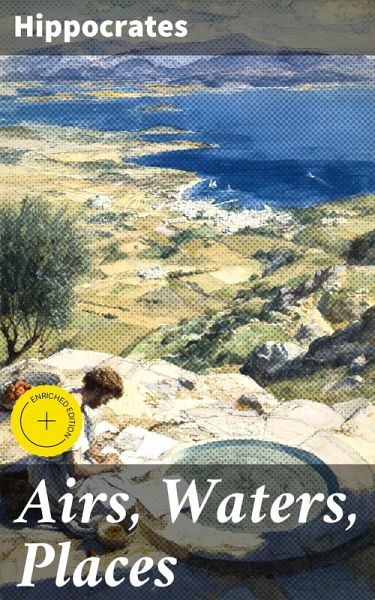
In "Airs, Waters, Places," Hippocrates, often hailed as the father of medicine, presents a profound exploration of the environmental influences on health and disease. Written in a precise yet poetic style characteristic of ancient Greek prose, this seminal work emphasizes the interrelationship between the physical environment and human health. Hippocrates meticulously discusses how factors such as climate, water quality, and geographical location shape the constitution and prevalence of illnesses, laying the groundwork for subsequent medical thought and environmental health studies in both ancient and modern contexts. Hippocrates, born around 460 BCE on the island of Kos, was immersed in a time when early medical practices were beginning to diverge from superstition and theology towards empirical observation and rationality. His experiences observing the effects of environment on health, likely influenced by both local practices and the diverse cultures he encountered, fueled his desire to catalog and understand health determinants systematically, representing a significant shift in medical philosophy. For readers intrigued by the intersection of environment and health, "Airs, Waters, Places" is an essential text that illuminates the origins of medicine and environmental sciences. Its relevance endures, provoking thoughtful reflection on current discussions surrounding public health and environmental policy. In this enriched edition, we have carefully created added value for your reading experience: - A succinct Introduction situates the work's timeless appeal and themes. - The Synopsis outlines the central plot, highlighting key developments without spoiling critical twists. - A detailed Historical Context immerses you in the era's events and influences that shaped the writing. - An Author Biography reveals milestones in the author's life, illuminating the personal insights behind the text. - A thorough Analysis dissects symbols, motifs, and character arcs to unearth underlying meanings. - Reflection questions prompt you to engage personally with the work's messages, connecting them to modern life. - Hand-picked Memorable Quotes shine a spotlight on moments of literary brilliance. - Interactive footnotes clarify unusual references, historical allusions, and archaic phrases for an effortless, more informed read.
Dieser Download kann aus rechtlichen Gründen nur mit Rechnungsadresse in A, B, BG, CY, CZ, D, DK, EW, E, FIN, F, GR, H, IRL, I, LT, L, LR, M, NL, PL, P, R, S, SLO, SK ausgeliefert werden.