Sie sind bereits eingeloggt. Klicken Sie auf 2. tolino select Abo, um fortzufahren.
Bitte loggen Sie sich zunächst in Ihr Kundenkonto ein oder registrieren Sie sich bei bücher.de, um das eBook-Abo tolino select nutzen zu können.
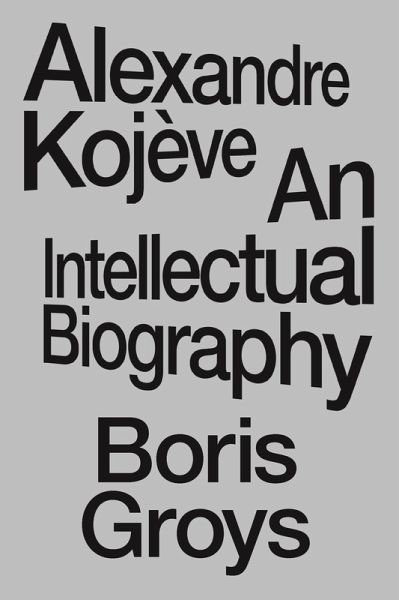
In this intellectual biography, critic and philosopher Boris Groys turns to the Arthur Rimbaud of modern bureaucracy, Alexandre Koj¿ve, a philosopher of little-known writings and profound influence. Koj¿ve was fascinated with Hegel's dialectics and with communism and envisioned a universal empire as the end of history. Koj¿ve drew on Buddhism and also proclaimed himself a Stalinist. At the same time, he was one of the creators of a nascent European Union. His concept of the human as something defined by negation and unique among animals in being separated from nature is highly political. It…mehr
In this intellectual biography, critic and philosopher Boris Groys turns to the Arthur Rimbaud of modern bureaucracy, Alexandre Koj¿ve, a philosopher of little-known writings and profound influence. Koj¿ve was fascinated with Hegel's dialectics and with communism and envisioned a universal empire as the end of history. Koj¿ve drew on Buddhism and also proclaimed himself a Stalinist. At the same time, he was one of the creators of a nascent European Union. His concept of the human as something defined by negation and unique among animals in being separated from nature is highly political. It explains why humans can never be fully satisfied by a political system based on their allegedly 'natural' rights.
Groys reveals a Koj¿ve with a unique perspective on our political capacities and human condition.
Dieser Download kann aus rechtlichen Gründen nur mit Rechnungsadresse in A, D ausgeliefert werden.
Die Herstellerinformationen sind derzeit nicht verfügbar.
Autorenporträt
Boris Groys is Professor of Aesthetics, Art History, and Media Theory at the Center for Art and Media Technology in Karlsruhe, and since 2005, the Global Distinguished Professor in the Faculty of Arts and Science, NYU. He has published numerous books including The Total Art of Stalinism, Ilya Kabakov: The Man Who Flew into Space from His Apartment, Art Power, and The Communist Postscript.
Inhaltsangabe
Introduction: What does it mean to be human?
I. History as Self-Negation 1. Struggle for Recognition 2. The Self-Reflection 3. The Anthropogenic Desire
II. From Sophia to Stalin and Back 1. Political Androgyny 2. Paradisal Work 3. Napoleon 4. Stalin 5. The Sage 6. The Working State 7. History as Magic
III. The Giving Empire 1. The Christian Empire 2. The Ideocratic State 3. The Latin Empire 4. Colonialism and the Giving Empire 5. Bataille and Marshall Plan
IV. Becoming a Sage 1. Painting the Totality 2. Visualization of Logos
Epilogue: How to remain human after the End of History?
I. History as Self-Negation 1. Struggle for Recognition 2. The Self-Reflection 3. The Anthropogenic Desire
II. From Sophia to Stalin and Back 1. Political Androgyny 2. Paradisal Work 3. Napoleon 4. Stalin 5. The Sage 6. The Working State 7. History as Magic
III. The Giving Empire 1. The Christian Empire 2. The Ideocratic State 3. The Latin Empire 4. Colonialism and the Giving Empire 5. Bataille and Marshall Plan
IV. Becoming a Sage 1. Painting the Totality 2. Visualization of Logos
Epilogue: How to remain human after the End of History?
Es gelten unsere Allgemeinen Geschäftsbedingungen: www.buecher.de/agb
Impressum
www.buecher.de ist ein Internetauftritt der buecher.de internetstores GmbH
Geschäftsführung: Monica Sawhney | Roland Kölbl | Günter Hilger
Sitz der Gesellschaft: Batheyer Straße 115 - 117, 58099 Hagen
Postanschrift: Bürgermeister-Wegele-Str. 12, 86167 Augsburg
Amtsgericht Hagen HRB 13257
Steuernummer: 321/5800/1497
USt-IdNr: DE450055826