61,95 €
61,95 €
inkl. MwSt.
Sofort per Download lieferbar

31 °P sammeln
61,95 €
Als Download kaufen
61,95 €
inkl. MwSt.
Sofort per Download lieferbar
31 °P sammeln
Jetzt verschenken
Alle Infos zum eBook verschenken
61,95 €
inkl. MwSt.
Sofort per Download lieferbar
Alle Infos zum eBook verschenken
31 °P sammeln

Andere Kunden interessierten sich auch für
") Alternative Food Networks (eBook, PDF)61,95 €
Alternative Food Networks (eBook, PDF)61,95 €") Event Portfolio Planning and Management (eBook, ePUB)56,95 €
Event Portfolio Planning and Management (eBook, ePUB)56,95 €") The Routledge Handbook of Mobilities (eBook, ePUB)51,95 €
The Routledge Handbook of Mobilities (eBook, ePUB)51,95 €") Justice and Tourism (eBook, ePUB)41,95 €
Justice and Tourism (eBook, ePUB)41,95 €") Moral Encounters in Tourism (eBook, ePUB)51,95 €
Moral Encounters in Tourism (eBook, ePUB)51,95 €") Responsible Tourist Behaviour (eBook, ePUB)47,95 €
Responsible Tourist Behaviour (eBook, ePUB)47,95 €") Micro-Clusters and Networks (eBook, ePUB)52,95 €
Micro-Clusters and Networks (eBook, ePUB)52,95 €






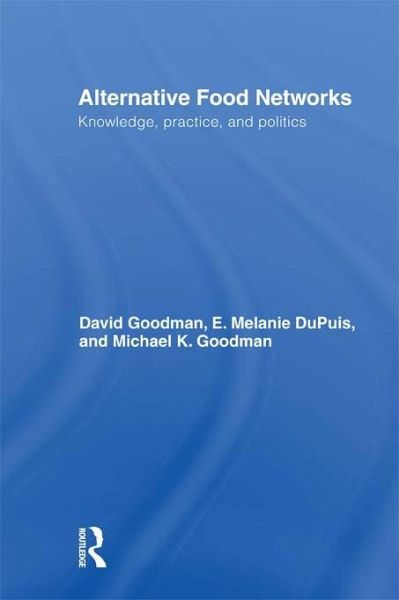
Farmers' markets, veggie boxes, local foods, organic products and Fair Trade goods - how have these once novel, "alternative" foods, and the people and networks supporting them, become increasingly familiar features of everyday consumption? Are the visions of "alternative worlds" built on ethics of sustainability, social justice, animal welfare and the aesthetic values of local food cultures and traditional crafts still credible now that these foods crowd supermarket shelves and other "mainstream" shopping outlets?
This timely book provides a critical review of the growth of alternative food networks and their struggle to defend their ethical and aesthetic values against the standardizing pressures of the corporate mainstream with its "placeless and nameless" global supply networks. It explores how these alternative movements are "making a difference" and their possible role as fears of global climate change and food insecurity intensify. It assesses the different experiences of these networks in three major arenas of food activism and politics: Britain and Western Europe, the United States, and the global Fair Trade economy. This comparative perspective runs throughout the book to fully explore the progressive erosion of the interface between alternative and mainstream food provisioning. As the era of "cheap food" draws to a close, analysis of the limitations of market-based social change and the future of alternative food economies and localist food politics place this book at the cutting-edge of the field.
The book is thoroughly informed by contemporary social theory and interdisciplinary social scientific scholarship, formulates an integrative social practice framework to understand alternative food production-consumption, and offers a unique geographical reach in its case studies.
This timely book provides a critical review of the growth of alternative food networks and their struggle to defend their ethical and aesthetic values against the standardizing pressures of the corporate mainstream with its "placeless and nameless" global supply networks. It explores how these alternative movements are "making a difference" and their possible role as fears of global climate change and food insecurity intensify. It assesses the different experiences of these networks in three major arenas of food activism and politics: Britain and Western Europe, the United States, and the global Fair Trade economy. This comparative perspective runs throughout the book to fully explore the progressive erosion of the interface between alternative and mainstream food provisioning. As the era of "cheap food" draws to a close, analysis of the limitations of market-based social change and the future of alternative food economies and localist food politics place this book at the cutting-edge of the field.
The book is thoroughly informed by contemporary social theory and interdisciplinary social scientific scholarship, formulates an integrative social practice framework to understand alternative food production-consumption, and offers a unique geographical reach in its case studies.
Dieser Download kann aus rechtlichen Gründen nur mit Rechnungsadresse in A, B, BG, CY, CZ, D, DK, EW, E, FIN, F, GR, HR, H, IRL, I, LT, L, LR, M, NL, PL, P, R, S, SLO, SK ausgeliefert werden.
"All serious analysts of modern food systems would do well to read this book. It is a magisterial volume, casting a critical yet sympathetic eye over the West's struggle to decide what a better food future might look like. Drawing on decades of research and experience, the authors generously review and make sense of hundreds of studies. This is academic and public musing of the very highest quality - exactly the kind of thinking which today's pressurised academics do too little of, in the rush to win grants, write papers, and score points. The authors not only give us one of the best books on food I have read, but provide a timely policy intervention. How good are alternative food projects, experiments and political debates? Are they really altering mass food reality? What theories and political frameworks make sense in a world where stark inequalities of land, capital, labour and consumption fit so uneasily with environmental fragility, health distortions, and fissured social existence? Never dismissive, they help us all refine one of the most important tasks facing the world in the 21st century: what is a good food system? How can we get it? What are the lessons of experimentation thus far? For certain, it's not what we have now." - Tim Lang, Professor of Food Policy, City University London, UK
"Wondering if we can shop our way to a better society? Can an ethically clean plate save the planet? Is conscientious consumption the ticket to a healthier, more equitable future? 'Alternative Food Networs' offers complex, challenging answers for those tired of simplistic, market-based formulas." - Warren Belasco, author of Appetite for Change: How the Counterculture Took on the Food Industry
"...Alternative Food Networks is a theoretically rich and cogent book, extremely valuable for scholars and those working to change the place of food in politics, practices and everyday lives. One of its main strengths is surely the vast and comprehensive overview of the most relevant literature on AFNs, both those originating in Western Europe and the USA. In addition, due to its capability to address and thoughtfully debate the numerous issues concerning these forms of alternative economy, Alternative Food Networks can be considered an essential book for academics and activists. Finally, this book can help undergraduates and graduates to better understand the significance of the economic and cultural spaces created by AFNs and the underlying problematic. The book also better defines the role of different social science disciplines in the solution of these main problems and delineates the core lines of future research." - Riccardo Vecchio, Department of Agricultural Sciences, University of Naples
"Wondering if we can shop our way to a better society? Can an ethically clean plate save the planet? Is conscientious consumption the ticket to a healthier, more equitable future? 'Alternative Food Networs' offers complex, challenging answers for those tired of simplistic, market-based formulas." - Warren Belasco, author of Appetite for Change: How the Counterculture Took on the Food Industry
"...Alternative Food Networks is a theoretically rich and cogent book, extremely valuable for scholars and those working to change the place of food in politics, practices and everyday lives. One of its main strengths is surely the vast and comprehensive overview of the most relevant literature on AFNs, both those originating in Western Europe and the USA. In addition, due to its capability to address and thoughtfully debate the numerous issues concerning these forms of alternative economy, Alternative Food Networks can be considered an essential book for academics and activists. Finally, this book can help undergraduates and graduates to better understand the significance of the economic and cultural spaces created by AFNs and the underlying problematic. The book also better defines the role of different social science disciplines in the solution of these main problems and delineates the core lines of future research." - Riccardo Vecchio, Department of Agricultural Sciences, University of Naples