Sie sind bereits eingeloggt. Klicken Sie auf 2. tolino select Abo, um fortzufahren.
Bitte loggen Sie sich zunächst in Ihr Kundenkonto ein oder registrieren Sie sich bei bücher.de, um das eBook-Abo tolino select nutzen zu können.
This book, the latest in the Seminar Studies in History series, examines the movement to abolish slavery in the US, from the origins of the movement in the eighteenth century through to the Civil War and the abolition of slavery in 1865. Books in this Seminar Studies in History series bridge the gap between textbook and specialist survey and consists of a brief "Introduction" and/or "Background" to the subject, valuable in bringing the reader up-to-speed on the area being examined, followed by a substantial and authoritative section of "Analysis" focusing on the main themes and issues. There…mehr
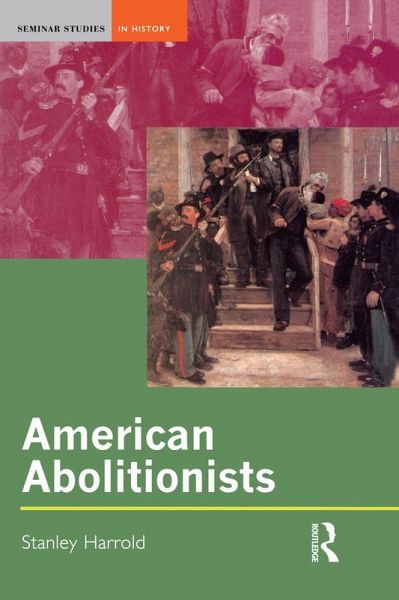
This book, the latest in the Seminar Studies in History series, examines the movement to abolish slavery in the US, from the origins of the movement in the eighteenth century through to the Civil War and the abolition of slavery in 1865. Books in this Seminar Studies in History series bridge the gap between textbook and specialist survey and consists of a brief "Introduction" and/or "Background" to the subject, valuable in bringing the reader up-to-speed on the area being examined, followed by a substantial and authoritative section of "Analysis" focusing on the main themes and issues. There is a succinct "Assessment" of the subject, a generous selection of "Documents" and a detailed bibliography. Stanley Harrold provides an accessible introduction to the subject, synthesizing the enormous amount of literature on the topic. American Abolitionists explores "the roles of slaves and free blacks in the movement, the importance of empathy among antislavery whites for the suffering slaves, and the impact of abolitionism upon the sectional struggle between the North and the South". Within a basic chronological framework the author also considers more general themes such as black abolitionists, feminism, and anti-slavery violence. For readers interested in American history.
Dieser Download kann aus rechtlichen Gründen nur mit Rechnungsadresse in A, B, BG, CY, CZ, D, DK, EW, E, FIN, F, GR, HR, H, IRL, I, LT, L, LR, M, NL, PL, P, R, S, SLO, SK ausgeliefert werden.
Die Herstellerinformationen sind derzeit nicht verfügbar.
Autorenporträt
Stanley Harrold is Professor of History at South Carolina State University and author of The Abolitionists and the South.
Inhaltsangabe
Part 1 Introduction Chapter 1 The Abolitionists in American History Part 2 Analysis Chapter 2 Early Abolitionism Chapter 3 The Rise of Immediatism Chapter 4 Abolitionists and Gender Chapter 5 Abolitionists and Race Chapter 6 A More Aggressive Abolitionism Chapter 7 Violent Abolitionism Chapter 8 Abolitionists and Black Freedom Part 3 Assessment Chapter 9 Abolitionists and the Reform Tradition Part 4 Documents Chapter 10 Document 1 John Woolman Warns Slaveholders, 1762 Chapter 11 Document 2 Boston Slaves Petition Foe Feeedom, 1773 Chapter 12 Document 3 A Black Abolitionist Calls on Congress to Take Action Against Slavery, 1797 Chapter 13 Document 4 David Walker Calls on African Americans to Seek Freedom, 1829 Chapter 14 Document 5 William Lloyd Gaeeisom Begins the Liberator, 1831 Chapter 15 Document 6 Declaration of Sentiments of the American Anti-Slavery Society, 1833 Chapter 16 Document 7 Lydia Maria Child on the Impact of Abolitionism on the South, 1833 Chapter 17 Document 8 Angelina Grimke Appeals to White Women of the South on Behalf of Emancipation, 1836 Chapter 18 Document 9 Elijah P. Lovejoy Advocates Defensive Violence, 1837 Chapter 19 Document 10 Gerrit Smith Calls on Slaves to Escape and on Abolitionists to Help Them, 1842 Chapter 20 Document 11 Henry Highland Garnet Calls on Slaves to Challenge Their Masters, 1843 Chapter 21 Document 12 Cassius M. Clay on the Sinfulness of Slavery, 1845 Chapter 22 Document 13 Gamaliel Bailey Introduces His National Era to a Southern White Audience, 1847 Chapter 23 Document 14 Frederick Douglass Comments on the First Women's Rights Convention, 1848 Chapter 24 Document 15 Sojourner Truth on Women's Rights, 1851 Chapter 25 Document 16 Franklim B. Sanborn Presents John Brown's Violent Commitment to Equal Rights, 1857-59 Chapter 26 Document 17 Wendell Phillips Reflects on the Election of Abraham Lincoln, 1860 Chapter 27 Document 18 Frederick Douglass Urges Black Men to Enlist in a Union War for Emancipation, 1863
Es gelten unsere Allgemeinen Geschäftsbedingungen: www.buecher.de/agb
Impressum
www.buecher.de ist ein Internetauftritt der buecher.de internetstores GmbH
Geschäftsführung: Monica Sawhney | Roland Kölbl | Günter Hilger
Sitz der Gesellschaft: Batheyer Straße 115 - 117, 58099 Hagen
Postanschrift: Bürgermeister-Wegele-Str. 12, 86167 Augsburg
Amtsgericht Hagen HRB 13257
Steuernummer: 321/5800/1497
USt-IdNr: DE450055826