37,95 €
37,95 €
inkl. MwSt.
Sofort per Download lieferbar

19 °P sammeln
37,95 €
Als Download kaufen
37,95 €
inkl. MwSt.
Sofort per Download lieferbar
19 °P sammeln
Jetzt verschenken
Alle Infos zum eBook verschenken
37,95 €
inkl. MwSt.
Sofort per Download lieferbar
Alle Infos zum eBook verschenken
19 °P sammeln

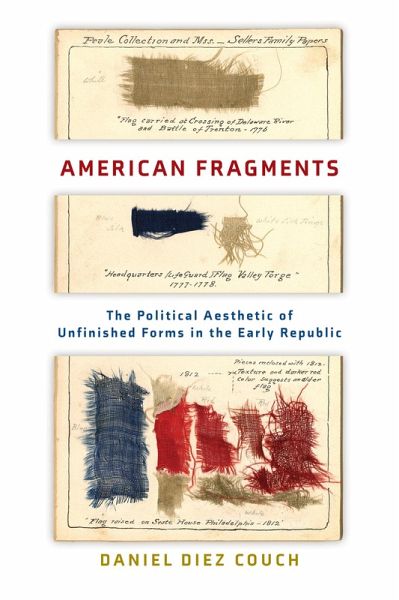
In the years between the independence of the colonies from Britain and the start of the Jacksonian age, American readers consumed an enormous number of literary texts called "fragments." American Fragments recovers this archive of the romantic period to raise a set of pressing questions about the relationship between aesthetic and national realities: What kind of artistic creation was a fragment?, And how and why did deliberately unfinished writing emerge alongside a country that was itself still unfinished?
Through discussions of eighteenth-century transatlantic aesthetics, the Revolutionary War, seduction novels, religious culture, and the construction of authorship, Daniel Diez Couch argues that the literary fragment was used as a means of representing individuals who did not fit neatly into the social fabric of the nation: beggars, prostitutes, veterans, and other ostracized figures. These individuals did not have a secure place in designs for the country's future, yet writers wielded the artistic form of the fragment as an apparatus for surveying their disputed positionality. Time and again, fragments asked what kind of identity marginalized individuals had, and how fictionalized versions of their life stories influenced the sociopolitical circumstances of the emergent nation. In their most progressive moments, the writers of fragments depicted their subjects as being "in process," opting for a fluid version of the self instead of the bounded and coherent one typically hailed as the liberal individual.
Traversing aesthetics, political philosophy, material culture, and history, American Fragments gives new life to a literary form that at once played a significant role in the print ecology of the early republic, and that endures in the works of modernist and postmodernist writers and artists.
Through discussions of eighteenth-century transatlantic aesthetics, the Revolutionary War, seduction novels, religious culture, and the construction of authorship, Daniel Diez Couch argues that the literary fragment was used as a means of representing individuals who did not fit neatly into the social fabric of the nation: beggars, prostitutes, veterans, and other ostracized figures. These individuals did not have a secure place in designs for the country's future, yet writers wielded the artistic form of the fragment as an apparatus for surveying their disputed positionality. Time and again, fragments asked what kind of identity marginalized individuals had, and how fictionalized versions of their life stories influenced the sociopolitical circumstances of the emergent nation. In their most progressive moments, the writers of fragments depicted their subjects as being "in process," opting for a fluid version of the self instead of the bounded and coherent one typically hailed as the liberal individual.
Traversing aesthetics, political philosophy, material culture, and history, American Fragments gives new life to a literary form that at once played a significant role in the print ecology of the early republic, and that endures in the works of modernist and postmodernist writers and artists.
Dieser Download kann aus rechtlichen Gründen nur mit Rechnungsadresse in A, D ausgeliefert werden.