Sie sind bereits eingeloggt. Klicken Sie auf 2. tolino select Abo, um fortzufahren.
Bitte loggen Sie sich zunächst in Ihr Kundenkonto ein oder registrieren Sie sich bei bücher.de, um das eBook-Abo tolino select nutzen zu können.
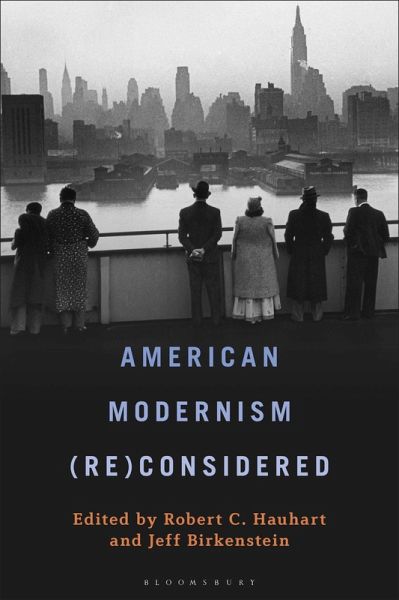
What exactly is modernism and who are modernist writers? What distinguishes American modernism from its European counterpart? American Modernism (Re)Considered questions the principal distinction between modernism and other genres/movements/styles in literature through new critical readings of canonical modernist texts alongside texts which pose a problem for modernism due to their ambiguous, if not marginal, relation to some of its predominant tenets. It asks: Is modernism characterized principally by a transition from older forms (like naturalism and realism) to a style that is new,…mehr
What exactly is modernism and who are modernist writers? What distinguishes American modernism from its European counterpart? American Modernism (Re)Considered questions the principal distinction between modernism and other genres/movements/styles in literature through new critical readings of canonical modernist texts alongside texts which pose a problem for modernism due to their ambiguous, if not marginal, relation to some of its predominant tenets. It asks: Is modernism characterized principally by a transition from older forms (like naturalism and realism) to a style that is new, innovative, and experimental? Is it found in shared understandings and alignments regarding the nature and purpose of art? Is it identifiable by modernists' treatment of various central themes - including as a reaction to modernity; as a response to the Boer and World wars; as an interrogation of Britain's empire and its dissolution - and how these events fragmented modern life? Or is it all of the above? Contributors discuss a wide range of texts - by authors such as Nella Larsen, Willa Cather, Charlotte Perkins Gilman, Anne Carson, Wallace Stevens, Américo Paredes, Richard Wright, Ernest Hemingway, and T. S. Eliot - to challenge the aesthetic, social, and temporal boundaries of modernism in America. Through original close readings of these texts, American Modernism (Re)Considered subjects modernism to new interrogations and offers new answers to questions that remain contemporary even as they harken back to its height of popularity and interest in the mid-1920s.
Die Herstellerinformationen sind derzeit nicht verfügbar.
Autorenporträt
Jeff Birkenstein is Assistant Professor of English at Centralia College, USA. His publications include The Cinema of Terry Gilliam: It's a Mad World (2013) and Reframing 9/11: Film, Popular Culture and the "War on Terror" (Bloomsbury, 2010). Robert C. Hauhart, Ph.D., J.D. is Professor in the Department of Society and Social Justice at Saint Martin's University, USA. He is the author or editor of ten books, including Food and the American Dream in American Literature (forthcoming), The Lonely Quest: Constructing the Self in 21st Century American Life (2019), and Social Justice in American Literature (2017).
Inhaltsangabe
List of Figures Acknowledgments Introduction: Modernism/Not Modernism Robert C. Hauhart, Saint Martin's University, USA Part I: A Preoccupation with Language and Interiority 1. Was Hemingway a Modernist? Disenchantment, Interiority, and Stream of Consciousness in His 1920s European Novels Robert C. Hauhart, Saint Martin's University, USA 2. Nella Larson and the Interior Lives of African American Women in Passing and Quicksand Kimberly Smith, Elizabeth City State University, USA 3. Loss and Mourning in Fitzgerald's The Great Gatsby and Tender Is the Night Rossie Artemis, University of Nicosia, Cyprus Part II: Collisions of Race, Ethnicity, and Nationality 4. "You've found that out too": Modernism in Jessie Redmon Fauset's Plum Bun Andrea Tinnemeyer, The College Preparatory School, USA 5. The Strange Career of Coleman Silk: The Human Stain as Jim Crow Narrative Durthy Washington, LitUnlocked LLC, USA 6. Mexican-American Generation Authors on the U.S. Color Line Melanie Hernandez, California State University, Fresno, USA 7. 400 Years of Apocalyptic Rage: New Modernist Depictions of Racial Justice in the Last Novels of Richard Wright and Chester Himes Kimberly Drake, Scripps College, USA Part III: Forms of Performance, Artistic Expression, and Literary Images 8. Revisiting Langston Hughes' Modernist Poetry Asma Dhouioui, University of Carthage, Tunisia 9. "The still point of the turning world" in T. S. Eliot's Four Quartets as a Key to Modernist Literature Inspired by the String Quartet Kiyoko Magome, University of Tsukuba, Japan 10. "The image of one fatal word": Verbal-Visual Crisscrossings in e.e. cummings' Experimental Modernism Bowen Wang, Shanghai Jiao Tong University, China 11. Images Reimagined: Modernist Photography, and the Short Story Jeff Birkenstein, Centralia College, USA and Ericka Birkenstein, Independent Scholar, USA Part IV: Transitioning: Expectations, Explorations, and Genders 12. The Betrayals of Passing Luis Alberto Cortés, Texas A&M University-Kingsville, USA 13. Modernism's Ghostly Men David Magill, Longwood University, USA 14. Reconstructed Citizen Ladies: Celia Madden and Edna Pontellier as Precursors to Modernism and Modernity Richmond Adams, Independent Scholar, USA 15. Modernism and the Quantified Self in Edith Wharton's Twilight Sleep Molly Mann, State University of New York, Stony Brook, USA 16. "Makings of the Sun": Phenomenal Perception in Stevens, Merleau-Ponty, and Anne Carson's Ancient Greek Poets Angus Cleghorn, Seneca Polytechnic, Canada Notes on Contributors Index
Es gelten unsere Allgemeinen Geschäftsbedingungen: www.buecher.de/agb
Impressum
www.buecher.de ist ein Internetauftritt der buecher.de internetstores GmbH
Geschäftsführung: Monica Sawhney | Roland Kölbl | Günter Hilger
Sitz der Gesellschaft: Batheyer Straße 115 - 117, 58099 Hagen
Postanschrift: Bürgermeister-Wegele-Str. 12, 86167 Augsburg
Amtsgericht Hagen HRB 13257
Steuernummer: 321/5800/1497
USt-IdNr: DE450055826