154,95 €
inkl. MwSt.
Sofort per Download lieferbar
77 °P sammeln

Andere Kunden interessierten sich auch für
") The Reception of Byzantium in European Culture since 1500 (eBook, ePUB)45,95 €
The Reception of Byzantium in European Culture since 1500 (eBook, ePUB)45,95 €") An Empire of Elites (eBook, PDF)154,95 €
An Empire of Elites (eBook, PDF)154,95 €") Dreaming in Byzantium and Beyond (eBook, ePUB)42,95 €
Dreaming in Byzantium and Beyond (eBook, ePUB)42,95 €") Our Man In Tokyo (eBook, ePUB)15,99 €
Our Man In Tokyo (eBook, ePUB)15,99 €") Rejected Princesses (eBook, ePUB)24,60 €
Rejected Princesses (eBook, ePUB)24,60 €") Miss Anne in Harlem (eBook, ePUB)8,99 €
Miss Anne in Harlem (eBook, ePUB)8,99 €") Pevsner: The Complete Broadcast Talks (eBook, ePUB)51,95 €
Pevsner: The Complete Broadcast Talks (eBook, ePUB)51,95 €







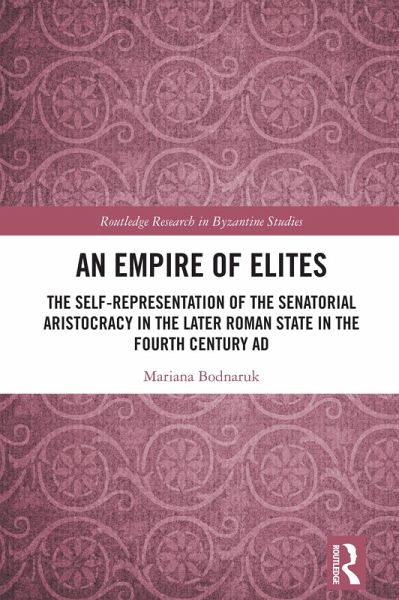
Empire of Elites investigates the self-representation of the late Roman senatorial aristocracy in epigraphic evidence to illuminate the cultural, social, and political dynamics of the Later Roman Empire. In the Roman hierarchy, the senatorial order stood above all social strata. By examining aristocratic inscriptions and materiality - supplemented by art identified as senatorial and contextualized within contemporary literature - the study situates the self-image of the empire's highest-ranking elites within the broader context of fourth-century imperial society.
Arguing that the ideological portrayals of the late antique aristocracy reflect an artistic perception of social totality in cultural form, the book moves beyond analyses of elite dominance in the imperial state to address wider cultural and social transformations as mediated through epigraphy and art. It explores how the late imperial rule transformed the role of senators in governance, drawing on archaeological, inscriptional, and textual evidence to reveal the political, social, and cultural impact of transregional senatorial officeholders. This study demonstrates how the integrated relationship between state and aristocracy shaped the administration and government of the empire, offering new insights into the interplay of power, representation, and culture in the late Roman world.
This book will appeal to scholars and students of Roman political and cultural history, administrative elites, institutional evolution, and the comparative study of premodern government. It will also be of interest to specialists in Latin and Greek epigraphy and literature, as well as late antique art, providing a multidisciplinary perspective on the social imagination and cultural expression of the late Roman aristocracy.
Arguing that the ideological portrayals of the late antique aristocracy reflect an artistic perception of social totality in cultural form, the book moves beyond analyses of elite dominance in the imperial state to address wider cultural and social transformations as mediated through epigraphy and art. It explores how the late imperial rule transformed the role of senators in governance, drawing on archaeological, inscriptional, and textual evidence to reveal the political, social, and cultural impact of transregional senatorial officeholders. This study demonstrates how the integrated relationship between state and aristocracy shaped the administration and government of the empire, offering new insights into the interplay of power, representation, and culture in the late Roman world.
This book will appeal to scholars and students of Roman political and cultural history, administrative elites, institutional evolution, and the comparative study of premodern government. It will also be of interest to specialists in Latin and Greek epigraphy and literature, as well as late antique art, providing a multidisciplinary perspective on the social imagination and cultural expression of the late Roman aristocracy.
Dieser Download kann aus rechtlichen Gründen nur mit Rechnungsadresse in A, B, BG, CY, CZ, D, DK, EW, E, FIN, F, GR, HR, H, IRL, I, LT, L, LR, M, NL, PL, P, R, S, SLO, SK ausgeliefert werden.