71,95 €
inkl. MwSt.
Sofort per Download lieferbar
36 °P sammeln

Andere Kunden interessierten sich auch für
") Introduction to Probability Models (eBook, ePUB)61,95 €
Introduction to Probability Models (eBook, ePUB)61,95 €") Stochastic Models in Queueing Theory (eBook, ePUB)65,95 €
Stochastic Models in Queueing Theory (eBook, ePUB)65,95 €") Introduction to Probability Models (eBook, ePUB)61,95 €
Introduction to Probability Models (eBook, ePUB)61,95 €") Stochastic Differential Equations for Science and Engineering (eBook, ePUB)104,95 €
Stochastic Differential Equations for Science and Engineering (eBook, ePUB)104,95 €") Point Processes and Their Statistical Inference (eBook, ePUB)48,95 €
Point Processes and Their Statistical Inference (eBook, ePUB)48,95 €") Introduction to Probability Models (eBook, ePUB)91,95 €
Introduction to Probability Models (eBook, ePUB)91,95 €") Time Series Analysis: Methods and Applications (eBook, ePUB)142,95 €
Time Series Analysis: Methods and Applications (eBook, ePUB)142,95 €

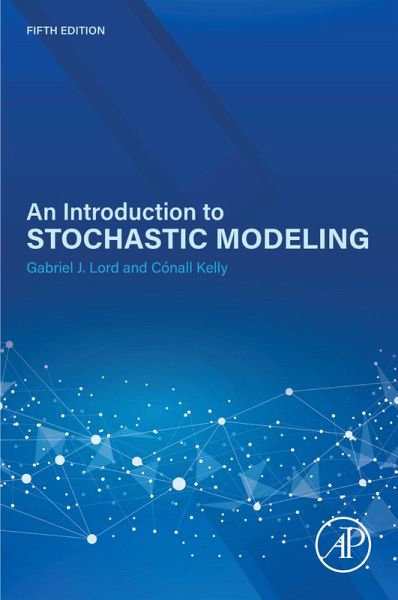
An Introduction to Stochastic Modeling, Fifth Edition bridges the gap between basic probability and an intermediate level course in stochastic processes, serving as the foundation for either a one-semester or two-semester course in stochastic processes for students familiar with elementary probability theory and calculus. The objectives are to introduce students to the standard concepts and methods of stochastic modeling, to illustrate the rich diversity of applications of stochastic processes in the applied sciences, and to provide an integrated treatment of theory, applications and practical implementation. A well-regarded resource for many years, the text is an ideal foundation for a broad range of students. - Explores realistic applications from a variety of disciplines, including biological, chemical, physical, engineering, and financial examples - Presents a completely new treatment of modeling with stochastic differential equations, and expanded coverage of Brownian motion and martingale processes - New applications of Markov chains to the simulation of chemical reactions via the Gillespie algorithm and to Bayesian inference via the Metropolis-Hastings algorithm - Provides extensive end-of-section exercises sets with answers, as well as numerical illustrations - Each chapter concludes with a section focusing on computational examples, code, and exercises that will empower students to explore concepts in a practical way - Offers online support, sample code and solutions to coding problems for instructors, and electronic access to sample Python code for students
Dieser Download kann aus rechtlichen Gründen nur mit Rechnungsadresse in A, B, BG, CY, CZ, D, DK, EW, E, FIN, F, GR, HR, H, IRL, I, LT, L, LR, M, NL, PL, P, R, S, SLO, SK ausgeliefert werden.