52,95 €
inkl. MwSt.
Sofort per Download lieferbar
26 °P sammeln

Andere Kunden interessierten sich auch für
") Performance Evaluation and Benchmarking of Intelligent Systems (eBook, PDF)112,95 €
Performance Evaluation and Benchmarking of Intelligent Systems (eBook, PDF)112,95 €") Bayesian Modeling of Uncertainty in Low-Level Vision (eBook, PDF)72,95 €
Bayesian Modeling of Uncertainty in Low-Level Vision (eBook, PDF)72,95 €") Three-Dimensional Machine Vision (eBook, PDF)232,95 €
Three-Dimensional Machine Vision (eBook, PDF)232,95 €") Biomimicry for Optimization, Control, and Automation (eBook, PDF)68,95 €
Biomimicry for Optimization, Control, and Automation (eBook, PDF)68,95 €") System Modelling and Optimization (eBook, PDF)232,95 €
System Modelling and Optimization (eBook, PDF)232,95 €") Computational Geometry (eBook, PDF)40,95 €
Computational Geometry (eBook, PDF)40,95 €") Design by Composition for Rapid Prototyping (eBook, PDF)72,95 €
Design by Composition for Rapid Prototyping (eBook, PDF)72,95 €
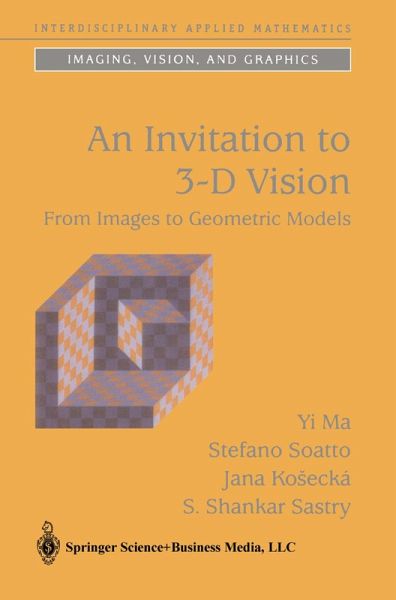
This book is intended to give undergraduate and beginning graduate students and researchers in computer vision, applied mathematics, robotics, and computer graphics a self-contained introduction to the geometry of 3D vision. Exercises are provided at the end of each chapter.
Dieser Download kann aus rechtlichen Gründen nur mit Rechnungsadresse in A, B, BG, CY, CZ, D, DK, EW, E, FIN, F, GR, HR, H, IRL, I, LT, L, LR, M, NL, PL, P, R, S, SLO, SK ausgeliefert werden.
From the reviews: "Computer vision is invading our daily lives ... . Covering all the aspects would be too vast an area to cover in one book, so here, the authors concentrated on the specific goal of recovering the geometry of a 3D object ... . The 22 pages of references form a good guide to the literature. The authors found an excellent balance between a thorough mathematical treatment and the applications themselves. ... the text will be a pleasure to read for students ... ." (Adhemar Bultheel, Bulletin of the Belgian Mathematical Society, Vol. 12 (2), 2005) "This is primarily a textbook of core principles, taking the reader from the most basic concepts of machine vision ... to detailed applications, such as autonomous vehicle navigation. ... It is a clearly written book ... . Everything that is required is introduced ... . an entirely self-contained work. ... The book is aimed at graduate or advanced undergraduate students in electrical engineering, computer science, applied mathematics, or indeed anyone interested in machine vision ... . is highly recommended." (D.E. Holmgren, The Photogrammetric Record, 2004) "This very interesting book is a great book teaching how to go from two-dimensional (2D)-images to three-dimensional (3D)-models of the geometry of a scene. ... A good part of this book develops the foundations of an appropriate mathematical approach necessary for solving those difficult problems. ... Exercises (drill exercises, advanced exercises and programming exercises) are provided at the end of each chapter." (Hans-Dietrich Hecker, Zentralblatt MATH, Vol. 1043 (18), 2004) "This book gives senior undergraduate and beginning graduate students and researchers in computer vision, applied mathematics, computer graphics, and robotics a self-contained introduction to the geometry of 3D vision. That is the reconstruction of 3D models of objects from a collection of 2D images. ... Exercises are provided at the end of each chapter. Software for examples and algorithms are available on the author's website." (Daniel Leitner, Simulation News Europe, Vol. 16 (1), 2006)