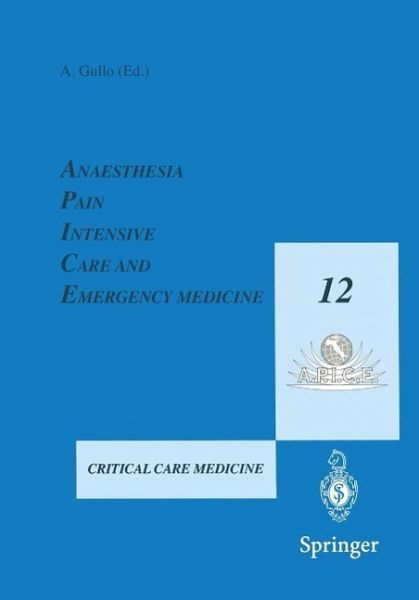
Anaesthesia, Pain, Intensive Care and Emergency Medicine - A.P.I.C.E. (eBook, PDF)
Proceedings of the 12th Postgraduate Course in Critical Care Medicine Trieste, Italy - November 19-21, 1997
Redaktion: Gullo, Antonio
72,95 €
72,95 €
inkl. MwSt.
Sofort per Download lieferbar

36 °P sammeln
72,95 €
Als Download kaufen
72,95 €
inkl. MwSt.
Sofort per Download lieferbar
36 °P sammeln
Jetzt verschenken
Alle Infos zum eBook verschenken
72,95 €
inkl. MwSt.
Sofort per Download lieferbar
Alle Infos zum eBook verschenken
36 °P sammeln

Anaesthesia, Pain, Intensive Care and Emergency Medicine - A.P.I.C.E. (eBook, PDF)
Proceedings of the 12th Postgraduate Course in Critical Care Medicine Trieste, Italy - November 19-21, 1997
Redaktion: Gullo, Antonio
- Format: PDF
- Merkliste
- Auf die Merkliste
- Bewerten Bewerten
- Teilen
- Produkt teilen
- Produkterinnerung
- Produkterinnerung

Bitte loggen Sie sich zunächst in Ihr Kundenkonto ein oder registrieren Sie sich bei
bücher.de, um das eBook-Abo tolino select nutzen zu können.
Hier können Sie sich einloggen
Sie sind bereits eingeloggt. Klicken Sie auf 2. tolino select Abo, um fortzufahren.

Bitte loggen Sie sich zunächst in Ihr Kundenkonto ein oder registrieren Sie sich bei bücher.de, um das eBook-Abo tolino select nutzen zu können.
This work is an updated and thorough collection of material that deals with the management of critically ill patients. This discipline has, in the past few years, been at the forefront of development which continues to make progress with the support of basic and clinical research.
- Geräte: PC
- ohne Kopierschutz
- eBook Hilfe
- Größe: 68.25MB
Andere Kunden interessierten sich auch für
Anaesthesia, Pain, Intensive Care and Emergency Medicine - A.P.I.C.E. (eBook, PDF)112,95 €
Antonino GulloAnaesthesia, Pain, Intensive Care and Emergency Medicine - A.P.I.C.E. (eBook, PDF)72,95 €
Anaesthesia, Pain, Intensive Care and Emergency Medicine - A.P.I.C.E. (eBook, PDF)40,95 €
Anesthesia, Pain, Intensive Care and Emergency Medicine - A.P.I.C.E. (eBook, PDF)40,95 €
Anaesthesia, Pain, Intensive Care and Emergency Medicine - A.P.I.C.E. (eBook, PDF)72,95 €-
-
-
This work is an updated and thorough collection of material that deals with the management of critically ill patients. This discipline has, in the past few years, been at the forefront of development which continues to make progress with the support of basic and clinical research.
Dieser Download kann aus rechtlichen Gründen nur mit Rechnungsadresse in A, B, BG, CY, CZ, D, DK, EW, E, FIN, F, GR, HR, H, IRL, I, LT, L, LR, M, NL, PL, P, R, S, SLO, SK ausgeliefert werden.
Produktdetails
- Produktdetails
- Verlag: Springer Milan
- Seitenzahl: 712
- Erscheinungstermin: 6. Dezember 2012
- Englisch
- ISBN-13: 9788847022782
- Artikelnr.: 44064044
- Verlag: Springer Milan
- Seitenzahl: 712
- Erscheinungstermin: 6. Dezember 2012
- Englisch
- ISBN-13: 9788847022782
- Artikelnr.: 44064044
- Herstellerkennzeichnung Die Herstellerinformationen sind derzeit nicht verfügbar.
Experimental and Clinical Research in Shock.- Cytokine Activity in Experimental Sepsis.- Role of Nitric Oxide in Septic Shock.- Novel Approaches to Improve Tissue Oxygen Extraction Capabilities: Lessons Learned from Experimental Septic Shock Models.- Should Beta-Blockers Have a Place in the Treatment of Septic Shock?.- Respiratory Flow Limitation.- Relationship between Chronic Dyspnea and Expiratory Flow Limitation in Patients with COPD.- Pathophysiology of Flow Limitation.- Pharmacological Reversibility of Flow Limitation in COPD and Asthmatic Patients.- Respiratory Muscle Fatigue in COPD Patients.- Mechanical Ventilation.- Patient-Ventilator Interaction.- Spontaneous Breathing Trial with T-Tube.- Continuous Flow Systems.- Lung Damage by Artificial Ventilation - Proof by Radiological Techniques.- Barotrauma, Volume Trauma and Their Relation to FRC.- Iatrogenic Lung Damage by Artificial Ventilation: What Is the Role of the Pulmonary Surfactant System?.- Side Effects of Mechanical Ventilation: Molecular Mechanisms.- Physiological Rationale to Prevent Ventilation-Induced Lung Injury.- Iatrogenic Lung Damage by Artificial Ventilation - Clinical Confirmation.- Mechanical Ventilation in ARDS: What a Fine Mess!.- Rationale for Reduction of Alveolar Ventilation in ARDS.- Cardiovascular.- Perioperative Hypertension.- Therapy of Perioperative Myocardial Ischemia.- Selection of Patients for Invasive Haemodynamic Monitoring.- Anaesthetic Considerations for Major Cardiovascular Surgery.- Therapeutic Strategies in Patients Suffering from Myocardiopathy (Awaiting Transplantation).- Head Injuries.- Pathophysiology of Head Trauma.- Cerebral Edema in Brain Ischemia and Trauma.- Cerebral Blood Flow and Metabolism in Severe Head Injury.- Monitoring of Jugular Bulb Hemoglobin Oxygen Saturation (SjvO2).- Integrated Monitoring in Intensive Care Head Injured Patients.- Surgical Management of Severely Head Injured Patients.- Thermoregulation - Metabolism.- Heat Exchange.- Perioperative Hypothermia. Prevention and Treatment.- Alternative Strategies to Deal with Perioperative Hypothermia.- Hypothermia for Neuroprotection.- Metabolism after Injury: The Effects of G. H..- Kidney - Liver - Acid-Base Balance.- Evolution of Hernofiltration.- Prevention of Acute Oliguric Renal Failure.- High Volume Slow Continuous Venovenous Hemofiltration in Septic Nonoliguric Burned Patients.- The Role of the Liver in Acid-Base Regulation.- Acid-Base Disturbances during Fulminant Hepatic Failure.- Acid-Base Regulatory Mechanisms during Orthotopic Liver Transplantation.- Sedation and Acute Pain Management.- Sedation and Analgesia in ICU Paediatric Patients.- The Strategy of Sedation and Analgesia in ICU Patients.- Use of Propacetamol in Postoperative Pain.- Tramadol - Acute Postoperative Pain Management.- Neurology.- Neurological Monitoring in the ICU.- Critical Neurologic Dysfunctions: Status Epilepticus and Guillain-Barré Syndrome.- Hyperbaric Oxygenation.- Hemodynamic Effects of Hyperoxia in Hemorrhagic Shock.- Hyperbaric Oxygen in the Treatment of Posthanging Cerebral Anoxia.- Infections - Sepsis.- The Problem of Fever in ICU Patients.- Diagnosis of Pneumonia: Do We Really Need Invasive Techniques in ICU Patients?.- How and Why to Prevent Respiratory Tract Infections in ICU.- Is Reduction in Mortality in Intensive Care Just Another Holy Grail?.- Clinical Assessment, Monitoring and Therapeutic Strategies for Septic Patients.- Receptor Blocking Agents: Why Did They Fail?.- High-Risk Pregnancy.- Risk Factors and Maternal Mortality.- Decision Making in High Risk ObstetricPatients.- Coagulation Disorders in the Obstetric Patient.- High Risk Patients and ICU Management.- Clinical Anaesthesia.- Biology of Aging and Anaesthesia.- Preoperative Assessment.- Options for Induction and Maintenance of Hypnosis in Anaesthesia.- The Role of Combined Anesthesia: Pros and Cons.- Preemptive Analgesia.- Is It Possible to Monitor the Depth of Anesthesia?.- Remifentanil: When and How to Use It.- Update on the Use of the Laryngeal Mask.- Anaesthesia and Intensive Care.- Training in Anaesthesia and Intensive Care.- Rationing Resources in the ICU: Perspectives for the Future.- Anaesthesiology and Intensive Care: Steps for the Future.- Critical Care Management.- Perioperative Management of Mentally Handicapped Patients.- Management of Diabetes in the Perioperative Period.- Management of Emergency Aortic Aneurysmectomy.- Acute Abdomen in the Emergency Department.- Metabolic Disorders and Electrolyte Derangement during Hypoperfusion Syndrome.- Organization and Management of Organ Donors.