112,95 €
112,95 €
inkl. MwSt.
Sofort per Download lieferbar

56 °P sammeln
112,95 €
Als Download kaufen
112,95 €
inkl. MwSt.
Sofort per Download lieferbar
56 °P sammeln
Jetzt verschenken
Alle Infos zum eBook verschenken
112,95 €
inkl. MwSt.
Sofort per Download lieferbar
Alle Infos zum eBook verschenken
56 °P sammeln

Andere Kunden interessierten sich auch für
") An Introduction to Mathematical Logic and Type Theory (eBook, PDF)72,95 €
An Introduction to Mathematical Logic and Type Theory (eBook, PDF)72,95 €") Introduction to Mathematical Logic (eBook, PDF)40,95 €
Introduction to Mathematical Logic (eBook, PDF)40,95 €") Mathematical Problems from Applied Logic II (eBook, PDF)72,95 €
Mathematical Problems from Applied Logic II (eBook, PDF)72,95 €") Proof Theory for Fuzzy Logics (eBook, PDF)88,95 €
Proof Theory for Fuzzy Logics (eBook, PDF)88,95 €") Mathematical Logic (eBook, PDF)40,95 €
Mathematical Logic (eBook, PDF)40,95 €") A Modern Perspective on Type Theory (eBook, PDF)96,95 €
A Modern Perspective on Type Theory (eBook, PDF)96,95 €") Cambridge Summer School in Mathematical Logic (eBook, PDF)38,95 €
Cambridge Summer School in Mathematical Logic (eBook, PDF)38,95 €
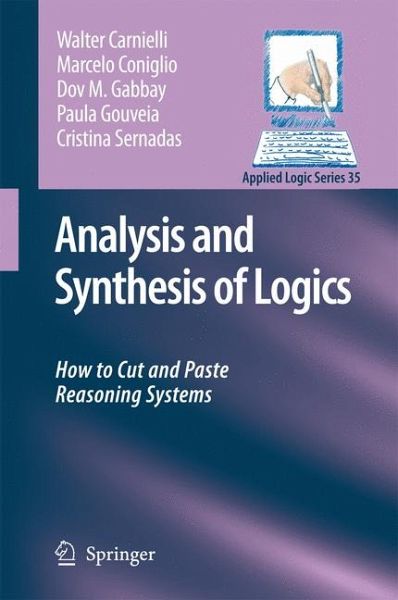
Starting with simple examples showing the relevance of cutting and pasting logics, the monograph develops a mathematical theory of combining and decomposing logics, ranging from propositional and first-order based logics to higher-order based logics as well as to non-truth functional logics. The theory covers mechanisms for combining semantic structures and deductive systems either of the same or different nature (for instance, two Hilbert calculi or a Hilbert calculus and a tableau calculus). The important issue of preservation of properties is extensively addressed. For instance, sufficient conditions are provided for a combined logic to be sound and complete when the original component logics are known to be sound and complete.
The book brings the reader to the front line of current research in the field by showing both recent achievements and directions of future investigations (in particular, multiple open problems). It also provides examples of potential applications in emergent fields like security protocols, quantum computing, networks and argumentation theory, besides discussing more classical applications like software specification, knowledge representation, computational linguistics and modular automated reasoning.
This monograph will be of interest to researchers and graduate students in mathematical logic, theory of computation and philosophical logic with no previous knowledge of the subject of combining and decomposing logics, but with a working knowledge of first-order logic. The book will also be relevant for people involved in research projects where logic is used as a tool and the need for working with several logics at the same time is mandatory (for instance, temporal, epistemic and probabilistic logics).
The book brings the reader to the front line of current research in the field by showing both recent achievements and directions of future investigations (in particular, multiple open problems). It also provides examples of potential applications in emergent fields like security protocols, quantum computing, networks and argumentation theory, besides discussing more classical applications like software specification, knowledge representation, computational linguistics and modular automated reasoning.
This monograph will be of interest to researchers and graduate students in mathematical logic, theory of computation and philosophical logic with no previous knowledge of the subject of combining and decomposing logics, but with a working knowledge of first-order logic. The book will also be relevant for people involved in research projects where logic is used as a tool and the need for working with several logics at the same time is mandatory (for instance, temporal, epistemic and probabilistic logics).
Dieser Download kann aus rechtlichen Gründen nur mit Rechnungsadresse in A, B, BG, CY, CZ, D, DK, EW, E, FIN, F, GR, HR, H, IRL, I, LT, L, LR, M, NL, PL, P, R, S, SLO, SK ausgeliefert werden.
From the reviews: "This is an advanced book on the combination of logics, which is a recent hot topic in logical research. The merit of the book is that it provides an overview of the scene, besides proving original theorems, in the scope of a general methodology for combination called fibring. ... This book will be of interest to a large audience given that it also deals with applications of fibring in different areas." (Alexandre Costa-Leite, Mathematical Reviews, Issue 2010 a)