96,95 €
inkl. MwSt.
Sofort per Download lieferbar
48 °P sammeln

Andere Kunden interessierten sich auch für
") The Queer Greek Weird Wave (eBook, PDF)22,95 €
The Queer Greek Weird Wave (eBook, PDF)22,95 €") Essay Cinema in the Digital Era (eBook, PDF)104,95 €
Essay Cinema in the Digital Era (eBook, PDF)104,95 €") European Cinema in the Streaming Era (eBook, PDF)104,95 €
European Cinema in the Streaming Era (eBook, PDF)104,95 €") Italian Americans in Film (eBook, PDF)128,95 €
Italian Americans in Film (eBook, PDF)128,95 €") An Investigative Cinema (eBook, PDF)48,95 €
An Investigative Cinema (eBook, PDF)48,95 €") European Film and Television Co-production (eBook, PDF)26,95 €
European Film and Television Co-production (eBook, PDF)26,95 €") Conflict Cinemas in Northern Ireland and Brazil (eBook, PDF)96,95 €
Conflict Cinemas in Northern Ireland and Brazil (eBook, PDF)96,95 €




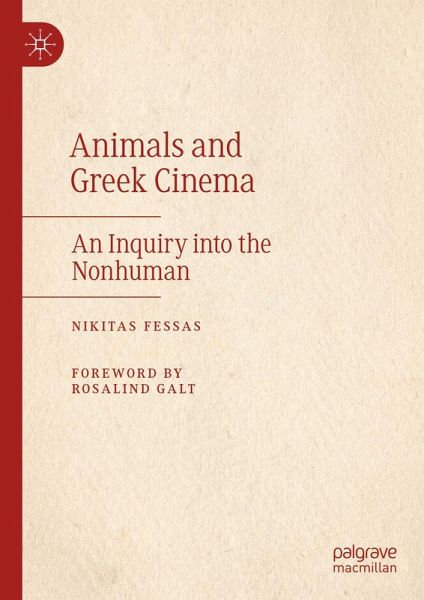
This book offers a non-anthropocentric account of a national cinema. Drawing on cutting-edge developments in Animal (film) studies, the book gathers a wide range of species and genres to discuss the Greek cinematic animal. This en-tails recalibrating the readers'/viewers' gazes to include particular nonhumans, often displaced in the frame's margins. While acknowledging the cost paid in animal suffering for Greek cinema to rise, the book features instances of animal-human bonding. Combining close readings with interviews with directors, human actors, screenwriters, cinematographers, producers, special effects artists, and animal wranglers, this book proposes a paradigm of human-animal praxis, arguing that revisiting nonhuman images can lead to renewed ethical relations, and to less speciesist cinemas, film industries, and societies..
Dieser Download kann aus rechtlichen Gründen nur mit Rechnungsadresse in A, B, BG, CY, CZ, D, DK, EW, E, FIN, F, GR, HR, H, IRL, I, LT, L, LR, M, NL, PL, P, R, S, SLO, SK ausgeliefert werden.