Sie sind bereits eingeloggt. Klicken Sie auf 2. tolino select Abo, um fortzufahren.
Bitte loggen Sie sich zunächst in Ihr Kundenkonto ein oder registrieren Sie sich bei bücher.de, um das eBook-Abo tolino select nutzen zu können.
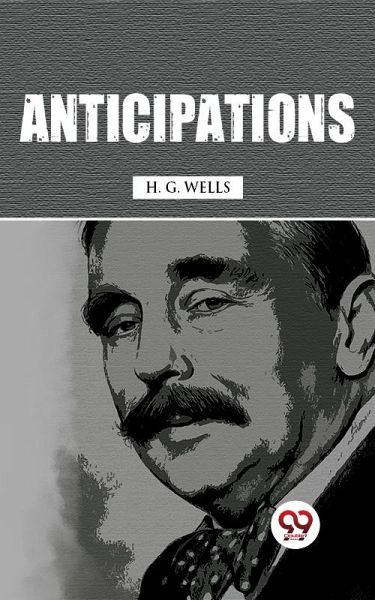
He considers the steam engine to be the 19th century's most defining emblem and examines its abrupt appearance. According to Wells, the pace of land movement will fundamentally alter human culture. According to Wells, there will be four social strata created by technology in the 20th century. He says that families in this class will live in well-run homes without a need for housekeepers. Jonathan H.B. Wells contends in Democracy and Other Essays on Statecraft that the term "democracy" is vague and just refers to the denial of a certain person or individuals' ability to act on behalf of the…mehr
He considers the steam engine to be the 19th century's most defining emblem and examines its abrupt appearance. According to Wells, the pace of land movement will fundamentally alter human culture. According to Wells, there will be four social strata created by technology in the 20th century. He says that families in this class will live in well-run homes without a need for housekeepers. Jonathan H.B. Wells contends in Democracy and Other Essays on Statecraft that the term "democracy" is vague and just refers to the denial of a certain person or individuals' ability to act on behalf of the population at large. The growing range and precision of the rifle and field gun establish the "new battle." Wells predicts that war will become less "dramatic" and more "monstrous." He expects that by the year 2000, many multilingual societies would speak languages like Spanish and Russian as a second language. Wells believes that due to the interconnectedness of the economy, culture, and politics, "a New Republic" would eventually rule the world. He discussed the future of society and how authorities will utilize science to "euthanize the weak and the sensual" in Anticipations.
Dieser Download kann aus rechtlichen Gründen nur mit Rechnungsadresse in A, D ausgeliefert werden.
Die Herstellerinformationen sind derzeit nicht verfügbar.
Autorenporträt
Herbert George Wells was an influential English writer, best known for his works in science fiction, though his prolific output spanned various genres, including history, social commentary, politics, and autobiography. Born on September 21, 1866, in Bromley, London, Wells attended the Normal School of Science in London, where he studied biology under Thomas Henry Huxley. Wells initially worked as a teacher and journalist before turning to writing full time. Over his career, he penned more than fifty novels, along with numerous short stories and non-fiction works. His early works, such as "The Time Machine,The War of the Worlds," and "The Invisible Man," helped establish him as one of the pioneers of modern science fiction. He also explored themes of social justice, the possibilities of science and technology, and the complexities of human nature in works like "The History of Mr. Polly" and "The Shape of Things to Come." Throughout his life, Wells engaged in political and philosophical discourse, influenced by thinkers like Mark Twain and Plato. He died on August 13, 1946, in London, leaving behind a legacy that shaped the development of speculative fiction and continued to inspire future generations of writers and thinkers.
Es gelten unsere Allgemeinen Geschäftsbedingungen: www.buecher.de/agb
Impressum
www.buecher.de ist ein Internetauftritt der buecher.de internetstores GmbH
Geschäftsführung: Monica Sawhney | Roland Kölbl | Günter Hilger
Sitz der Gesellschaft: Batheyer Straße 115 - 117, 58099 Hagen
Postanschrift: Bürgermeister-Wegele-Str. 12, 86167 Augsburg
Amtsgericht Hagen HRB 13257
Steuernummer: 321/5800/1497
USt-IdNr: DE450055826