52,95 €
inkl. MwSt.
Sofort per Download lieferbar
26 °P sammeln

Andere Kunden interessierten sich auch für
") Antiviral Secrets of Medicinal Plants (eBook, ePUB)52,95 €
Antiviral Secrets of Medicinal Plants (eBook, ePUB)52,95 €") Medicinal Plants of Himalayas (eBook, PDF)52,95 €
Medicinal Plants of Himalayas (eBook, PDF)52,95 €") Medicinal Plants in the Asia Pacific for Zoonotic Pandemics, Volume 3 (eBook, PDF)109,95 €
Medicinal Plants in the Asia Pacific for Zoonotic Pandemics, Volume 3 (eBook, PDF)109,95 €") Medicinal Plants in the Asia Pacific for Zoonotic Pandemics, Volume 2 (eBook, PDF)109,95 €
Medicinal Plants in the Asia Pacific for Zoonotic Pandemics, Volume 2 (eBook, PDF)109,95 €") Phytopharmaceuticals and Biotechnology of Herbal Plants (eBook, PDF)56,95 €
Phytopharmaceuticals and Biotechnology of Herbal Plants (eBook, PDF)56,95 €") The Guinea Pig Model (eBook, PDF)43,95 €
The Guinea Pig Model (eBook, PDF)43,95 €") Medicinal Chemistry of Neglected and Tropical Diseases (eBook, PDF)51,95 €
Medicinal Chemistry of Neglected and Tropical Diseases (eBook, PDF)51,95 €

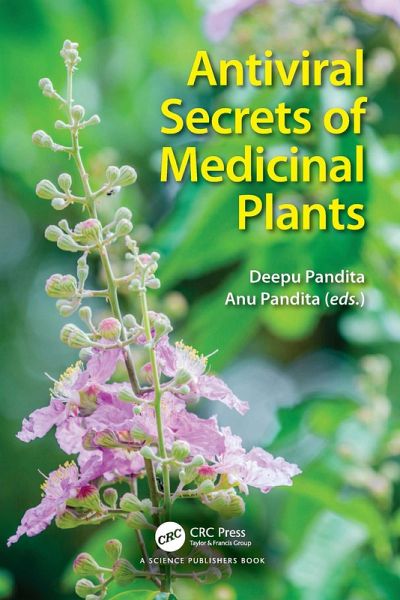
Plant-based therapies are in tune with nature and have relatively little or no side effects. World Health Organisation (WHO) is a strong advocate of herbal inputs in modern systems of medicine. This book contains detailed descriptions of 23 medicinal plants with antiviral properties. The molecules from these plants are known to be effective against viruses. For instance, alkaloids like perivine, pericalline, periformyline, leurocristine, leurosivine, vincaleukoblastine, perividine, vindolinine, and carosine derived from Catharanthus roseus, are effective against viruses like herpes simplex virus type 1, vaccinia virus, poliovirus, and dengue virus type 2 (DENV-2). Large amounts of pentacyclic triterpenoid saponins, also referred as centelloids, are present in C. asiatica. Asiaticoside, centelloside, madecassoside, brahmoside, brahminoside, thankuniside, sceffoleoside, centellose, asiatic-, brahmic-, centellic-, and madecassic acids are some of the terpenoids of this group. Studies show the effectiveness of asiatic acid and their derivatives against the inhibition of human enterovirus 71 replication and anti-HSV-1 and 2 activity of Centella asiatica is because of the asiaticoside.
The book is intended for botanists, biotechnologists, healthcare professionals and general readers interested in enhancing their knowledge on natural plant-based sources of antiviral compounds.
The book is intended for botanists, biotechnologists, healthcare professionals and general readers interested in enhancing their knowledge on natural plant-based sources of antiviral compounds.
Dieser Download kann aus rechtlichen Gründen nur mit Rechnungsadresse in A, B, BG, CY, CZ, D, DK, EW, E, FIN, F, GR, HR, H, IRL, I, LT, L, LR, M, NL, PL, P, R, S, SLO, SK ausgeliefert werden.