Sie sind bereits eingeloggt. Klicken Sie auf 2. tolino select Abo, um fortzufahren.
Bitte loggen Sie sich zunächst in Ihr Kundenkonto ein oder registrieren Sie sich bei bücher.de, um das eBook-Abo tolino select nutzen zu können.
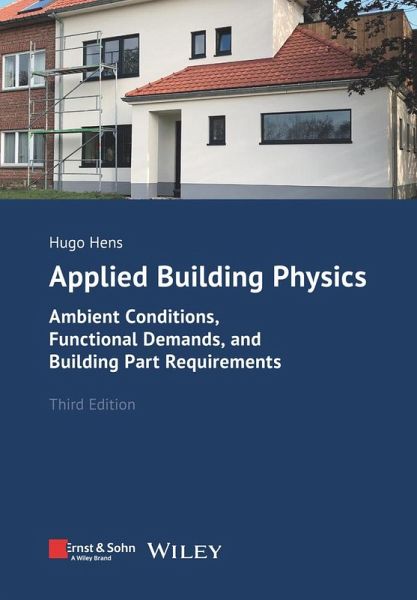
While the first volume on building physics deals with the physical principles of heat, air and moisture behaviour of buildings, building structures and components, this second volume on applied building physics focuses on the question of what the desired performance of buildings consists of. To achieve this, knowledge of the external environmental effects and the internal live loads to which buildings are subjected is a necessary first step. Subsequently, the performance requirements and the physical correspondences are deepened with the determination of their physical parameters, at the…mehr
While the first volume on building physics deals with the physical principles of heat, air and moisture behaviour of buildings, building structures and components, this second volume on applied building physics focuses on the question of what the desired performance of buildings consists of. To achieve this, knowledge of the external environmental effects and the internal live loads to which buildings are subjected is a necessary first step. Subsequently, the performance requirements and the physical correspondences are deepened with the determination of their physical parameters, at the levels of buildings, building structures and building components. Compared to the second edition, the discussion of criteria is not limited to thermal comfort, but also includes acoustic, visual and olfactory aspects. Likewise, the indoor air quality is considered in a broader way. Analyses and calculations result in sustainable buildings with a comfortable indoor climate from functional and durable building constructions. Compared to the second edition, the text for the third edition has been reorganised, corrected, revised and expanded where appropriate. A useful appendix for quick reference contains standard values of material properties for a wide range of building materials. The analyses and calculations described in this book result in sustainable buildings made of functional and durable building constructions, with comfortable and healthy indoor climate and air quality. Compared to the second edition the text in this third edition has been reshuffled, corrected, reworked and extended where appropriate.
Dieser Download kann aus rechtlichen Gründen nur mit Rechnungsadresse in D ausgeliefert werden.
Die Herstellerinformationen sind derzeit nicht verfügbar.
Autorenporträt
Dr. Ir. Hugo S.L.C. Hens is an emeritus professor of the University of Leuven (KULeuven), Belgium. Until 1972, he worked as a structural engineer and site supervisor at a mid-sized architectural office. After the sudden death of his predecessor and promotor Professor A. de Grave in 1975 and after defending his PhD thesis, he stepwise built up the Department of Building Physics at the Department of Civil Engineering. He taught Building Physics from 1975 to 2003, performance based building design from 1975 to 2005 and building services from 1975 to 1977 and 1990 to 2008. He authored and co-authored 68 peer reviewed journal papers and 174 conference papers about the research done, has helped to manage hundreds of building damage cases and acted as coordinator of the CIB W40 working group on Heat and Mass Transfer in Buildings from 1983 to 1993. Between 1986 and 2008, he was operating agent of the Annexes 14, 24, 32 and 41 of the IEA EXCO on Energy in Buildings and Communities. He is a fellow of the American Society of Heating, Refrigeration and Air Conditioning Engineers (ASHRAE).
Inhaltsangabe
Preface Units and Symbols Introduction, Historical Review 1 Ambient Conditions Out- and Indoors 1.1 Overview 1.2 Outdoors 1.3 Indoors Further Reading 2 Performance Metrics and Arrays 2.1 Definitions 2.2 Functional Demands 2.3 Performance Requirements 2.4 A short history 2.5 Performance arrays Further Reading 3 Functional Demands at the Whole Building Level 3.1 In brief 3.2 Thermal, acoustical, visual and olfactory comfort 3.3 Health and Indoor environmental quality (IEQ) 3.4 Energy Efficiency 3.5 Durability 3.6 Economics 3.7 Sustainability 3.8 High performance buildings Further Reading 4 Heat, Air, Moisture Metrics at the Building Assembly Level 4.1 Introduction 4.2 Air-tightness 4.3 Thermal transmittance 4.4 Transient thermal response 4.5 Moisture tolerance 4.6 Thermal bridging 4.7 Contact coefficient 4.8 Hygrothermal stress and strain 4.9 Transparent parts: solar transmittance Further Reading 5 The Envelope Parts HAM Performances Applied to Timber-Frame 5.1 In general 5.2 Assembly 5.3 Performance evaluation Further Reading Appendix: Heat, Air, Moisture Material Properties IndexVorwort Einheiten und Symbole Einleitung, Historischer Rückblick 1 Umgebungsbedingungen in Außen- und Innenräumen 1.1 Überblick 1.2 Außenklima 1.3 Innenraumklima Literatur 2 Performance-Kennzahlen und -Spektrum 2.1 Definitionen 2.2 Funktionale Anforderungen 2.3 Leistungsanforderungen 2.4 Eine kurze Geschichte 2.5 Performance-Spektrum Literatur 3 Funktionale Anforderungen auf der Ebene des gesamten Gebäudes 3.1 In Kürze 3.2 Thermischer, akustischer, visueller und olfaktorischer Komfort 3.3 Gesundheit und Umweltqualität in Innenräumen (IEQ) 3.4 Energieeffizienz 3.5 Dauerhaftigkeit 3.6 Wirtschaftlichkeit 3.7 Nachhaltigkeit 3.8 High-Performance-Gebäude Literatur 4 Wärme-, Luft- und Feuchtekenngrößen von Baukonstruktionen 4.1 Einführung 4.2 Luftdichtheit 4.3 Wärmedurchgangskoeffizient 4.4 Thermisches Verhalten 4.5 Feuchtetoleranz 4.6 Wärmebrücken 4.7 Kontaktkoeffizient 4.8 Hygrothermische Beanspruchungen 4.9 Transparente Teile: Sonneneinstrahlung Literatur 5 Die hygrothermische Performance der Gebäudehülle im Holzrahmenbau 5.1 Allgemeines 5.2 Baukonstruktion 5.3 Beurteilung der Performance Literatur Anhang: Materialeigenschaften ausgewählter Baustoffe Stichwortverzeichnis