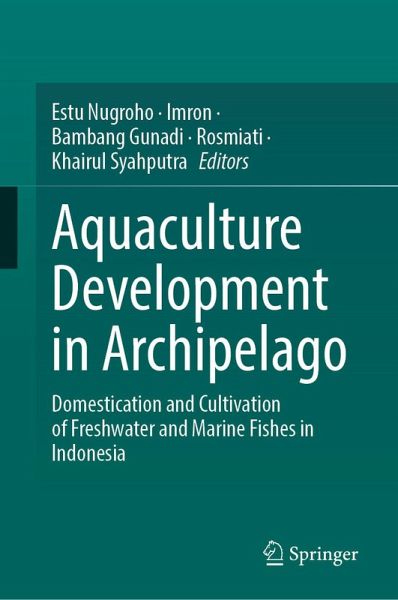
Aquaculture Development in Archipelago (eBook, PDF)
Domestication and Cultivation of Freshwater and Marine Fishes in Indonesia Redaktion: Nugroho, Estu; Syahputra, Khairul; Rosmiati; Gunadi, Bambang; Imron
Aquaculture Development in Archipelago (eBook, PDF)
Domestication and Cultivation of Freshwater and Marine Fishes in Indonesia Redaktion: Nugroho, Estu; Syahputra, Khairul; Rosmiati; Gunadi, Bambang; Imron
Sie sind bereits eingeloggt. Klicken Sie auf 2. tolino select Abo, um fortzufahren.
Bitte loggen Sie sich zunächst in Ihr Kundenkonto ein oder registrieren Sie sich bei bücher.de, um das eBook-Abo tolino select nutzen zu können.
This book is a guide to domesticating and cultivating freshwater and marine fishes in Indonesia, offering a concise and comprehensive approach. It bridges the gap between theory and practice, equipping readers with practical techniques for success in the aquaculture industry. The book covers key topics such as breeding programs, nutrition management, disease prevention and sustainable aquaculture practices. It explores the diverse species found in Indonesian waters, providing valuable guidance on their unique requirements. Readers will find detailed case studies, step-by-step guides, and…mehr
This book is a guide to domesticating and cultivating freshwater and marine fishes in Indonesia, offering a concise and comprehensive approach. It bridges the gap between theory and practice, equipping readers with practical techniques for success in the aquaculture industry. The book covers key topics such as breeding programs, nutrition management, disease prevention and sustainable aquaculture practices. It explores the diverse species found in Indonesian waters, providing valuable guidance on their unique requirements. Readers will find detailed case studies, step-by-step guides, and expert tips that enhance understanding and application. The book provides deep understanding of the principles and techniques involved, ultimately enhancing productivity and sustainability in the Indonesian aquaculture industry.
This book is intended for researchers, academics, fish farmers and aquaculture enthusiasts, and caters to both beginners and experienced professionals.
Dieser Download kann aus rechtlichen Gründen nur mit Rechnungsadresse in A, B, BG, CY, CZ, D, DK, EW, E, FIN, F, GR, HR, H, IRL, I, LT, L, LR, M, NL, PL, P, R, S, SLO, SK ausgeliefert werden.
Die Herstellerinformationen sind derzeit nicht verfügbar.
Autorenporträt
Prof. Dr. Estu Nugroho holds a bachelor's degree in fisheries from the Bogor Agricultural Institute, Indonesia, a master's degree from Kochi University, Japan, and a doctorate degree from Tohoku University, Japan. He is currently working as a main researcher at the Center for Fisheries Research, BRIN, Indonesia. Dr. Nugroho has authored around 15 books, covering topics such as genetic management of brood stock, catfish agribusiness, aquaponic systems for fish and vegetable cultivation, superior tilapia, total aquaculture system for catfish farming, pearl catfish, genetics in breeding freshwater fisheries, and the practical guide to cultivating mighty catfish. Dr. Imron Imron specializes in fish biodiversity, with a focus on fish breeding and domestication using both conventional and modern biotechnological methods. He earned his bachelor's degree in fisheries from Djuanda University, Indonesia and a master's degree in aquatic science from IPB University, Indonesia. Imron further obtained a PhD in zoology from The University of Queensland, Australia. His team has developed genetically enhanced strains of farmed fish, notably the African catfish. Presently, Imron holds the position of Principal Researcher and leads the Fish Domestication and Breeding Program at the Fisheries Research Center, National Research and Innovation Agency (BRIN). Dr. Bambang Gunadi completed his bachelor's degree in aquaculture from Bogor Agricultural University (IPB University) in 1987. He obtained his master's aquaculture from the Asian Institute of Technology, Thailand in 1999, and his doctoral degree in aquaculture from Bogor Agricultural University in 2012. After working for 30 years at the Agency for Agricultural Research and Development and the Agency for Marine Affairs and Fisheries Research and Human Resources, he now serves as senior researcher at the National Research and Innovation Agency (BRIN) under The Research Center for Fishery. He has published expertise on water quality management, aquaculture systems, biofloc technology, fish culture and fish breeding. Dr. Rosmiati received a B.S. in chemistry from the Hasanuddin University Makassar in 1997. She currently works at National Research and Innovation Agency Indonesia. She has finished master's and doctoral degree in Natural Product Chemistry and Biotechnology in Universiti Putra Malaysia and Universiti Malaysia Terengganu, respectively. Her research interest includes utilization of herbs for disease control and fish reproduction, natural product chemistry, domestication and breeding, and biotechnology. Dr. Khairul Syahputra received his bachelor's degree in marine science from Riau University in 2005 and his master's degree in biotechnology from IPB University in 2008. He completed his PhD degree in immunology and infectious diseases from University of Copenhagen, Denmark in 2020. He was a postdoctoral fellow in the Institute for Fish and Wildlife Health, University of Bern, Switzerland in 2023-2024 funded by the SWISS government excellence scholarships (ESKAS). After 12 years doing research at the Research Institute for Fish Breeding, Ministry of Marine Affairs and Fisheries (MMAF), Indonesia, he currently works as researcher at Research Center for Fishery, National Research and Innovation Agency of Republic of Indonesia (BRIN). His research interests include aquaculture, genetic and fish breeding, focusing on genetic marker, genetic engineering, gene expression and omics studies, and disease resistances.
Inhaltsangabe
.- Chapter 1_ Introduction. .- Chapter 2_ Agroecological intensification of legume-cereal intercropping systems: The 4C approach. .- Chapter 3_ Innovative cropping systems to maximize the use of available natural resources.
.- Chapter 4_ Enhancing the efficiency of light interception in soybean and maize intercropping system. .- Chapter 5_ Mitigation of shading stress on soybean varieties through intercropping with maize. .- Chapter 6_ Advanced soybean breeding techniques to alleviate biotic and abiotic stresses under intercropping. .- Chapter 7_ Opportunities and challenges of greenhouses and soilless agricultural systems in combating food insecurity. .- Chapter 8_ Using Fishponds Wastewater to Enhance Agricultural Crop Productivity and Sustainability. .- Chapter 9_ Adaptation techniques to irrigation water shortages due to climate change. .- Chapter 10_ Climate change effects on sustainable field crops production in Egypt: challenges and prospective. .- Chapter 11_ AquaCrop model for simulating maize productivity with varying planting dates under deficit irrigation in the context of climate change. .- Chapter 12_ Legume-based intercropping systems mitigate climate change. .- Chapter 13_ Evaluating soil degradation processes and their exacerbation by climate change in the Nile Delta of Egypt. .- Chapter 14_ Impact of climate change drivers on soil microbial communities and nutrient cycling in agricultural soils in the Nile Delta of Egypt. .- Chapter 15_ Climate change impacts on crop yield prediction: A machine learning perspective. .- Chapter 16_ Coupling process-based models with machine learning for robust predictions of soil, water, and crop dynamics. .- Chapter 17_ Fusion of process-based models, machine learning, and remote sensing for yield gap assessment. .- Chapter 18_ Conclusions, and Recommendations to Resilient Agroecosystems: Innovations in Cropping Systems and Climate Change Mitigation .
.- Chapter 1_ Introduction. .- Chapter 2_ Agroecological intensification of legume-cereal intercropping systems: The 4C approach. .- Chapter 3_ Innovative cropping systems to maximize the use of available natural resources.
.- Chapter 4_ Enhancing the efficiency of light interception in soybean and maize intercropping system. .- Chapter 5_ Mitigation of shading stress on soybean varieties through intercropping with maize. .- Chapter 6_ Advanced soybean breeding techniques to alleviate biotic and abiotic stresses under intercropping. .- Chapter 7_ Opportunities and challenges of greenhouses and soilless agricultural systems in combating food insecurity. .- Chapter 8_ Using Fishponds Wastewater to Enhance Agricultural Crop Productivity and Sustainability. .- Chapter 9_ Adaptation techniques to irrigation water shortages due to climate change. .- Chapter 10_ Climate change effects on sustainable field crops production in Egypt: challenges and prospective. .- Chapter 11_ AquaCrop model for simulating maize productivity with varying planting dates under deficit irrigation in the context of climate change. .- Chapter 12_ Legume-based intercropping systems mitigate climate change. .- Chapter 13_ Evaluating soil degradation processes and their exacerbation by climate change in the Nile Delta of Egypt. .- Chapter 14_ Impact of climate change drivers on soil microbial communities and nutrient cycling in agricultural soils in the Nile Delta of Egypt. .- Chapter 15_ Climate change impacts on crop yield prediction: A machine learning perspective. .- Chapter 16_ Coupling process-based models with machine learning for robust predictions of soil, water, and crop dynamics. .- Chapter 17_ Fusion of process-based models, machine learning, and remote sensing for yield gap assessment. .- Chapter 18_ Conclusions, and Recommendations to Resilient Agroecosystems: Innovations in Cropping Systems and Climate Change Mitigation .
Es gelten unsere Allgemeinen Geschäftsbedingungen: www.buecher.de/agb
Impressum
www.buecher.de ist ein Internetauftritt der buecher.de internetstores GmbH
Geschäftsführung: Monica Sawhney | Roland Kölbl | Günter Hilger
Sitz der Gesellschaft: Batheyer Straße 115 - 117, 58099 Hagen
Postanschrift: Bürgermeister-Wegele-Str. 12, 86167 Augsburg
Amtsgericht Hagen HRB 13257
Steuernummer: 321/5800/1497
USt-IdNr: DE450055826