Rakesh Baruah
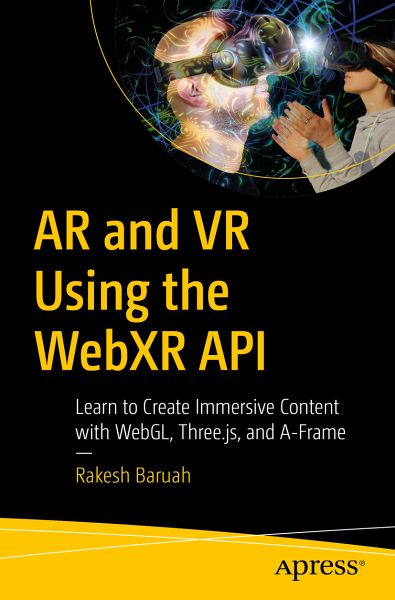
AR and VR Using the WebXR API (eBook, PDF)
Learn to Create Immersive Content with WebGL, Three.js, and A-Frame
43,95 €
43,95 €
inkl. MwSt.
Sofort per Download lieferbar

22 °P sammeln
43,95 €
Als Download kaufen
43,95 €
inkl. MwSt.
Sofort per Download lieferbar
22 °P sammeln
Jetzt verschenken
Alle Infos zum eBook verschenken
43,95 €
inkl. MwSt.
Sofort per Download lieferbar
Alle Infos zum eBook verschenken
22 °P sammeln

Rakesh Baruah
AR and VR Using the WebXR API (eBook, PDF)
Learn to Create Immersive Content with WebGL, Three.js, and A-Frame
- Format: PDF
- Merkliste
- Auf die Merkliste
- Bewerten Bewerten
- Teilen
- Produkt teilen
- Produkterinnerung
- Produkterinnerung

Bitte loggen Sie sich zunächst in Ihr Kundenkonto ein oder registrieren Sie sich bei
bücher.de, um das eBook-Abo tolino select nutzen zu können.
Hier können Sie sich einloggen
Sie sind bereits eingeloggt. Klicken Sie auf 2. tolino select Abo, um fortzufahren.

Bitte loggen Sie sich zunächst in Ihr Kundenkonto ein oder registrieren Sie sich bei bücher.de, um das eBook-Abo tolino select nutzen zu können.
Using a project-based approach, readers will see how to make the most of what spatial computing and immersive technology have to offer.
- Geräte: PC
- ohne Kopierschutz
- eBook Hilfe
- Größe: 4.4MB
Andere Kunden interessierten sich auch für
Jayven NhanMastering ARKit (eBook, PDF)43,95 €
Jayven NhanMastering ARKit (eBook, PDF)49,95 €
Christopher CoutinhoUnity® Virtual Reality Development with VRTK4 (eBook, PDF)50,95 €
Allan FowlerBeginning iOS AR Game Development (eBook, PDF)35,95 €
Allen G. TaylorDevelop Microsoft HoloLens Apps Now (eBook, PDF)30,95 €
Michael D. CallaghanAngular for Business (eBook, PDF)40,95 €
Venkata Keerti KotaruAngular for Material Design (eBook, PDF)47,95 €-
-
-
Using a project-based approach, readers will see how to make the most of what spatial computing and immersive technology have to offer.
Dieser Download kann aus rechtlichen Gründen nur mit Rechnungsadresse in A, B, BG, CY, CZ, D, DK, EW, E, FIN, F, GR, HR, H, IRL, I, LT, L, LR, M, NL, PL, P, R, S, SLO, SK ausgeliefert werden.
Produktdetails
- Produktdetails
- Verlag: Apress
- Seitenzahl: 328
- Erscheinungstermin: 30. November 2020
- Englisch
- ISBN-13: 9781484263181
- Artikelnr.: 62296693
- Verlag: Apress
- Seitenzahl: 328
- Erscheinungstermin: 30. November 2020
- Englisch
- ISBN-13: 9781484263181
- Artikelnr.: 62296693
- Herstellerkennzeichnung Die Herstellerinformationen sind derzeit nicht verfügbar.
Rakesh Baruah is a writer and creator with 15 years of experience in new media, film, and television in New York City. After completing an MFA in screenwriting and directing for film from Columbia University, Rakesh joined the writers' room of a hit, primetime, network drama as an assistant. The experience opened his eyes to the limits of television and the opportunities promised by 3D, immersive content. In 2016 he began a self-guided journey toward mixed reality design that has taken him through startups, bootcamps, the Microsoft offices, and many, many hours in front of a computer. He is the author of one previous book on virtual reality and the Unity Game Engine and has received an Nvidia-certified nanodegree in Computer Vision. He shares what he's learned with you in a style and format designed specifically for the person who, in high school, preferred English class to Trigonometry.
Chapter 1: Getting Started. - Chapter 2: Up and Running with WebGL. - Chapter 3: Toward the 3rd Dimension in WebGL. - Chapter 4: Matrices, Transformations, and Perspective in WebGL. - Chapter 5: Diving into Three.js. - Chapter 6: Entering VR through the WebXR API. - Chapter 7: Augmented Reality with Three.js and the WebXR API. - Chapter 8: Building Virtual Reality for the Web with A-Frame. - Chapter 9: Physics and User Interaction in A-Frame through the WebXR Gamepad API. - Chapter 10: Deploying 3D Animated Models in AR with A-Frame and GitHub Pages.