
187,95 €
inkl. MwSt.
Sofort per Download lieferbar
94 °P sammeln

Andere Kunden interessierten sich auch für
") Arbitration Law and Practice in China (eBook, PDF)165,95 €
Arbitration Law and Practice in China (eBook, PDF)165,95 €") Litigation and Arbitration in Central and Eastern Europe (eBook, PDF)211,95 €
Litigation and Arbitration in Central and Eastern Europe (eBook, PDF)211,95 €") Arbitration in England (eBook, PDF)192,95 €
Arbitration in England (eBook, PDF)192,95 €") Arbitration in Turkey (eBook, PDF)182,95 €
Arbitration in Turkey (eBook, PDF)182,95 € and China and their Enforcement in International Supply Chain Arbitrations (eBook, PDF)") CSR and Codes of Business Ethics in the USA, Austria (EU) and China and their Enforcement in International Supply Chain Arbitrations (eBook, PDF)96,95 €
CSR and Codes of Business Ethics in the USA, Austria (EU) and China and their Enforcement in International Supply Chain Arbitrations (eBook, PDF)96,95 €") Interaction and Conflict of Treaties in Investment Arbitration (eBook, PDF)175,95 €
Interaction and Conflict of Treaties in Investment Arbitration (eBook, PDF)175,95 €") Anti-dumping Law and Practice of China (eBook, PDF)168,95 €
Anti-dumping Law and Practice of China (eBook, PDF)168,95 €
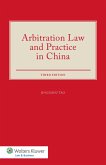




Arbitration in China has been aligned with international norms since the enactment of the Arbitration Law in 1994. The purpose of this book is to assist practitioners by describing the law governing arbitration in China as it is currently applied to practice, both domestically and internationally, taking into account the regime''s numerous features. Among the details affecting arbitration practice and procedure in China covered are the following:
Although focusing predominantly on the practical effects of Arbitration Law provisions, the authors stress practice involving China's two commissions specifically addressing international matters, the China International Economic and Trade Arbitration Commission (CIETAC) and the Beijing Arbitration Commission (BAC). Among the numerous local commissions functioning under the Arbitration Law, special attention is paid to those in Beijing, Shanghai, and Guangzhou, which (along with CIETAC) accept the greatest number of cases with a foreign element. The book will be invaluable to corporate counsel and other practitioners dealing with Chinese companies. Scholars of comparative arbitration law will also find much here to interest them.
- . arbitration agreement as a precondition for any arbitration proceedings;
- . finality of arbitral awards without any right of appeal;
- . procedure governing arbitral proceedings;
- . the extent of permissible judicial review;
- . arbitrations with a connection to Hong Kong, Macau, or Taiwan;
- . persistent involvement of local governments in arbitration acceptance and proceedings;
- . rules on the handling of cases with foreign elements;
- . guidelines provided in the Supreme People's Court's judicial interpretations;
- . fees;
- . grounds for objecting to jurisdiction;
- . mechanisms for multi-party arbitration;
- . interim injunctions;
- . formation of arbitral tribunals;
- . use of expert witnesses;
- . enforcement of arbitral awards; and
- . use of mediation.
Although focusing predominantly on the practical effects of Arbitration Law provisions, the authors stress practice involving China's two commissions specifically addressing international matters, the China International Economic and Trade Arbitration Commission (CIETAC) and the Beijing Arbitration Commission (BAC). Among the numerous local commissions functioning under the Arbitration Law, special attention is paid to those in Beijing, Shanghai, and Guangzhou, which (along with CIETAC) accept the greatest number of cases with a foreign element. The book will be invaluable to corporate counsel and other practitioners dealing with Chinese companies. Scholars of comparative arbitration law will also find much here to interest them.
Dieser Download kann aus rechtlichen Gründen nur mit Rechnungsadresse in A, B, BG, CY, CZ, D, DK, EW, E, FIN, F, GR, HR, H, IRL, I, LT, L, LR, M, NL, PL, P, R, S, SLO, SK ausgeliefert werden.