42,95 €
42,95 €
inkl. MwSt.
Sofort per Download lieferbar

21 °P sammeln
42,95 €
Als Download kaufen
42,95 €
inkl. MwSt.
Sofort per Download lieferbar
21 °P sammeln
Jetzt verschenken
Alle Infos zum eBook verschenken
42,95 €
inkl. MwSt.
Sofort per Download lieferbar
Alle Infos zum eBook verschenken
21 °P sammeln

Andere Kunden interessierten sich auch für
") Religious NGOs at the United Nations (eBook, PDF)41,95 €
Religious NGOs at the United Nations (eBook, PDF)41,95 €") Conservative Christian Politics in Russia and the United States (eBook, PDF)41,95 €
Conservative Christian Politics in Russia and the United States (eBook, PDF)41,95 €") The Routledge Handbook of Religious Literacy, Pluralism, and Global Engagement (eBook, PDF)0,00 €
The Routledge Handbook of Religious Literacy, Pluralism, and Global Engagement (eBook, PDF)0,00 €") An Introduction to International Relations and Religion (eBook, PDF)61,95 €
An Introduction to International Relations and Religion (eBook, PDF)61,95 €") Towards A New Christian Political Realism (eBook, PDF)42,95 €
Towards A New Christian Political Realism (eBook, PDF)42,95 €") Faith and Politics in South Asia (eBook, PDF)42,95 €
Faith and Politics in South Asia (eBook, PDF)42,95 €") Religion, Identity and Human Security (eBook, PDF)37,95 €
Religion, Identity and Human Security (eBook, PDF)37,95 €


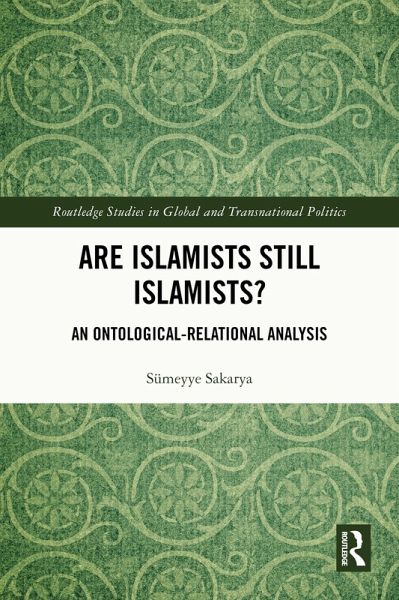
This book offers an ontological study of Islamism and its transformation with a specific focus on Türkiye, Bangladesh, and Senegal.
The dominant reading of the transformation of Islamism from a discernibly Islamist, then anti-systemic discourse to a more systemic one has been through the arguments of post-Islamism, which claim the failure and end of Islamism. However, this assumes that Islamists are still Islamists, which is an oxymoron. This book suggests that this scholarship fails to recognise the political, ontological nature of Islamism. It argues that under-theorisation of the political, accompanied by Eurocentrism and positivism, hinders a proper understanding of Islamism by engendering methodological nationalism and state-centrism and obstructing Islamists as political actors by denying them political agency to undertake transformation. This shows the need for an ontological analysis to surmount the mentioned problems and comprehend Islamists as political actors by disarticulating any necessary relationship between the political and any fixed entity, such as the state, a specific rhetoric or form. The book, as an exercise in political theory, offers such an analysis, articulated through the tools provided by post-foundationalist political theory, particularly the works of Martin Heidegger, Antonio Gramsci, Hannah Arendt, and Salman Sayyid, who mobilises Carl Schmitt and post-Marxist discourse theory to read Islamism.
This book will appeal to scholars and students of Politics, International Relations, Area Studies, and Sociology, especially those specialising in Islam and Islamism.
The dominant reading of the transformation of Islamism from a discernibly Islamist, then anti-systemic discourse to a more systemic one has been through the arguments of post-Islamism, which claim the failure and end of Islamism. However, this assumes that Islamists are still Islamists, which is an oxymoron. This book suggests that this scholarship fails to recognise the political, ontological nature of Islamism. It argues that under-theorisation of the political, accompanied by Eurocentrism and positivism, hinders a proper understanding of Islamism by engendering methodological nationalism and state-centrism and obstructing Islamists as political actors by denying them political agency to undertake transformation. This shows the need for an ontological analysis to surmount the mentioned problems and comprehend Islamists as political actors by disarticulating any necessary relationship between the political and any fixed entity, such as the state, a specific rhetoric or form. The book, as an exercise in political theory, offers such an analysis, articulated through the tools provided by post-foundationalist political theory, particularly the works of Martin Heidegger, Antonio Gramsci, Hannah Arendt, and Salman Sayyid, who mobilises Carl Schmitt and post-Marxist discourse theory to read Islamism.
This book will appeal to scholars and students of Politics, International Relations, Area Studies, and Sociology, especially those specialising in Islam and Islamism.
Dieser Download kann aus rechtlichen Gründen nur mit Rechnungsadresse in A, B, BG, CY, CZ, D, DK, EW, E, FIN, F, GR, HR, H, IRL, I, LT, L, LR, M, NL, PL, P, R, S, SLO, SK ausgeliefert werden.