Sie sind bereits eingeloggt. Klicken Sie auf 2. tolino select Abo, um fortzufahren.
Bitte loggen Sie sich zunächst in Ihr Kundenkonto ein oder registrieren Sie sich bei bücher.de, um das eBook-Abo tolino select nutzen zu können.
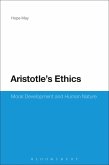
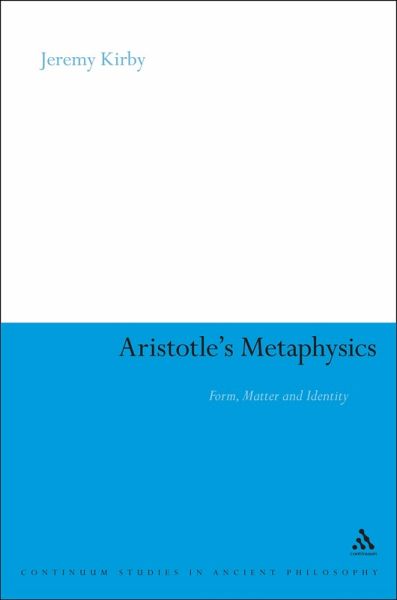
Aristotle maintains that biological organisms are compounds of matter and form and that compounds that have the same form are individuated by their matter. According to Aristotle, an object that undergoes change is an object that undergoes a change in form, i.e. form is imposed upon something material in nature. Aristotle therefore identifies organisms according to their matter and essential forms, forms that are arguably essential to an object's existence. Jeremy Kirby addresses a difficulty in Aristotle's metaphysics, namely the possibility that two organisms of the same species might share…mehr
Aristotle maintains that biological organisms are compounds of matter and form and that compounds that have the same form are individuated by their matter. According to Aristotle, an object that undergoes change is an object that undergoes a change in form, i.e. form is imposed upon something material in nature. Aristotle therefore identifies organisms according to their matter and essential forms, forms that are arguably essential to an object's existence. Jeremy Kirby addresses a difficulty in Aristotle's metaphysics, namely the possibility that two organisms of the same species might share the same matter. If they share the same form, as Aristotle seems to suggest, then they seem to share that which they cannot, their identity. By taking into account Aristotle's views on the soul, its relation to living matter, and his rejection of the possibility of resurrection, Kirby reconstructs an answer to this problem and shows how Aristotle relies on some of the central themes in his system in order to resist this unwelcome result that his metaphysics might suggest.
Die Herstellerinformationen sind derzeit nicht verfügbar.
Autorenporträt
Jeremy Kirby is Assistant Professor of Philosophy at Albion College, USA.
Inhaltsangabe
Introduction i. The Metaphysics of Aristotle ii. Two Challenges to Change iii. Matter, Form, and Paradox 1. Matters of Individuation i. Matters of Change ii. Matters of Difference iii. Identity, Diversity, and Unity iv. Aristotle and the Absolutist versus Relativist Controversy v. The Bare Materials vi. Prime Matter, Somatic Matter, and Individuation vii. The Varieties of Matter viii. Two Old Arguments against Migration ix. A Possible Objection x. Conclusion 2. Resurrection and Entrapment i. A Putative Response to the Puzzle of Simple Composition ii. Anastasis and Anachronism iii. Scientific and Dialectical Contexts iv. Possibility and Inevitability v. Eternal Recurrence Limited vi. Eternality and Essentialism vii. Resurrection, Migration, and Gappy Existences viii. Resurrection and the Problem of Shared Identity ix. Aristotle's Rejection of Migration x. Conclusion 4. Aristotle on Composition and the Puzzle of Unity i. Composition ii. The Puzzle of Unity iii. The Popular Strategy iv. Eliminativism v. The Identity Thesis vi. Constituency as Adjectival Being vii. Toward a Relational Unity viii. Teleological Dependence as the Adhesive for Unity ix. Conclusion 5. Particularities and the Puzzle of Composition i. Haecceities ii. The Problem of Universals iii. The Zeta Problem iv. No Substance is a Universal v. Conclusion 5. Conclusion i. The Puzzle of Simple Composition Revisited ii. Alternative Proposals for Resolving the Puzzle of Simple Composition iii. The Puzzle of Transplantation Postscript Bibliography
Es gelten unsere Allgemeinen Geschäftsbedingungen: www.buecher.de/agb
Impressum
www.buecher.de ist ein Internetauftritt der buecher.de internetstores GmbH
Geschäftsführung: Monica Sawhney | Roland Kölbl | Günter Hilger
Sitz der Gesellschaft: Batheyer Straße 115 - 117, 58099 Hagen
Postanschrift: Bürgermeister-Wegele-Str. 12, 86167 Augsburg
Amtsgericht Hagen HRB 13257
Steuernummer: 321/5800/1497
USt-IdNr: DE450055826