16,95 €
16,95 €
inkl. MwSt.
Sofort per Download lieferbar

8 °P sammeln
16,95 €
Als Download kaufen
16,95 €
inkl. MwSt.
Sofort per Download lieferbar
8 °P sammeln
Jetzt verschenken
Alle Infos zum eBook verschenken
16,95 €
inkl. MwSt.
Sofort per Download lieferbar
Alle Infos zum eBook verschenken
8 °P sammeln

Andere Kunden interessierten sich auch für
") Armenians Beyond Diaspora (eBook, PDF)0,00 €
Armenians Beyond Diaspora (eBook, PDF)0,00 €") Conflict on Mount Lebanon (eBook, ePUB)20,95 €
Conflict on Mount Lebanon (eBook, ePUB)20,95 €") Arab Philosophical Trends (eBook, ePUB)72,95 €
Arab Philosophical Trends (eBook, ePUB)72,95 €") Kurds in Erdogan's Turkey (eBook, ePUB)20,95 €
Kurds in Erdogan's Turkey (eBook, ePUB)20,95 €") Sayfo - An Account of the Assyrian Genocide (eBook, ePUB)16,95 €
Sayfo - An Account of the Assyrian Genocide (eBook, ePUB)16,95 €") Conquered Populations in Early Islam (eBook, ePUB)3,99 €
Conquered Populations in Early Islam (eBook, ePUB)3,99 €") Political Change in the Middle East and North Africa (eBook, ePUB)22,95 €
Political Change in the Middle East and North Africa (eBook, ePUB)22,95 €





A socio-political and cultural history of the Armenians in Cold War Lebanon
- Explores Lebanese Armenians' changing views of their place in the making of the Lebanese state and its wider Arab environment, and in relation to the Armenian Socialist Soviet Republic
- Challenges the dominant Armenian historiography, which treats Lebanese Armenians as a subsidiary of an Armenian global diaspora
- Contributes to an understanding of the development of class and sectarian cleavages that led to the breakdown of civil society in Lebanon from 1975
- Highlights the role of societal actors in the US-Soviet Cold War in the Middle East
- Challenges the tendency to read Middle East history through the lens of dominant (Arab) nationalisms
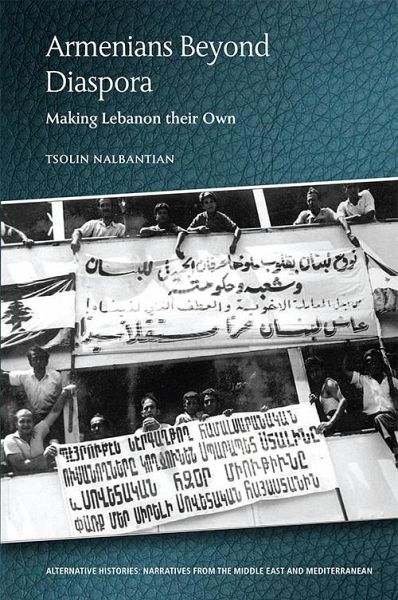
This book argues that Armenians around the world - in the face of the Genocide, and despite the absence of an independent nation-state after World War I - developed dynamic socio-political, cultural, ideological and ecclesiastical centres. Tsolin Nalbantian focuses on one such centre, Beirut, in the postcolonial 1940s and 1950s. Nalbantian explores Armenians' discursive re-positioning within the newly independent Lebanese nation-state; the political-cultural impact (in Lebanon as well as Syria) of the 1946-48 repatriation initiative to Soviet Armenia; the 1956 Catholicos election; and the 1957 Lebanese elections and 1958 mini-civil war. What emerges is a post-Genocide Armenian history of - principally - power, renewal and presence, rather than one of loss and absence.
Dieser Download kann aus rechtlichen Gründen nur mit Rechnungsadresse in A, B, BG, CY, CZ, D, DK, EW, E, FIN, F, GR, HR, H, IRL, I, LT, L, LR, M, NL, PL, P, R, S, SLO, SK ausgeliefert werden.