41,95 €
inkl. MwSt.
Sofort per Download lieferbar
21 °P sammeln

Andere Kunden interessierten sich auch für
") Creative Women in Ireland (eBook, ePUB)24,95 €
Creative Women in Ireland (eBook, ePUB)24,95 €") Building Better Arts Facilities (eBook, ePUB)55,95 €
Building Better Arts Facilities (eBook, ePUB)55,95 €") The Routledge Handbook of Global Cultural Policy (eBook, ePUB)47,95 €
The Routledge Handbook of Global Cultural Policy (eBook, ePUB)47,95 €") Rethinking Cultural Centers (eBook, ePUB)19,95 €
Rethinking Cultural Centers (eBook, ePUB)19,95 €") The Art Business (eBook, ePUB)41,95 €
The Art Business (eBook, ePUB)41,95 €") The Routledge Companion to Governance in the Arts World (eBook, ePUB)43,95 €
The Routledge Companion to Governance in the Arts World (eBook, ePUB)43,95 €") Arts and Cultural Management (eBook, PDF)41,95 €
Arts and Cultural Management (eBook, PDF)41,95 €



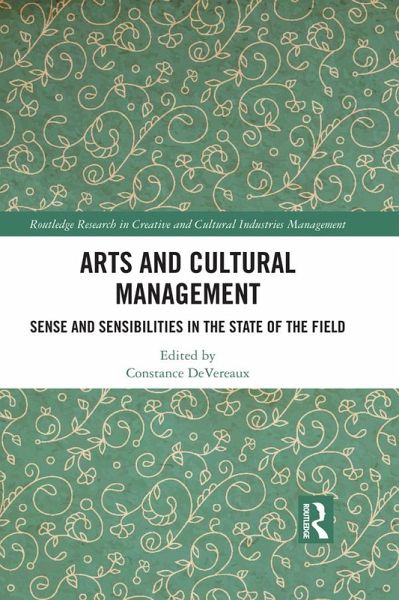
Arts and Cultural Management: Sense and Sensibilities in the State of the Field opens a conversation that is much needed for anyone identifying arts management or cultural management as primary areas of research, teaching, or practice. In the evolution of any field arises the need for scrutiny, reflection, and critique, as well as to display the advancements and diversity in approaches and thinking that contribute to a discipline's forward progression. While no one volume could encompass all that a discipline is or should be, a representational snapshot serves as a valuable benchmark.
This book is addressed to those who operate as researchers, scholars, and practitioners of arts and cultural management. Driven by concerns about quality of life, globalization, development of economies, education of youth, the increasing mobility of cultural groups, and many other significant issues of the twenty-first century, governments and individuals have increasingly turned to arts and culture as means of mitigating or resolving tough policy issues. For their growth, arts and culture sectors depend on people in positions of leadership and management who play a significant role in the creation, production, exhibition, dissemination, interpretation, and evaluation of arts and culture experiences for publics and policies. Less than a century old as a formal field of inquiry, however, arts and cultural management has been in flux since its inception. What is arts and cultural management? remains an open question. A comprehensive literature on the discipline, as an object of study, is still developing. This State of the Discipline offers a benchmark for those interested in the evolution and development of arts and cultural management as a branch of knowledge alongside more established disciplines of research and scholarship.
This book is addressed to those who operate as researchers, scholars, and practitioners of arts and cultural management. Driven by concerns about quality of life, globalization, development of economies, education of youth, the increasing mobility of cultural groups, and many other significant issues of the twenty-first century, governments and individuals have increasingly turned to arts and culture as means of mitigating or resolving tough policy issues. For their growth, arts and culture sectors depend on people in positions of leadership and management who play a significant role in the creation, production, exhibition, dissemination, interpretation, and evaluation of arts and culture experiences for publics and policies. Less than a century old as a formal field of inquiry, however, arts and cultural management has been in flux since its inception. What is arts and cultural management? remains an open question. A comprehensive literature on the discipline, as an object of study, is still developing. This State of the Discipline offers a benchmark for those interested in the evolution and development of arts and cultural management as a branch of knowledge alongside more established disciplines of research and scholarship.
Dieser Download kann aus rechtlichen Gründen nur mit Rechnungsadresse in A, B, BG, CY, CZ, D, DK, EW, E, FIN, F, GR, HR, H, IRL, I, LT, L, LR, M, NL, PL, P, R, S, SLO, SK ausgeliefert werden.
"Constance DeVereaux is a pioneer scholar in arts and cultural management [and] in this book defines the new field of arts and cultural management, which helps academics and professionals to benchmark their research and practices." Xiao Lu, International Journal of Cultural Policy
'A contribution of immense value for the field of cultural management.' Jonathan Paquette, Journal of Arts Management, Law and Society
'The book's contribution is not only to present the latest arts and cultural management discourse or to simply denote the state of the discipline and expand existing scholarship. It offers a platform for dialogue and food for thought.' Olga Kolokytha, Cultural Trends
'DeVereaux has done a great service ... the book should appeal to students and academics.' Ann Tonks, Arts Management Network
'The anthology provides a good picture of the emergence of new multidisciplinary practices and also interesting reflections on cultural and cultural policy differences in when and why there is a need for the term "arts management". DeVereaux makes a great contribution by writing an introductory article for each of the three parts, which provides a breadth, a deep and philosophical reflection on how it is possible to think of a research relationship in the position of art and culture in society.' Nordic Journal of Cultural Policy
'A contribution of immense value for the field of cultural management.' Jonathan Paquette, Journal of Arts Management, Law and Society
'The book's contribution is not only to present the latest arts and cultural management discourse or to simply denote the state of the discipline and expand existing scholarship. It offers a platform for dialogue and food for thought.' Olga Kolokytha, Cultural Trends
'DeVereaux has done a great service ... the book should appeal to students and academics.' Ann Tonks, Arts Management Network
'The anthology provides a good picture of the emergence of new multidisciplinary practices and also interesting reflections on cultural and cultural policy differences in when and why there is a need for the term "arts management". DeVereaux makes a great contribution by writing an introductory article for each of the three parts, which provides a breadth, a deep and philosophical reflection on how it is possible to think of a research relationship in the position of art and culture in society.' Nordic Journal of Cultural Policy