Sie sind bereits eingeloggt. Klicken Sie auf 2. tolino select Abo, um fortzufahren.
Bitte loggen Sie sich zunächst in Ihr Kundenkonto ein oder registrieren Sie sich bei bücher.de, um das eBook-Abo tolino select nutzen zu können.
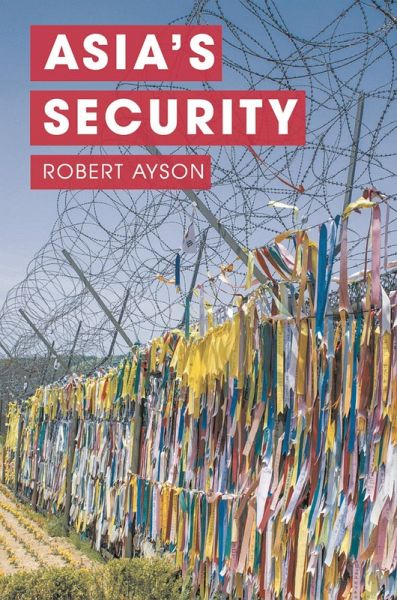
Security threats in Asia fast become issues for the rest of the world. This introductory and wide-ranging text on the subject takes a thematic approach to assess how localized security issues - from territorial rivalry to the rise of China - materialize as 'ripple effects' across the whole region.
Security threats in Asia fast become issues for the rest of the world. This introductory and wide-ranging text on the subject takes a thematic approach to assess how localized security issues - from territorial rivalry to the rise of China - materialize as 'ripple effects' across the whole region.
Die Herstellerinformationen sind derzeit nicht verfügbar.
Autorenporträt
Robert Ayson is Professor of Strategic Studies at Victoria University of Wellington, New Zealand, where he works closely with the Centre for Strategic Studies. He gained his PhD as a Commonwealth Scholar at King's College London, UK and his MA as a Freyberg Scholar to the Australian National University. His previous writing includes Thomas Schelling and the Nuclear Age (Frank Cass, 2004) and Hedley Bull and the Accommodation of Power (Palgrave Macmillan, 2012). He is an Honorary Professor with the New Zealand Defence Force Command and Staff College and Adjunct Professor with the Australian National University's Strategic and Defence Studies Centre.
Inhaltsangabe
1. Introduction: How Should Asia's Security Be Approached? 2. Peace: Why Does Asia Seem More Secure? 3. Power: Is It All About the US and China? 4. Money: Can Economic Interdependence Keep Asia Safe? 5. Guns: Will Military Technology Lead to New Conflict in Asia? 6. Rivalry: Will Territorial Competition and Nationalism Ruin Asia's Peace? 7. Fragmentation: Are Asia's Main Security Problems Domestic Ones? 8. Hazards: Will Non-state Actors & Transnational challenges overtake Asia? 9. Interference: Can Intervention Work in Today's Asia? 10. Solidarity: Can Asia Work Together on Security? 11. Division: Will Alliances and Partnerships Separate the region? 12. Conclusion: Towards a New Asian Security?
1. Introduction: How Should Asia's Security Be Approached? 2. Peace: Why Does Asia Seem More Secure? 3. Power: Is It All About the US and China? 4. Money: Can Economic Interdependence Keep Asia Safe? 5. Guns: Will Military Technology Lead to New Conflict in Asia? 6. Rivalry: Will Territorial Competition and Nationalism Ruin Asia's Peace? 7. Fragmentation: Are Asia's Main Security Problems Domestic Ones? 8. Hazards: Will Non-state Actors & Transnational challenges overtake Asia? 9. Interference: Can Intervention Work in Today's Asia? 10. Solidarity: Can Asia Work Together on Security? 11. Division: Will Alliances and Partnerships Separate the region? 12. Conclusion: Towards a New Asian Security?
Es gelten unsere Allgemeinen Geschäftsbedingungen: www.buecher.de/agb
Impressum
www.buecher.de ist ein Internetauftritt der buecher.de internetstores GmbH
Geschäftsführung: Monica Sawhney | Roland Kölbl | Günter Hilger
Sitz der Gesellschaft: Batheyer Straße 115 - 117, 58099 Hagen
Postanschrift: Bürgermeister-Wegele-Str. 12, 86167 Augsburg
Amtsgericht Hagen HRB 13257
Steuernummer: 321/5800/1497
USt-IdNr: DE450055826