39,95 €
39,95 €
inkl. MwSt.
Sofort per Download lieferbar

20 °P sammeln
39,95 €
Als Download kaufen
39,95 €
inkl. MwSt.
Sofort per Download lieferbar
20 °P sammeln
Jetzt verschenken
Alle Infos zum eBook verschenken
39,95 €
inkl. MwSt.
Sofort per Download lieferbar
Alle Infos zum eBook verschenken
20 °P sammeln

Andere Kunden interessierten sich auch für
") At the Mountains' Altar (eBook, ePUB)39,95 €
At the Mountains' Altar (eBook, ePUB)39,95 €") Digital Religion (eBook, PDF)37,95 €
Digital Religion (eBook, PDF)37,95 €") The Nature of Sufism (eBook, PDF)41,95 €
The Nature of Sufism (eBook, PDF)41,95 € (eBook, PDF)") The Politicized Concert Mass (1967-2007) (eBook, PDF)39,95 €
The Politicized Concert Mass (1967-2007) (eBook, PDF)39,95 €") Religion and its History (eBook, PDF)39,95 €
Religion and its History (eBook, PDF)39,95 €") Studying Hinduism (eBook, PDF)46,95 €
Studying Hinduism (eBook, PDF)46,95 €") Theory for Religious Studies (eBook, PDF)37,95 €
Theory for Religious Studies (eBook, PDF)37,95 €
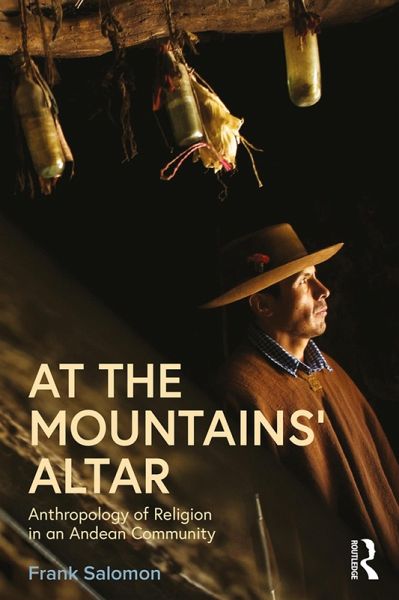
In high-Andean Peru, Rapaz village maintains a temple to mountain beings who command water and weather. By examining the ritual practices and belief systems of an Andean community, this book provides students with rich understandings of unfamiliar religious experiences and delivers theories of religion from the realm of abstraction. From core field encounters, each chapter guides readers outward in a different theoretical direction, successively exploring the main paths in the anthropology of religion.
As well as addressing classical approaches in the anthropology of religion to rural modernity, Salomon engages with newer currents such as cognitive-evolution models, power-oriented critiques, the ontological reworking of relativism, and the "new materialism" in the context of a deep-rooted Andean ethos. He reflects on central questions such as: Why does sacred ritualism seem almost universal? Is it seated in social power, human psychology, symbolic meanings, or cultural logics? Are varied theories compatible? Is "religion" still a tenable category in the post-colonial world?
At the Mountains' Altar is a valuable resource for students taking courses on the anthropology of religion, Andean cultures, Latin American ethnography, religious studies, and indigenous peoples of the Americas.
As well as addressing classical approaches in the anthropology of religion to rural modernity, Salomon engages with newer currents such as cognitive-evolution models, power-oriented critiques, the ontological reworking of relativism, and the "new materialism" in the context of a deep-rooted Andean ethos. He reflects on central questions such as: Why does sacred ritualism seem almost universal? Is it seated in social power, human psychology, symbolic meanings, or cultural logics? Are varied theories compatible? Is "religion" still a tenable category in the post-colonial world?
At the Mountains' Altar is a valuable resource for students taking courses on the anthropology of religion, Andean cultures, Latin American ethnography, religious studies, and indigenous peoples of the Americas.
Dieser Download kann aus rechtlichen Gründen nur mit Rechnungsadresse in A, B, BG, CY, CZ, D, DK, EW, E, FIN, F, GR, HR, H, IRL, I, LT, L, LR, M, NL, PL, P, R, S, SLO, SK ausgeliefert werden.
"At the Mountains' Altar will be a vital resource for undergraduate and postgraduate modules on the
anthropology of religion, whether or not there is a focus on Christianity and/or the Andes. It will also be invaluable in the teaching of fieldwork methods[...]the book has a wider reach than the classroom. It is a book to be enjoyed for the author's keen insights into what he calls religiosity, and how his responses to his reading of an intriguing range of authors can be used to illuminate a phenomenon that cannot be satisfactorily defined yet still has the power to demand our attention."
Penelope Dransart, University of Wales Trinity Saint David, BioOne Complete
anthropology of religion, whether or not there is a focus on Christianity and/or the Andes. It will also be invaluable in the teaching of fieldwork methods[...]the book has a wider reach than the classroom. It is a book to be enjoyed for the author's keen insights into what he calls religiosity, and how his responses to his reading of an intriguing range of authors can be used to illuminate a phenomenon that cannot be satisfactorily defined yet still has the power to demand our attention."
Penelope Dransart, University of Wales Trinity Saint David, BioOne Complete
"At the Mountains' Altar will be a vital resource for undergraduate and postgraduate modules on the
anthropology of religion, whether or not there is a focus on Christianity and/or the Andes. It will also be invaluable in the teaching of fieldwork methods[...]the book has a wider reach than the classroom. It is a book to be enjoyed for the author's keen insights into what he calls religiosity, and how his responses to his reading of an intriguing range of authors can be used to illuminate a phenomenon that cannot be satisfactorily defined yet still has the power to demand our attention."
Penelope Dransart, University of Wales Trinity Saint David, BioOne Complete
anthropology of religion, whether or not there is a focus on Christianity and/or the Andes. It will also be invaluable in the teaching of fieldwork methods[...]the book has a wider reach than the classroom. It is a book to be enjoyed for the author's keen insights into what he calls religiosity, and how his responses to his reading of an intriguing range of authors can be used to illuminate a phenomenon that cannot be satisfactorily defined yet still has the power to demand our attention."
Penelope Dransart, University of Wales Trinity Saint David, BioOne Complete