Valery S. Lisitsa
Atoms in Plasmas (eBook, PDF)
40,95 €
40,95 €
inkl. MwSt.
Sofort per Download lieferbar

20 °P sammeln
40,95 €
Als Download kaufen
40,95 €
inkl. MwSt.
Sofort per Download lieferbar
20 °P sammeln
Jetzt verschenken
Alle Infos zum eBook verschenken
40,95 €
inkl. MwSt.
Sofort per Download lieferbar
Alle Infos zum eBook verschenken
20 °P sammeln
Valery S. Lisitsa
Atoms in Plasmas (eBook, PDF)
- Format: PDF
- Merkliste
- Auf die Merkliste
- Bewerten Bewerten
- Teilen
- Produkt teilen
- Produkterinnerung
- Produkterinnerung

Bitte loggen Sie sich zunächst in Ihr Kundenkonto ein oder registrieren Sie sich bei
bücher.de, um das eBook-Abo tolino select nutzen zu können.
Hier können Sie sich einloggen
Hier können Sie sich einloggen
Sie sind bereits eingeloggt. Klicken Sie auf 2. tolino select Abo, um fortzufahren.
Bitte loggen Sie sich zunächst in Ihr Kundenkonto ein oder registrieren Sie sich bei bücher.de, um das eBook-Abo tolino select nutzen zu können.
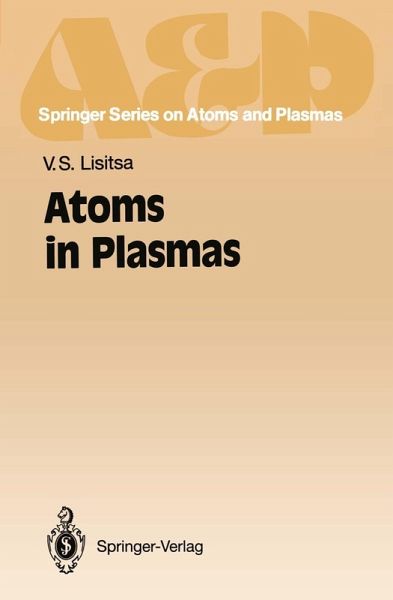
This monograph certralizes the studies of a "perturbed atom" that is an atom under the influence of different perturbations in plasmas. Atoms and Plasmas covers the fundamental aspects of modern physics, such as Plasma radiation, Atomic collisions, Spectral line broadening, Laser spectroscopy, etc. and should be interesting for scientists as well as for newcomers in this field.
- Geräte: PC
- ohne Kopierschutz
- eBook Hilfe
- Größe: 39.53MB
Andere Kunden interessierten sich auch für
") Harold J. MetcalfLaser Cooling and Trapping (eBook, PDF)48,95 €
Harold J. MetcalfLaser Cooling and Trapping (eBook, PDF)48,95 €") Hermann HakenThe Physics of Atoms and Quanta (eBook, PDF)68,95 €
Hermann HakenThe Physics of Atoms and Quanta (eBook, PDF)68,95 €") The Hydrogen Atom (eBook, PDF)72,95 €
The Hydrogen Atom (eBook, PDF)72,95 €") Boris M. SmirnovReference Data on Atomic Physics and Atomic Processes (eBook, PDF)72,95 €
Boris M. SmirnovReference Data on Atomic Physics and Atomic Processes (eBook, PDF)72,95 €") Jean-Louis BasdevantThe Quantum Mechanics Solver (eBook, PDF)40,95 €
Jean-Louis BasdevantThe Quantum Mechanics Solver (eBook, PDF)40,95 €") Hermann HakenAtomic and Quantum Physics (eBook, PDF)40,95 €
Hermann HakenAtomic and Quantum Physics (eBook, PDF)40,95 €") Advances in Spectroscopy for Lasers and Sensing (eBook, PDF)232,95 €
Advances in Spectroscopy for Lasers and Sensing (eBook, PDF)232,95 €-
-
-





This monograph certralizes the studies of a "perturbed atom" that is an atom under the influence of different perturbations in plasmas. Atoms and Plasmas covers the fundamental aspects of modern physics, such as Plasma radiation, Atomic collisions, Spectral line broadening, Laser spectroscopy, etc. and should be interesting for scientists as well as for newcomers in this field.
Dieser Download kann aus rechtlichen Gründen nur mit Rechnungsadresse in A, B, BG, CY, CZ, D, DK, EW, E, FIN, F, GR, HR, H, IRL, I, LT, L, LR, M, NL, PL, P, R, S, SLO, SK ausgeliefert werden.
Produktdetails
- Produktdetails
- Verlag: Springer Berlin Heidelberg
- Seitenzahl: 302
- Erscheinungstermin: 6. Dezember 2012
- Englisch
- ISBN-13: 9783642787263
- Artikelnr.: 53086845
- Verlag: Springer Berlin Heidelberg
- Seitenzahl: 302
- Erscheinungstermin: 6. Dezember 2012
- Englisch
- ISBN-13: 9783642787263
- Artikelnr.: 53086845
- Herstellerkennzeichnung Die Herstellerinformationen sind derzeit nicht verfügbar.
Frank B. Rosmej is a Nationally Distinguished Professor at the Sorbonne University in Paris and is leading the research group "Atomic Physics in Dense Plasmas" at the LULI-Laboratory, Ecole Polytechnique, Palaiseau, France. Born in 1962 in Germany, he obtained his Ph.D. in 1991 and Habilitation thesis in 1998 in Physics from the Ruhr-University in Bochum, Germany. He received the Feodor Lynen award from the Alexander von Humboldt Foundation in Germany, the Eminent Scientist price from the RIKEN research center in Japan, the Kurchatov price from the National Research Center "Kurchatov Institute" in Russia and several pedagogic and research awards from the Sorbonne University; he has been an invited Professor at the University of Tokyo, University of Nagoya, University of Osaka and the Research Center RIKEN in Japan, Scholar of the Stanford University and the University of Maryland in USA; had research stays at the Los Alamos National Laboratories, Lawrence Livermore Laboratories, Max-Planck Institute for Quantum Optics. He was honored with professorships at the Excellence Universities "Moscow Institute of Physics and Technology MIPT" and the "National Research Nuclear University MEPhI" in Russia, was founding editor of "International Pedagogical Research Papers", and President of the National French Federation of "Fusion Science". His field of research covers experimental and theoretical atomic and plasmas physics, quantum kinetics, non-equilibrium radiative properties, magnetic and inertial fusion science, the interaction of X-ray Free Electron Lasers XFEL with dense matter, suprathermal electron generation in high energy density and ultra-high intensity lasers, plasma spectroscopy and diagnostics. He is the author of 150 research papers and has held 70 invited talks at international conferences and workshops. Valery A. Astapenko is a Professor and principal researcher at the Moscow Institute of Physics and Technology MIPT in Dolgoprudny, Russia and isa Scientific expert of the Russian Ministry of Education Science. Born in 1959 in Russia, he obtained his Ph.D. in 1985 and Habilitation thesis in 2000 from the Moscow Institute of Physics and Technology. He has been honored with the Kurchatov Prize, the Russian Federation Government Prize in the Field of Education and twice with the Moscow Government Prize for achievements in new technologies in education. He has been an invited Professor at the University Pierre and Marie Curie and Ecole Polytechnique in France. He is the author of 9 monographs and has published more than 170 research articles. His field of research is theoretical physics of photo-processes in the field of ultra-short laser pulses and bichromatic radiation fields, interaction of radiation with matter, elementary processes in atoms and plasmas, coherent optical phenomena and polarization Bremsstrahlung. Valery S. Lisitsa heads the Laboratory of "Radiation Theory" at the National Research Center Kurchatov Institute in Moscow and is a Professor at the Moscow Institute of Physics and Technology MIPT in Dolgoprudny and the National Research Nuclear University "MEPhI" in Russia. Born in 1945 in Russia, he obtained his Ph.D. in 1975 from the Moscow State University and his Habilitation thesis in 1979 from the Kurchatov Institute of Atomic Energy. He has been a member of the Scientific Council of Spectroscopy of the Russian Academy of Science and has been a leading research scientist of the Kurchatov Institute for more than 30 years. He has also been the deputy editor of the international Journal of Experimental and Theoretical Physics JETP and a managing director of several research projects in the Kurchatov Institute. Honored three times with the Kurchatov Prize and the best publication prize of the International Publishing Company "Nauka" he has been an invited Professor at the University of Bochum, Germany, the Universities Aix-Marseille, University Pierre and Marie Curie and
1. Introduction. General Problems of Description of Atomic Spectra in Plasmas.- 1.1 Atomic Physics and Plasma Physics. Quasiclassical Methods for Atomic Processes.- 1.2 General Problems of Atomic-State Mixing in a Plasma Medium. Density Matrix Method.- 2. Classical Motion in an Atomic Potential. Atomic Structure.- 2.1 Classical Radiation Spectra in a Coulomb Field. Peculiarities of the High-Frequency Domain. Kramers' Electrodynamics.- 2.2 Symmetry Properties of the Coulomb Field.- 2.3 Nonhydrogenic Atoms. Allowed and Forbidden Transitions. Properties of Multicharged Ion Spectra.- 2.3.1 Nonhydrogenic Atomic Spectra Structure. Allowed and Forbidden Transitions.- 2.3.2 Properties of Multicharged Ions (MCI) Spectra.- 2.4 Auto-ionization States. Stationary (Fano) and Time-Dependent (Kompaneets) Descriptions.- 2.4.1 Auto-ionization States.- 2.4.2 The Interaction of Discrete States with a Continuum. Fano and Kompaneets Descriptions.- 2.5 Rydberg Atomic States in Plasmas.- 3. Radiation Itansition Probabilities and Radiation Kinetics in Kramers' Electrodynamics.- 3.1 Quasiclassical Transition Probabilities.- 3.2 Line Radiation (LR) Probabilities.- 3.3 Photorecombination (PR) Cross Section.- 3.4 Kramers' Electrodynamics and Radiative Cascades Between Rydberg Atomic States.- 3.4.1 Classical Kinetic Equation.- 3.4.2 Quantum Kinetic Equation in the Quasiclassical Approximation.- 3.4.3 Relationship of the Quasiclassical Solution to the Quantum Cascade Matrix. The Solution in the General Quantum Case.- 3.4.4 Atomic-Level Populations for a Photorecombinative Source. Quasiclassical Scaling Laws.- 4. Fermi Method of Equivalent Photons and the Probabilities of Radiative-Collisional Transitions in Atoms.- 4.1 Applicability of the Fermi Method.- 4.2 Excitation by Electron Impact asAbsorption of Equivalent Photons by an Ion.- 4.3 Dielectronic Recombination as the Resonance Fluorescence of Equivalent Photons.- 4.4 Polarization Radiation as Non-Resonant Scattering of Equivalent Photons.- 5. Hydrogenic Atom in an Electric Field. Quasiclassical Consideration.- 5.1 Quasiclassical Results for the Transition Probabilities and Lifetimes in Parabolic Coordinates.- 5.1.1 Introductory Comments.- 5.1.2 General Relationships.- 5.1.3 Radiative Lifetimes of States.- 5.2 Intensities of the Stark Components.- 5.3 Weak Fields. Asymptotic Theory of the Decay of an Atom.- 5.4 Classical Theory of the Decay of an Atom in an Electric Field.- 5.5 Decay of States Near the Critical Value of an Electric Field.- 5.6 General Theory of Atomic States in an Electric Field.- 5.6.1 Basis of the Semiclassical Approach.- 5.6.2 Energy Levels.- 5.6.3 Decay Rates.- 5.7 Results of Numerical Calculations.- 6. Atom in a Magnetic Field and Crossed F-B Fields.- 6.1 Introductory Remarks. Energy Spectrum of Low Lying Atomic States.- 6.1.1 Energy Spectrum of Lower States.- 6.2 Adiabatic Theory for Highly Excited Atomic States in a Strong Magnetic Field.- 6.3 "Latent" Symmetry of an Atom in a Magnetic Field.- 6.4 Oscillator Strengths of Atomic Transitions in Strong Magnetic Fields.- 6.5 Classical Trajectories of an Atomic Electron in a Magnetic Field. Stochastization Effects.- 6.5.1 Calculation of Classical Trajectories.- 6.5.2 Stochastization of Electron Motion in Coulomb and Magnetic Fields.- 6.5.3 Numerical Calculations of Spectra of an Atom in a Magnetic Field.- 6.6 Hydrogen Atom in Crossed Electric and Magnetic Fields.- 6.6.1 First-Order Theory.- 6.6.2 Second-Order Corrections.- 6.6.3 Atom in Electric and Strong Magnetic Fields.- 6.7 Conclusions.- 7. Atom in a NonresonantOscillating Electric Field.- 7.1 The Types of Oscillating Fields in Plasmas. Quasi-energetic Level Structure.- 7.2 The Blokhintsev Spectrum.- 7.3 Hydrogen Atom in a Rotating Electric Field.- 7.4 Multiphoton Transitions in a Two-Level System.- 7.5 The Quasi-energy Spectrum of a Two-Level System. Intensities of Satellites.- 7.6 Highly Excited Atom in a Low Frequency, Nonresonant Electric Field. Quasiclassical Solution.- 8. Atom in a Resonant Oscillating Electric Field. Simultaneous Influence of Constant and Oscillating Fields.- 8.1 Features of Resonance Conditions in Plasmas.- 8.2 Action of Weak Oscillating Electric Fields of Broad Spectral Composition on the Atom.- 8.3 Hydrogen Atom in Static (S) and Strong Oscillating (Dynamie-D) Fields. Numerical Solutions for the Case when S?D.- 8.4 Analytical Theory of Multiquantum Resonances in S - D Fields.- 8.5 Hydrogen Spectral, Line Structure Near Resonances in S - D Fields.- 8.6 On the Stochastization of Highly Excited Electron Motion in a Periodic Field.- 9. Decay of Atomic States.- 9.1 Resonance of Discrete States Against the Background of a Continuous Spectrum.- 9.1.1 A Number of Discrete States Against the Background of One Continuum.- 9.1.2 Several Continua. Scattering Problems.- 9.1.3 Two-Level Problem with a Stationary Perturbation.- 9.1.4 Certain Examples.- 9.2 Damping of Atomic States Due to Their Relaxation in Plasmas.- 9.2.1 Impact Relaxation of Atomic Levels.- 9.2.2 Features of the Spectral Line Shape Under Impact Relaxation of Atomic Sublevels in an Ion Field.- 9.3 Emission of Forbidden Spectral Lines and the Decay of Metastable Levels in Plasmas.- 9.3.1 The Polarization Mechanism for Forbidden Transitions in an Atom.- 9.3.2 Interrelation Between the Nonelastic and Polarization Mechanisms. The WeisskopfMechanism for Inelastic Transitions.- 9.3.3 The Adiabatic Approximation for Polarization Radiation.- 9.4 Decay of Atomic States and Some Elementary Processes in Plasmas.- 9.4.1 Transition Discrete Spectrum - Continuum in Hydrogenic Plasmas.- 9.4.2 Charge Exchange of Atoms at Multicharged Ions as a Decay Process.- 9.4.3 Auto-ionization Decays and Dielectronic Recombination in Plasmas.- 10. Excited Hydrogen-Like Atom in Electrical Fields of Charged Particles.- 10.1 The Atomic State Evolution in the Electric Field of a Classically Moving Charged Particle.- 10.2 Effect of the Hydrogenic State Mixing During Charge Exchange of an Atom at the Multicharged Ion.- 10.3 Quantum Motion of an Electron in an Electric Field of Hydrogen-Like Atom or Ion. Connection with the Line-Broadening Problem.- 10.3.1 Classical and Quantum Formulations of the Problem of Electron Interaction with an Excited Atom.- 10.3.2 The System of Wave Functions of an Excited Hydrogen Atom and a Broadening Particle.- 10.3.3 The Hydrogen Line Shape and the Overlap Integral of the Wave Functions of a Broadening Particle.- 10.3.4 Generalization onto the Case of Hydrogen-Like Ions.- 10.4 Differential Cross Sections for Electron and Ion Scattering at the Excited Hydrogen Atom. Precise Solutions.- 11. Collisions of an Atom with Atomic Particles in External Fields.- 11.1 Collisional Transitions Between Fine Structure Sublevels of a Hydrogen Atom in a Magnetic Field.- 11.2 Collisions of a Two-Level Atom with Particles in a Strong Resonant Electromagnetic Field.- 11.2.1 Optical Collisions. The Basic System of Equations.- 11.2.2 Optical Collisions and Characteristics of Light Absorption in Media.- 11.3 Landau-Zener Mechanism of Strong Electromagnetic (E.M.) Radiation Absorption in the Wings of a Spectral Line.- 11.3.1Landau-Zener Model for Optical Phenomena.- 11.3.2 Nonlinear Effects in Absorption for the Collision of Identical Atoms.- 11.3.3 Experimental Aspects.- 11.4 Multiparticle Effects. The Change of the Atom's Quantization Direction in a Laser Field.- 11.4.1 Multiparticle Approach to the Powerful Radiation Absorption by the Atom in a Plasma.- 11.4.2 Calculation of Spectra in a Laser Field.- 11.4.3 The Change of the Atom Quantization Direction in a Laser Field.- 11.5 Radiative Collisions.- 11.6 Effect of the Electric Microfield on Resonant Charge Exchange in a Dense Medium.- 12. The Influence of Regular and Stochastic Accelerations on Atomic Spectra.- 12.1 Regular Acceleration. Adiabatic Population Inversion in a Strong Laser Field.- 12.1.1 Landau-Zener Nonlinearities in the Spectra of a Two-Level System Subjected to Acceleration.- 12.1.2 Adiabatic Inversion of the Populations of Atomic Levels.- 12.2 Model of Brownian Motion and Optical Phenomena. Path Integral Method.- 12.2.1 The State Amplitude Method and the Path Integration.- 12.3 Investigation of Nonlinear Effects in Absorption Due to Brownian Fluctuations of Atomic Velocity.- 12.4 An Electron in a Planck Radiation Field. "Infrared Catastrophe".- 12.4.1 Classical Current Approximation.- 12.4.2 Multiphoton-Induced Processes in a Planck Radiation Field.- 12.4.3 Calculation of the Absorbed Energy.- References.
1. Introduction. General Problems of Description of Atomic Spectra in Plasmas.- 1.1 Atomic Physics and Plasma Physics. Quasiclassical Methods for Atomic Processes.- 1.2 General Problems of Atomic-State Mixing in a Plasma Medium. Density Matrix Method.- 2. Classical Motion in an Atomic Potential. Atomic Structure.- 2.1 Classical Radiation Spectra in a Coulomb Field. Peculiarities of the High-Frequency Domain. Kramers' Electrodynamics.- 2.2 Symmetry Properties of the Coulomb Field.- 2.3 Nonhydrogenic Atoms. Allowed and Forbidden Transitions. Properties of Multicharged Ion Spectra.- 2.3.1 Nonhydrogenic Atomic Spectra Structure. Allowed and Forbidden Transitions.- 2.3.2 Properties of Multicharged Ions (MCI) Spectra.- 2.4 Auto-ionization States. Stationary (Fano) and Time-Dependent (Kompaneets) Descriptions.- 2.4.1 Auto-ionization States.- 2.4.2 The Interaction of Discrete States with a Continuum. Fano and Kompaneets Descriptions.- 2.5 Rydberg Atomic States in Plasmas.- 3. Radiation Itansition Probabilities and Radiation Kinetics in Kramers' Electrodynamics.- 3.1 Quasiclassical Transition Probabilities.- 3.2 Line Radiation (LR) Probabilities.- 3.3 Photorecombination (PR) Cross Section.- 3.4 Kramers' Electrodynamics and Radiative Cascades Between Rydberg Atomic States.- 3.4.1 Classical Kinetic Equation.- 3.4.2 Quantum Kinetic Equation in the Quasiclassical Approximation.- 3.4.3 Relationship of the Quasiclassical Solution to the Quantum Cascade Matrix. The Solution in the General Quantum Case.- 3.4.4 Atomic-Level Populations for a Photorecombinative Source. Quasiclassical Scaling Laws.- 4. Fermi Method of Equivalent Photons and the Probabilities of Radiative-Collisional Transitions in Atoms.- 4.1 Applicability of the Fermi Method.- 4.2 Excitation by Electron Impact asAbsorption of Equivalent Photons by an Ion.- 4.3 Dielectronic Recombination as the Resonance Fluorescence of Equivalent Photons.- 4.4 Polarization Radiation as Non-Resonant Scattering of Equivalent Photons.- 5. Hydrogenic Atom in an Electric Field. Quasiclassical Consideration.- 5.1 Quasiclassical Results for the Transition Probabilities and Lifetimes in Parabolic Coordinates.- 5.1.1 Introductory Comments.- 5.1.2 General Relationships.- 5.1.3 Radiative Lifetimes of States.- 5.2 Intensities of the Stark Components.- 5.3 Weak Fields. Asymptotic Theory of the Decay of an Atom.- 5.4 Classical Theory of the Decay of an Atom in an Electric Field.- 5.5 Decay of States Near the Critical Value of an Electric Field.- 5.6 General Theory of Atomic States in an Electric Field.- 5.6.1 Basis of the Semiclassical Approach.- 5.6.2 Energy Levels.- 5.6.3 Decay Rates.- 5.7 Results of Numerical Calculations.- 6. Atom in a Magnetic Field and Crossed F-B Fields.- 6.1 Introductory Remarks. Energy Spectrum of Low Lying Atomic States.- 6.1.1 Energy Spectrum of Lower States.- 6.2 Adiabatic Theory for Highly Excited Atomic States in a Strong Magnetic Field.- 6.3 "Latent" Symmetry of an Atom in a Magnetic Field.- 6.4 Oscillator Strengths of Atomic Transitions in Strong Magnetic Fields.- 6.5 Classical Trajectories of an Atomic Electron in a Magnetic Field. Stochastization Effects.- 6.5.1 Calculation of Classical Trajectories.- 6.5.2 Stochastization of Electron Motion in Coulomb and Magnetic Fields.- 6.5.3 Numerical Calculations of Spectra of an Atom in a Magnetic Field.- 6.6 Hydrogen Atom in Crossed Electric and Magnetic Fields.- 6.6.1 First-Order Theory.- 6.6.2 Second-Order Corrections.- 6.6.3 Atom in Electric and Strong Magnetic Fields.- 6.7 Conclusions.- 7. Atom in a NonresonantOscillating Electric Field.- 7.1 The Types of Oscillating Fields in Plasmas. Quasi-energetic Level Structure.- 7.2 The Blokhintsev Spectrum.- 7.3 Hydrogen Atom in a Rotating Electric Field.- 7.4 Multiphoton Transitions in a Two-Level System.- 7.5 The Quasi-energy Spectrum of a Two-Level System. Intensities of Satellites.- 7.6 Highly Excited Atom in a Low Frequency, Nonresonant Electric Field. Quasiclassical Solution.- 8. Atom in a Resonant Oscillating Electric Field. Simultaneous Influence of Constant and Oscillating Fields.- 8.1 Features of Resonance Conditions in Plasmas.- 8.2 Action of Weak Oscillating Electric Fields of Broad Spectral Composition on the Atom.- 8.3 Hydrogen Atom in Static (S) and Strong Oscillating (Dynamie-D) Fields. Numerical Solutions for the Case when S?D.- 8.4 Analytical Theory of Multiquantum Resonances in S - D Fields.- 8.5 Hydrogen Spectral, Line Structure Near Resonances in S - D Fields.- 8.6 On the Stochastization of Highly Excited Electron Motion in a Periodic Field.- 9. Decay of Atomic States.- 9.1 Resonance of Discrete States Against the Background of a Continuous Spectrum.- 9.1.1 A Number of Discrete States Against the Background of One Continuum.- 9.1.2 Several Continua. Scattering Problems.- 9.1.3 Two-Level Problem with a Stationary Perturbation.- 9.1.4 Certain Examples.- 9.2 Damping of Atomic States Due to Their Relaxation in Plasmas.- 9.2.1 Impact Relaxation of Atomic Levels.- 9.2.2 Features of the Spectral Line Shape Under Impact Relaxation of Atomic Sublevels in an Ion Field.- 9.3 Emission of Forbidden Spectral Lines and the Decay of Metastable Levels in Plasmas.- 9.3.1 The Polarization Mechanism for Forbidden Transitions in an Atom.- 9.3.2 Interrelation Between the Nonelastic and Polarization Mechanisms. The WeisskopfMechanism for Inelastic Transitions.- 9.3.3 The Adiabatic Approximation for Polarization Radiation.- 9.4 Decay of Atomic States and Some Elementary Processes in Plasmas.- 9.4.1 Transition Discrete Spectrum - Continuum in Hydrogenic Plasmas.- 9.4.2 Charge Exchange of Atoms at Multicharged Ions as a Decay Process.- 9.4.3 Auto-ionization Decays and Dielectronic Recombination in Plasmas.- 10. Excited Hydrogen-Like Atom in Electrical Fields of Charged Particles.- 10.1 The Atomic State Evolution in the Electric Field of a Classically Moving Charged Particle.- 10.2 Effect of the Hydrogenic State Mixing During Charge Exchange of an Atom at the Multicharged Ion.- 10.3 Quantum Motion of an Electron in an Electric Field of Hydrogen-Like Atom or Ion. Connection with the Line-Broadening Problem.- 10.3.1 Classical and Quantum Formulations of the Problem of Electron Interaction with an Excited Atom.- 10.3.2 The System of Wave Functions of an Excited Hydrogen Atom and a Broadening Particle.- 10.3.3 The Hydrogen Line Shape and the Overlap Integral of the Wave Functions of a Broadening Particle.- 10.3.4 Generalization onto the Case of Hydrogen-Like Ions.- 10.4 Differential Cross Sections for Electron and Ion Scattering at the Excited Hydrogen Atom. Precise Solutions.- 11. Collisions of an Atom with Atomic Particles in External Fields.- 11.1 Collisional Transitions Between Fine Structure Sublevels of a Hydrogen Atom in a Magnetic Field.- 11.2 Collisions of a Two-Level Atom with Particles in a Strong Resonant Electromagnetic Field.- 11.2.1 Optical Collisions. The Basic System of Equations.- 11.2.2 Optical Collisions and Characteristics of Light Absorption in Media.- 11.3 Landau-Zener Mechanism of Strong Electromagnetic (E.M.) Radiation Absorption in the Wings of a Spectral Line.- 11.3.1Landau-Zener Model for Optical Phenomena.- 11.3.2 Nonlinear Effects in Absorption for the Collision of Identical Atoms.- 11.3.3 Experimental Aspects.- 11.4 Multiparticle Effects. The Change of the Atom's Quantization Direction in a Laser Field.- 11.4.1 Multiparticle Approach to the Powerful Radiation Absorption by the Atom in a Plasma.- 11.4.2 Calculation of Spectra in a Laser Field.- 11.4.3 The Change of the Atom Quantization Direction in a Laser Field.- 11.5 Radiative Collisions.- 11.6 Effect of the Electric Microfield on Resonant Charge Exchange in a Dense Medium.- 12. The Influence of Regular and Stochastic Accelerations on Atomic Spectra.- 12.1 Regular Acceleration. Adiabatic Population Inversion in a Strong Laser Field.- 12.1.1 Landau-Zener Nonlinearities in the Spectra of a Two-Level System Subjected to Acceleration.- 12.1.2 Adiabatic Inversion of the Populations of Atomic Levels.- 12.2 Model of Brownian Motion and Optical Phenomena. Path Integral Method.- 12.2.1 The State Amplitude Method and the Path Integration.- 12.3 Investigation of Nonlinear Effects in Absorption Due to Brownian Fluctuations of Atomic Velocity.- 12.4 An Electron in a Planck Radiation Field. "Infrared Catastrophe".- 12.4.1 Classical Current Approximation.- 12.4.2 Multiphoton-Induced Processes in a Planck Radiation Field.- 12.4.3 Calculation of the Absorbed Energy.- References.