
72,95 €
inkl. MwSt.
Sofort per Download lieferbar
36 °P sammeln

Andere Kunden interessierten sich auch für
") Auction Theory (eBook, PDF)52,95 €
Auction Theory (eBook, PDF)52,95 €") Foundations in Microeconomic Theory (eBook, PDF)112,95 €
Foundations in Microeconomic Theory (eBook, PDF)112,95 €") The General Economic Theory (eBook, PDF)72,95 €
The General Economic Theory (eBook, PDF)72,95 €") Game Theory for the Social Sciences (eBook, PDF)48,95 €
Game Theory for the Social Sciences (eBook, PDF)48,95 €") Uncertainty in Economics (eBook, PDF)68,95 €
Uncertainty in Economics (eBook, PDF)68,95 €") Foundations and Applications of Complexity Economics (eBook, PDF)72,95 €
Foundations and Applications of Complexity Economics (eBook, PDF)72,95 €") The Alternating Double Auction Market (eBook, PDF)72,95 €
The Alternating Double Auction Market (eBook, PDF)72,95 €
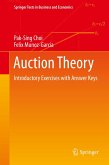





This textbook provides a short introduction to auction theory through exercises with detailed answer keys. Focusing on practical examples, this textbook offers over 98 exercises that predict bidders' equilibrium behaviour in different auction formats, along with the seller's strategic incentives to organize one auction format over the other. The book emphasizes game-theoretic tools, so students can apply similar tools to other auction formats. Also included are several exercises based on published articles, with the model reduced to its main elements and the question divided into several easy-to-answer parts. Little mathematical background in algebra and calculus is assumed, and most algebraic steps and simplifications are provided, making the text ideal for upper undergraduate and graduate students.
The book begins with a discussion of second-price auctions, which can be studied without using calculus, and works through progressively more complicated auction scenarios: first-price auctions, all-pay auctions, third-price auctions, the Revenue Equivalence principle, common-value auctions, multi-unit auctions, and procurement auctions. Exercises in each chapter are ranked according to their difficulty, with a letter (A-C) next to the exercise title, which allows students to pace their studies accordingly. The authors also offer a list of suggested exercises for each chapter, for instructors teaching at varying levels: undergraduate, Masters, Ph.D.
Revised and updated for the second edition, this textbook includes new and expanded exercises as well as a mathematical appendix to help students review basic math and statistical properties frequently used throughout the book. Providing a practical, customizable approach to auction theory, it is appropriate for students of economics, finance, and business administration. This book may also be used for related classes such as game theory, market design, economics of information, contract theory, or topics in microeconomics.
The book begins with a discussion of second-price auctions, which can be studied without using calculus, and works through progressively more complicated auction scenarios: first-price auctions, all-pay auctions, third-price auctions, the Revenue Equivalence principle, common-value auctions, multi-unit auctions, and procurement auctions. Exercises in each chapter are ranked according to their difficulty, with a letter (A-C) next to the exercise title, which allows students to pace their studies accordingly. The authors also offer a list of suggested exercises for each chapter, for instructors teaching at varying levels: undergraduate, Masters, Ph.D.
Revised and updated for the second edition, this textbook includes new and expanded exercises as well as a mathematical appendix to help students review basic math and statistical properties frequently used throughout the book. Providing a practical, customizable approach to auction theory, it is appropriate for students of economics, finance, and business administration. This book may also be used for related classes such as game theory, market design, economics of information, contract theory, or topics in microeconomics.
Dieser Download kann aus rechtlichen Gründen nur mit Rechnungsadresse in A, B, BG, CY, CZ, D, DK, EW, E, FIN, F, GR, HR, H, IRL, I, LT, L, LR, M, NL, PL, P, R, S, SLO, SK ausgeliefert werden.