47,95 €
inkl. MwSt.
Sofort per Download lieferbar
24 °P sammeln

Andere Kunden interessierten sich auch für
") Australian Theatre, Modernism and Patrick White (eBook, ePUB)46,95 €
Australian Theatre, Modernism and Patrick White (eBook, ePUB)46,95 €") Performing Indigenous Identities on the Contemporary Australian Stage (eBook, PDF)41,95 €
Performing Indigenous Identities on the Contemporary Australian Stage (eBook, PDF)41,95 €") American Accent Drills for British and Australian Speakers (eBook, PDF)25,95 €
American Accent Drills for British and Australian Speakers (eBook, PDF)25,95 €") French Theatre, Orientalism, and the Representation of India, 1770-1865 (eBook, PDF)39,95 €
French Theatre, Orientalism, and the Representation of India, 1770-1865 (eBook, PDF)39,95 €") Mainstream AIDS Theatre, the Media, and Gay Civil Rights (eBook, PDF)41,95 €
Mainstream AIDS Theatre, the Media, and Gay Civil Rights (eBook, PDF)41,95 €") Research Theatre, Climate Change, and the Ecocide Project: A Casebook (eBook, PDF)64,95 €
Research Theatre, Climate Change, and the Ecocide Project: A Casebook (eBook, PDF)64,95 €") Theatre, Performance and Analogue Technology (eBook, PDF)72,95 €
Theatre, Performance and Analogue Technology (eBook, PDF)72,95 €

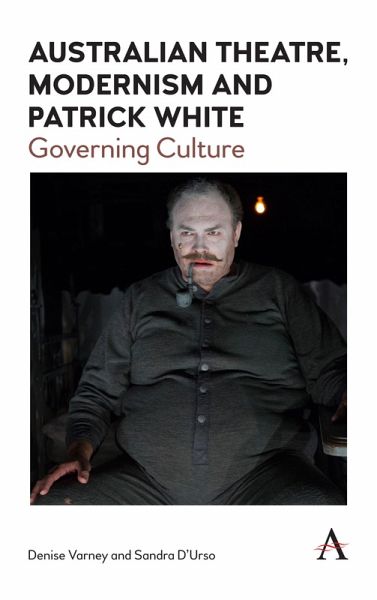
'Australian Theatre, Modernism and Patrick White' details the rejection of two Patrick White plays by the Adelaide Festival of Arts in Australia in the early 1960s. In 1961 the board of governors rejected a proposal to include the world premiere of White's first major play 'The Ham Funeral' for the 1962 festival. In 1963 it rejected a proposal to premiere a subsequent play 'Night on Bald Mountain' for the 1964 festival. These two rejections were taken up in the press where the former was referred to as the 'affaire "Ham Funeral"' and the latter was greeted as 'here we go again'. 'Australian Theatre, Modernism and Patrick White' documents the scandal that followed the board's rejections of White's plays, especially as it acted against the advice of its own drama committee and artistic director on both occasions.
Denise Varney and Sandra D'Urso analyze the two events by drawing on the performative behaviour of the board of governors to focus on the question of governance. They shed new light on the cultural politics that surrounded the rejections, arguing that it represents an instance of executive governance of cultural production, in this case theatre and performance. The governing body was a self-appointed private board comprising wealthy men, who were representative of an Adelaide establishment made up of business, farming, newspaper and military interests.
The central argument of 'Australian Theatre, Modernism and Patrick White' is that aesthetic modernism in theatre and drama struggled to achieve visibility and acceptability, and was perceived as a threat to the norms and values of early to mid-twentieth-century Australia. The authors argue that when modern drama entered the stage, its preference for aesthetic experimentation over commercial considerations challenged regimes of value based on the popular appeal of musicals, touring productions and overseas imports. The resistance to that prevailing theatre culture and the provocation of Patrick White's plays provide a prime example of Australia in transition between its colonial heritage and modern future. The 1960s set the scene for the confrontation between modernist experimentation and arts governance, and between aesthetic and commercial values.
Denise Varney and Sandra D'Urso analyze the two events by drawing on the performative behaviour of the board of governors to focus on the question of governance. They shed new light on the cultural politics that surrounded the rejections, arguing that it represents an instance of executive governance of cultural production, in this case theatre and performance. The governing body was a self-appointed private board comprising wealthy men, who were representative of an Adelaide establishment made up of business, farming, newspaper and military interests.
The central argument of 'Australian Theatre, Modernism and Patrick White' is that aesthetic modernism in theatre and drama struggled to achieve visibility and acceptability, and was perceived as a threat to the norms and values of early to mid-twentieth-century Australia. The authors argue that when modern drama entered the stage, its preference for aesthetic experimentation over commercial considerations challenged regimes of value based on the popular appeal of musicals, touring productions and overseas imports. The resistance to that prevailing theatre culture and the provocation of Patrick White's plays provide a prime example of Australia in transition between its colonial heritage and modern future. The 1960s set the scene for the confrontation between modernist experimentation and arts governance, and between aesthetic and commercial values.
Dieser Download kann aus rechtlichen Gründen nur mit Rechnungsadresse in A, D ausgeliefert werden.