55,95 €
inkl. MwSt.
Sofort per Download lieferbar
28 °P sammeln

Andere Kunden interessierten sich auch für
") Balancing Written History with Oral Tradition (eBook, ePUB)55,95 €
Balancing Written History with Oral Tradition (eBook, ePUB)55,95 €") Colonialism, Ethnicity and War in Angola (eBook, PDF)41,95 €
Colonialism, Ethnicity and War in Angola (eBook, PDF)41,95 €") Mistaking Africa (eBook, PDF)37,95 €
Mistaking Africa (eBook, PDF)37,95 €") Senegal (eBook, PDF)27,95 €
Senegal (eBook, PDF)27,95 €") Pan-Africanism, and the Politics of African Citizenship and Identity (eBook, PDF)48,95 €
Pan-Africanism, and the Politics of African Citizenship and Identity (eBook, PDF)48,95 €") Epitaph to Indirect Rule (eBook, PDF)52,95 €
Epitaph to Indirect Rule (eBook, PDF)52,95 €") A History of Rwanda (eBook, PDF)44,95 €
A History of Rwanda (eBook, PDF)44,95 €
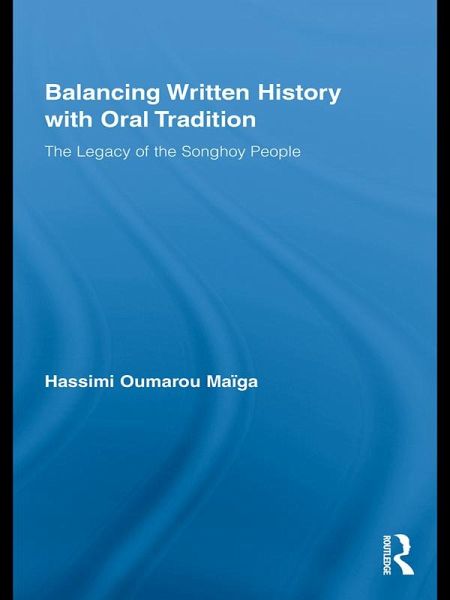
By balancing written history with the African oral tradition, this book conceptualizes the integrations among diverse peoples of Africa and specifically among the Songhoy people. Drawing from a number of academic disciplines and original research that documents the oral and literate traditions of the Songhoy people, Hassimi Oumarou Maiga offers a unique interpretation of indigenous Songhoy-African perspectives on African history, culture and education from antiquity to the present day and from continental Africa to the worldwide African Diaspora. In explaining the cosmology, philosophy, values and process of indigenous, non-Muslim education, this book also corrects and balances the perception of the Songhoy as a wholly Muslim society. The legacy of the Songhoy Empire, Maiga argues, is as a model of African integration through its administrative and political organization, which remains relevant even today. This book is an essential addition for scholars and students of African history.
Dieser Download kann aus rechtlichen Gründen nur mit Rechnungsadresse in A, B, BG, CY, CZ, D, DK, EW, E, FIN, F, GR, HR, H, IRL, I, LT, L, LR, M, NL, PL, P, R, S, SLO, SK ausgeliefert werden.