19,99 €
inkl. MwSt.
Sofort per Download lieferbar
0 °P sammeln

Andere Kunden interessierten sich auch für
") Pulp and Paper Magazine (eBook, ePUB)19,99 €
Pulp and Paper Magazine (eBook, ePUB)19,99 €") Cork (eBook, ePUB)19,99 €
Cork (eBook, ePUB)19,99 €") Cork (eBook, ePUB)19,99 €
Cork (eBook, ePUB)19,99 €") Industrial Piping and Equipment Estimating Manual (eBook, ePUB)122,95 €
Industrial Piping and Equipment Estimating Manual (eBook, ePUB)122,95 €") Manufacturing Cost Data on Artificial Ice (eBook, ePUB)19,99 €
Manufacturing Cost Data on Artificial Ice (eBook, ePUB)19,99 €") Coal and the coal mines (eBook, ePUB)19,99 €
Coal and the coal mines (eBook, ePUB)19,99 €") Nigeria and its tin fields (eBook, ePUB)19,99 €
Nigeria and its tin fields (eBook, ePUB)19,99 €
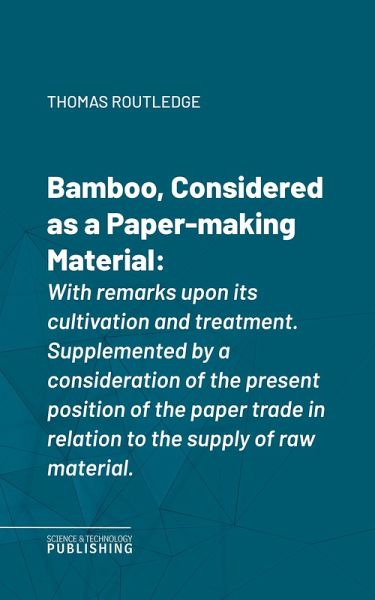
Bamboo, Considered as a Paper-making Material With remarks upon its cultivation and treatment. Supplemented by a consideration of the present position of the paper trade in relation to the supply of raw material is a comprehensive treatise exploring the potential of bamboo as a viable and sustainable raw material for the paper-making industry. Authored in the late 19th century, this work delves into the botanical characteristics of bamboo, its rapid growth, and its adaptability to various climates, making it an attractive alternative to traditional paper-making fibers such as rags, wood, and esparto grass. The book provides detailed insights into the methods of cultivating and harvesting bamboo, as well as the processes required to convert it into high-quality pulp suitable for paper production. The author meticulously examines the mechanical and chemical properties of bamboo fibers, comparing them to other commonly used materials, and highlights the advantages of bamboo, including its abundance, renewability, and cost-effectiveness. The text also addresses the challenges associated with processing bamboo, offering practical solutions and recommendations for its treatment to optimize yield and quality. In addition to the technical aspects, the book offers a critical analysis of the global paper trade during the period, focusing on the increasing demand for paper and the consequent strain on existing raw material supplies. It discusses the economic and environmental implications of continued reliance on traditional sources and advocates for the adoption of bamboo as a means to ensure the sustainability and growth of the paper industry. Supplemented by statistical data, case studies, and references to contemporary experiments and industrial practices, this work serves as both a scientific resource and a call to action for manufacturers, agriculturists, and policymakers. It remains a valuable historical document, reflecting the innovative spirit of its time and the ongoing quest for sustainable industrial solutions.
Dieser Download kann aus rechtlichen Gründen nur mit Rechnungsadresse in A, B, BG, CY, CZ, D, DK, EW, E, FIN, F, GR, HR, H, IRL, I, LT, L, LR, M, NL, PL, P, R, S, SLO, SK ausgeliefert werden.