21,95 €
21,95 €
inkl. MwSt.
Sofort per Download lieferbar

11 °P sammeln
21,95 €
Als Download kaufen
21,95 €
inkl. MwSt.
Sofort per Download lieferbar
11 °P sammeln
Jetzt verschenken
Alle Infos zum eBook verschenken
21,95 €
inkl. MwSt.
Sofort per Download lieferbar
Alle Infos zum eBook verschenken
11 °P sammeln

Andere Kunden interessierten sich auch für
") Barcelona (eBook, PDF)21,95 €
Barcelona (eBook, PDF)21,95 €") The Climate Planner (eBook, ePUB)33,95 €
The Climate Planner (eBook, ePUB)33,95 €") Cities and Digital Platforms (eBook, ePUB)39,95 €
Cities and Digital Platforms (eBook, ePUB)39,95 €") Mapping Urbanities (eBook, ePUB)55,95 €
Mapping Urbanities (eBook, ePUB)55,95 €") The Humanities in City Planning (eBook, ePUB)36,95 €
The Humanities in City Planning (eBook, ePUB)36,95 €") Artificial Intelligence for Urban Planning (eBook, ePUB)35,95 €
Artificial Intelligence for Urban Planning (eBook, ePUB)35,95 €") Urbanism for a Difficult Future (eBook, ePUB)33,95 €
Urbanism for a Difficult Future (eBook, ePUB)33,95 €


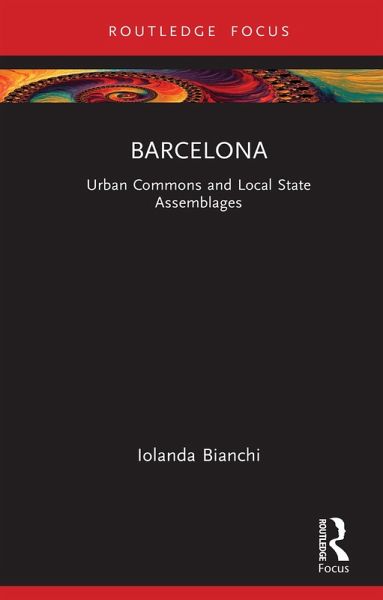
This book explores the complex relationship between urban commons - understood as a repertoire of collective action that fosters a politics of antagonism - and the local state. It critiques the dominant neo-institutionalist and neo-Marxist perspectives for their deterministic and siloed views, as well as the insufficient attention they pay to the municipal scale. The book proposes a more nuanced, urban-based, outcome-oriented approach rooted in assemblage theory.
The analysis addresses a central question: can urban commons-local state assemblages benefit the politics of urban commons? The book argues that they can, provided they form rhizomatic assemblages. These allow urban commons to retain their self-governing autonomy, even as they lose some of their material autonomy. Conversely, it shows that assemblages can also take arborescent forms, allowing the local state to undermine the self-governing autonomy of the urban commons.
Focusing on Barcelona, the book examines how rhizomatic and arborescent assemblages are constructed, as well as the strategies that urban commons can undertake to build rhizomatic assemblages. This book is essential for scholars, policymakers, and activists interested in urban governance, commons theory and transformative politics. It provides both theoretical insights and practical tools for harnessing the dynamics of the urban commons and the local state to drive meaningful socio-political change.
The analysis addresses a central question: can urban commons-local state assemblages benefit the politics of urban commons? The book argues that they can, provided they form rhizomatic assemblages. These allow urban commons to retain their self-governing autonomy, even as they lose some of their material autonomy. Conversely, it shows that assemblages can also take arborescent forms, allowing the local state to undermine the self-governing autonomy of the urban commons.
Focusing on Barcelona, the book examines how rhizomatic and arborescent assemblages are constructed, as well as the strategies that urban commons can undertake to build rhizomatic assemblages. This book is essential for scholars, policymakers, and activists interested in urban governance, commons theory and transformative politics. It provides both theoretical insights and practical tools for harnessing the dynamics of the urban commons and the local state to drive meaningful socio-political change.
Dieser Download kann aus rechtlichen Gründen nur mit Rechnungsadresse in A, B, BG, CY, CZ, D, DK, EW, E, FIN, F, GR, HR, H, IRL, I, LT, L, LR, M, NL, PL, P, R, S, SLO, SK ausgeliefert werden.