4,49 €
4,49 €
inkl. MwSt.
Sofort per Download lieferbar

0 °P sammeln
4,49 €
Als Download kaufen
4,49 €
inkl. MwSt.
Sofort per Download lieferbar
0 °P sammeln
Jetzt verschenken
Alle Infos zum eBook verschenken
4,49 €
inkl. MwSt.
Sofort per Download lieferbar
Alle Infos zum eBook verschenken
0 °P sammeln

Andere Kunden interessierten sich auch für
") Treading Water at the Shark Café: A Memoir of the Yugoslav Wars (eBook, ePUB)3,49 €
Treading Water at the Shark Café: A Memoir of the Yugoslav Wars (eBook, ePUB)3,49 €") A House Divided : The American Civil War: Causes, Battles, and Consequences (eBook, ePUB)2,99 €
A House Divided : The American Civil War: Causes, Battles, and Consequences (eBook, ePUB)2,99 € (eBook, ePUB)") World War II Submarines: Stunning World War 2 Submarine Stories And Warfare From The Depths Of The Ocean (World War 2 Submarines, #1) (eBook, ePUB)0,00 €
World War II Submarines: Stunning World War 2 Submarine Stories And Warfare From The Depths Of The Ocean (World War 2 Submarines, #1) (eBook, ePUB)0,00 €") The Battle of Long Tan (eBook, ePUB)2,99 €
The Battle of Long Tan (eBook, ePUB)2,99 €") Civil War Torpedoes and the Global Development of Landmine Warfare (eBook, ePUB)24,95 €
Civil War Torpedoes and the Global Development of Landmine Warfare (eBook, ePUB)24,95 €") Narratives, Routes and Intersections in Pre-Modern Asia (eBook, ePUB)41,95 €
Narratives, Routes and Intersections in Pre-Modern Asia (eBook, ePUB)41,95 €") Neutrality and Neutralism in the Global Cold War (eBook, ePUB)51,95 €
Neutrality and Neutralism in the Global Cold War (eBook, ePUB)51,95 €


War is not only fought on battlefields-it is also fought on pages, in memories, and through stories.
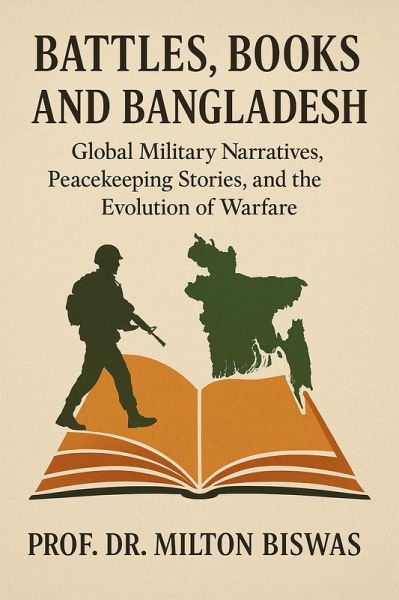
Battles, Books and Bangladesh: Global Military Narratives, Peacekeeping Stories, and the Evolution of Warfare brings together world military history, literary analysis, and Bangladeshi experience in a single, powerful volume. Moving from classical epics and colonial campaigns to liberation struggles, UN peacekeeping missions, and twenty-first-century conflicts, this book shows how war is narrated, justified, resisted and remembered in literature and life.
Prof. Dr. Milton Biswas examines how generals, soldiers, prisoners, peacekeepers, and civilians have turned their experiences of violence and survival into writing-memoirs, novels, diaries, letters, reportage, mission records, and creative non-fiction. Special attention is given to Bangladesh's own military and peacekeeping narratives, tracing how a once war-torn nation emerged as one of the world's leading contributors to UN peace operations.
Across its chapters, the book:
Written in clear, accessible language but grounded in rigorous research, this book is ideal for students, researchers, military professionals, peacekeepers, and general readers interested in the human, literary, and ethical dimensions of war and peace.
Whether you are curious about the 1971 Liberation War, fascinated by global conflict narratives, or engaged with UN peacekeeping and Bangladeshi contributions to world security, this book offers a rich, comparative lens on how battles become books-and how books can shape the battles of tomorrow.
Battles, Books and Bangladesh: Global Military Narratives, Peacekeeping Stories, and the Evolution of Warfare brings together world military history, literary analysis, and Bangladeshi experience in a single, powerful volume. Moving from classical epics and colonial campaigns to liberation struggles, UN peacekeeping missions, and twenty-first-century conflicts, this book shows how war is narrated, justified, resisted and remembered in literature and life.
Prof. Dr. Milton Biswas examines how generals, soldiers, prisoners, peacekeepers, and civilians have turned their experiences of violence and survival into writing-memoirs, novels, diaries, letters, reportage, mission records, and creative non-fiction. Special attention is given to Bangladesh's own military and peacekeeping narratives, tracing how a once war-torn nation emerged as one of the world's leading contributors to UN peace operations.
Across its chapters, the book:
- Connects classical military texts and modern war literature from different cultures
- Analyses liberation war stories and post-colonial conflicts in South Asia
- Highlights the role of Bangladeshi soldiers and officers in global peacekeeping
- Explores how trauma, heroism, sacrifice, faith, and ethics appear in military writing
- Reflects on the future of warfare in an age of drones, cyberwar, and hybrid conflicts
Written in clear, accessible language but grounded in rigorous research, this book is ideal for students, researchers, military professionals, peacekeepers, and general readers interested in the human, literary, and ethical dimensions of war and peace.
Whether you are curious about the 1971 Liberation War, fascinated by global conflict narratives, or engaged with UN peacekeeping and Bangladeshi contributions to world security, this book offers a rich, comparative lens on how battles become books-and how books can shape the battles of tomorrow.
Dieser Download kann aus rechtlichen Gründen nur mit Rechnungsadresse in A, B, CY, CZ, D, DK, EW, E, FIN, F, GR, H, IRL, I, LT, L, LR, M, NL, PL, P, R, S, SLO, SK ausgeliefert werden.