77,95 €
77,95 €
inkl. MwSt.
Erscheint vor. 02.02.26

39 °P sammeln
77,95 €
Als Download kaufen
77,95 €
inkl. MwSt.
Erscheint vor. 02.02.26
39 °P sammeln
Jetzt verschenken
Alle Infos zum eBook verschenken
77,95 €
inkl. MwSt.
Erscheint vor. 02.02.26
Alle Infos zum eBook verschenken
39 °P sammeln

Andere Kunden interessierten sich auch für
") Bayesian Statistical Methods (eBook, PDF)42,95 €
Bayesian Statistical Methods (eBook, PDF)42,95 €") Bayesian Statistical Methods (eBook, ePUB)77,95 €
Bayesian Statistical Methods (eBook, ePUB)77,95 €") Bayesian Statistical Methods (eBook, ePUB)42,95 €
Bayesian Statistical Methods (eBook, ePUB)42,95 €") Markov Chain Monte Carlo (eBook, PDF)98,95 €
Markov Chain Monte Carlo (eBook, PDF)98,95 €") Case Studies in Bayesian Methods for Biopharmaceutical CMC (eBook, PDF)52,95 €
Case Studies in Bayesian Methods for Biopharmaceutical CMC (eBook, PDF)52,95 €") Bayesian Psychometric Modeling (eBook, PDF)48,95 €
Bayesian Psychometric Modeling (eBook, PDF)48,95 €") An Introduction to Generalized Linear Models (eBook, PDF)76,95 €
An Introduction to Generalized Linear Models (eBook, PDF)76,95 €
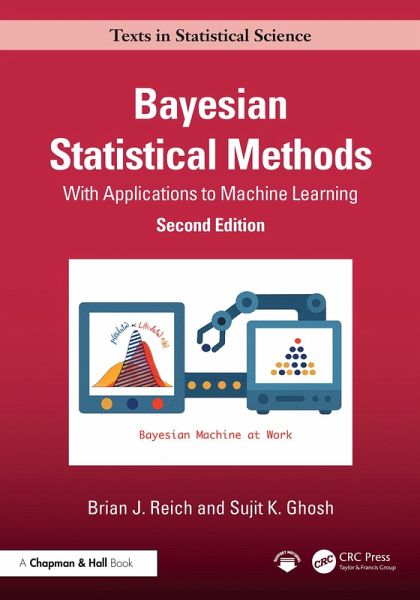
Bayesian Statistical Methods: With Applications to Machine Learning provides data scientists with the foundational and computational tools needed to carry out a Bayesian analysis. Compared to others, this book is more focused on Bayesian methods applied routinely in practice, including multiple linear regression, mixed effects models and generalized linear models. This second edition includes a new chapter on Bayesian machine learning methods to handle large and complex datasets and several new applications to illustrate the benefits of the Bayesian approach in terms of uncertainty quantification.
Readers familiar with only introductory statistics will find this book accessible, as it includes many worked examples with complete R code, and comparisons are presented with analogous frequentist procedures. The book can be used as a one-semester course for advanced undergraduate and graduate students and can be used in courses comprising undergraduate statistics majors, as well as non-statistics graduate students from other disciplines such as engineering, ecology and psychology. In addition to thorough treatment of the basic concepts of Bayesian inferential methods, the book covers many general topics:
To illustrate the flexibility of the Bayesian approaches for complex data structures, the latter chapters provide case studies covering advanced topics:
The advanced topics are presented with sufficient conceptual depth that the reader will be able to carry out such analysis and argue the relative merits of Bayesian and classical methods. A repository of R code, motivating data sets and complete data analyses is made available on the book's website.
Readers familiar with only introductory statistics will find this book accessible, as it includes many worked examples with complete R code, and comparisons are presented with analogous frequentist procedures. The book can be used as a one-semester course for advanced undergraduate and graduate students and can be used in courses comprising undergraduate statistics majors, as well as non-statistics graduate students from other disciplines such as engineering, ecology and psychology. In addition to thorough treatment of the basic concepts of Bayesian inferential methods, the book covers many general topics:
- Advice on selecting prior distributions
- Computational methods including Markov chain Monte Carlo (MCMC) sampling
- Model-comparison and goodness-of-fit measures, including sensitivity to priors.
To illustrate the flexibility of the Bayesian approaches for complex data structures, the latter chapters provide case studies covering advanced topics:
- Handling of missing and censored data
- Priors for high-dimensional regression models
- Machine learning models including Bayesian adaptive regression trees and deep learning
- Computational techniques for large datasets
- Frequentist properties of Bayesian methods.
The advanced topics are presented with sufficient conceptual depth that the reader will be able to carry out such analysis and argue the relative merits of Bayesian and classical methods. A repository of R code, motivating data sets and complete data analyses is made available on the book's website.
Dieser Download kann aus rechtlichen Gründen nur mit Rechnungsadresse in A, B, BG, CY, CZ, D, DK, EW, E, FIN, F, GR, HR, H, IRL, I, LT, L, LR, M, NL, PL, P, R, S, SLO, SK ausgeliefert werden.
"Brian J. Reich and Sujit K. Ghosh make a valuable contribution to the growing canon of introductory texts on Bayesian statistics...The extensive data and problem sets provided are a major highlight of the work...Features that instructors will find quite appealing include the nice library of problem sets (with solutions to odd problems in chapters 1-5 online), the availability online of several nice worked data examples including code, and coverage of some topics not yet standard in introductory texts, including Bayesian computation with big data...A big plus is the recent addition of Python code (PyMC) online...Because several of the exercises are application based and incorporate data from a variety of disciplines, the book will surely capture the interest of its intended readership."
~Biometrics
"A book that gives a comprehensive coverage of Bayesian inference for a diverse background of scientific practitioners is needed. The book Bayesian Statistical Methods seems to be a good candidate for this purpose, which aims at a balanced treatment between theory and computation. The authors are leading researchers and experts in Bayesian statistics. I believe this book is likely to be an excellent text book for an introductory course targeting at first-year graduate students or undergraduate statistics majors...This new book is more focused on the most fundamental components of Bayesian methods. Moreover, this book contains many simulated examples and real-data applications, with computer code provided to demonstrate the implementations."
~Qing Zhou, UCLA
"The book gives an overview of Bayesian statistical modeling with a focus on the building blocks for fitting and analyzing hierarchical models. The book uses a number of interesting and realistic examples to illustrate the methods. The computational focus is in the use of JAGS, as a tool to perform Bayesian inference using Markov chain Monte Carlo methods...It can be targeted as a textbook for upper-division undergraduate students in statistics and some areas of science, engineering and social sciences with an interest in a reasonably formal development of data analytic methods and uncertainty quantification. It could also be used for a Master's class in statistical modeling."
~Bruno Sansó, University of California Santa Cruz
"The given manuscript sample is technically correct, clearly written, and at an appropriate level of difficulty... I enjoyed the real-life problems in the Chapter 1 exercises. I especially like the problem on the Federalist Papers, because the students can revisit this problem and perform more powerful inferences using the advanced Bayesian methods that they will learn later in the textbook... I would seriously consider adopting the book as a required textbook. This text provides more details, R codes, and illuminating visualizations compared to competing books, and more quickly introduces a broad scope of regression models that are important in practical applications."
~Arman Sabbaghi, Purdue University
"The authors are leading researchers and experts in Bayesian statistics. I believe this book is likely to be an excellent textbook for an introductory course targeting at first-year graduate students or
undergraduate statistics majors..."
~Qing Zhou, UCLA
"I would seriously consider adopting the book as a required textbook. This text provides more details, R codes, and illuminating visualizations compared to competing books, and more quickly introduces a broad scope of regression models that are important in practical applications..."
~Arman Sabbaghi, Purdue University
"The book gives an overview of Bayesian statistical modeling with a focus on the building blocks for fitting and analyzing hierarchical models. The book uses a number of interesting and realistic examples to illustrate the methods. The computational focus is in the use of JAGS, as a tool to perform Bayesian inference using Markov chain Monte Carlo methods...It can be targeted as a textbook for upper-division undergraduate students in statistics and some areas of science, engineering and social sciences with an interest in a reasonably formal development of data analytic methods and uncertainty quantification. It could also be used for a Master's class in statistical modeling."
~Bruno Sansó, University of California Santa Cruz
~Biometrics
"A book that gives a comprehensive coverage of Bayesian inference for a diverse background of scientific practitioners is needed. The book Bayesian Statistical Methods seems to be a good candidate for this purpose, which aims at a balanced treatment between theory and computation. The authors are leading researchers and experts in Bayesian statistics. I believe this book is likely to be an excellent text book for an introductory course targeting at first-year graduate students or undergraduate statistics majors...This new book is more focused on the most fundamental components of Bayesian methods. Moreover, this book contains many simulated examples and real-data applications, with computer code provided to demonstrate the implementations."
~Qing Zhou, UCLA
"The book gives an overview of Bayesian statistical modeling with a focus on the building blocks for fitting and analyzing hierarchical models. The book uses a number of interesting and realistic examples to illustrate the methods. The computational focus is in the use of JAGS, as a tool to perform Bayesian inference using Markov chain Monte Carlo methods...It can be targeted as a textbook for upper-division undergraduate students in statistics and some areas of science, engineering and social sciences with an interest in a reasonably formal development of data analytic methods and uncertainty quantification. It could also be used for a Master's class in statistical modeling."
~Bruno Sansó, University of California Santa Cruz
"The given manuscript sample is technically correct, clearly written, and at an appropriate level of difficulty... I enjoyed the real-life problems in the Chapter 1 exercises. I especially like the problem on the Federalist Papers, because the students can revisit this problem and perform more powerful inferences using the advanced Bayesian methods that they will learn later in the textbook... I would seriously consider adopting the book as a required textbook. This text provides more details, R codes, and illuminating visualizations compared to competing books, and more quickly introduces a broad scope of regression models that are important in practical applications."
~Arman Sabbaghi, Purdue University
"The authors are leading researchers and experts in Bayesian statistics. I believe this book is likely to be an excellent textbook for an introductory course targeting at first-year graduate students or
undergraduate statistics majors..."
~Qing Zhou, UCLA
"I would seriously consider adopting the book as a required textbook. This text provides more details, R codes, and illuminating visualizations compared to competing books, and more quickly introduces a broad scope of regression models that are important in practical applications..."
~Arman Sabbaghi, Purdue University
"The book gives an overview of Bayesian statistical modeling with a focus on the building blocks for fitting and analyzing hierarchical models. The book uses a number of interesting and realistic examples to illustrate the methods. The computational focus is in the use of JAGS, as a tool to perform Bayesian inference using Markov chain Monte Carlo methods...It can be targeted as a textbook for upper-division undergraduate students in statistics and some areas of science, engineering and social sciences with an interest in a reasonably formal development of data analytic methods and uncertainty quantification. It could also be used for a Master's class in statistical modeling."
~Bruno Sansó, University of California Santa Cruz