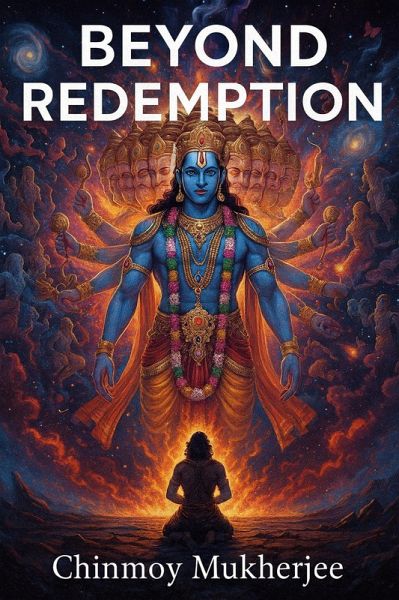
2,99 €
2,99 €
inkl. MwSt.
Sofort per Download lieferbar

0 °P sammeln
2,99 €
Als Download kaufen
2,99 €
inkl. MwSt.
Sofort per Download lieferbar
0 °P sammeln
Jetzt verschenken
Alle Infos zum eBook verschenken
2,99 €
inkl. MwSt.
Sofort per Download lieferbar
Alle Infos zum eBook verschenken
0 °P sammeln

Andere Kunden interessierten sich auch für
") The Sage's Redemption (eBook, ePUB)2,99 €
The Sage's Redemption (eBook, ePUB)2,99 € (eBook, ePUB)") Star-drake (Lodestone Tales, #4) (eBook, ePUB)2,99 €
Star-drake (Lodestone Tales, #4) (eBook, ePUB)2,99 € (eBook, ePUB)") Illumine Hades (The Hades Cycle, #7) (eBook, ePUB)2,99 €
Illumine Hades (The Hades Cycle, #7) (eBook, ePUB)2,99 €") Lord Jim (eBook, ePUB)8,95 €
Lord Jim (eBook, ePUB)8,95 € (eBook, ePUB)") Redemption (Cinderella's Secret Witch Diaries, #4) (eBook, ePUB)4,99 €
Redemption (Cinderella's Secret Witch Diaries, #4) (eBook, ePUB)4,99 €") Red's Wolf Volume 6: Redemption (eBook, ePUB)2,99 €
Red's Wolf Volume 6: Redemption (eBook, ePUB)2,99 € (eBook, ePUB)") Ruins and Redemption (Night and Day, #3) (eBook, ePUB)9,99 €
Ruins and Redemption (Night and Day, #3) (eBook, ePUB)9,99 €






"Beyond Redemption" is a philosophical novella framed as a spiritual pilgrimage across contemporary India, where the narrator seeks answers to a profound existential question rooted in the Bhagavad Gita: why has the Avatar, Krishnathe Lord of Preservationnot returned to restore dharma amid a world overrun by sins like greed, violence, and environmental destruction? The narrative unfolds through vivid, sensory-rich descriptions of encounters with twenty spiritual luminaries, each representing diverse traditions of Indian wisdom, from yogic discipline and breathwork to intellectual Vedanta and ecstatic devotion. Drawing on fictionalized portrayals inspired by real figures such as Sadhguru, Sri Sri Ravi Shankar, and Osho, the story explores themes of personal responsibility, inner transformation, and the democratization of evil in the Kali Yuga, where adharma is no longer confined to singular tyrants but permeates every human heart.
Each chapter delves into a unique guru's philosophy, offering varied interpretations of the Avatar's "delay." For instance, the Master of the Cosmic Coil emphasizes self-engineering and ecological action, viewing the Avatar as a state of consciousness rather than a superhero; the Dialectic Sage dismisses the notion as a fairy tale, urging intellectual inquiry to dismantle the ego; while the Storyteller of the Divine Epic sees the divine return in the emotional power of sacred narratives like the Ramayana. These responses range from calls for muscular discipline and joyful service to scientific meditation techniques and unconditional love, collectively shifting the blame from divine absence to human inaction. The novella critiques modern spirituality's commodification while highlighting its potential for empowerment, portraying the gurus' ashrams as microcosms of their teachingsearthy and vibrant, sterile and logical, or chaotic and miraculous.
The climax occurs in a transcendent vision of Vaikuntha, where Krishna himself reveals a devastating truth: humanity has degraded beyond redemption, with sins so diffuse that intervention would require near-total annihilation. Instead, the Lord allows karma to run its course, leading to self-destruction and the emergence of a new, enlightened species. The conclusion synthesizes these insights into a tripartite doctrine: the delay as a test of responsibility, the Avatar as a subtle inner mechanism, and the ultimate cosmic law demanding self-transformation. Ultimately, the novella posits that the true Avatar resides within, challenging readers to embody dharma rather than await external salvation
Each chapter delves into a unique guru's philosophy, offering varied interpretations of the Avatar's "delay." For instance, the Master of the Cosmic Coil emphasizes self-engineering and ecological action, viewing the Avatar as a state of consciousness rather than a superhero; the Dialectic Sage dismisses the notion as a fairy tale, urging intellectual inquiry to dismantle the ego; while the Storyteller of the Divine Epic sees the divine return in the emotional power of sacred narratives like the Ramayana. These responses range from calls for muscular discipline and joyful service to scientific meditation techniques and unconditional love, collectively shifting the blame from divine absence to human inaction. The novella critiques modern spirituality's commodification while highlighting its potential for empowerment, portraying the gurus' ashrams as microcosms of their teachingsearthy and vibrant, sterile and logical, or chaotic and miraculous.
The climax occurs in a transcendent vision of Vaikuntha, where Krishna himself reveals a devastating truth: humanity has degraded beyond redemption, with sins so diffuse that intervention would require near-total annihilation. Instead, the Lord allows karma to run its course, leading to self-destruction and the emergence of a new, enlightened species. The conclusion synthesizes these insights into a tripartite doctrine: the delay as a test of responsibility, the Avatar as a subtle inner mechanism, and the ultimate cosmic law demanding self-transformation. Ultimately, the novella posits that the true Avatar resides within, challenging readers to embody dharma rather than await external salvation
Dieser Download kann aus rechtlichen Gründen nur mit Rechnungsadresse in A, B, CY, CZ, D, DK, EW, E, FIN, F, GR, H, IRL, I, LT, L, LR, M, NL, PL, P, R, S, SLO, SK ausgeliefert werden.