Sie sind bereits eingeloggt. Klicken Sie auf 2. tolino select Abo, um fortzufahren.
Bitte loggen Sie sich zunächst in Ihr Kundenkonto ein oder registrieren Sie sich bei bücher.de, um das eBook-Abo tolino select nutzen zu können.
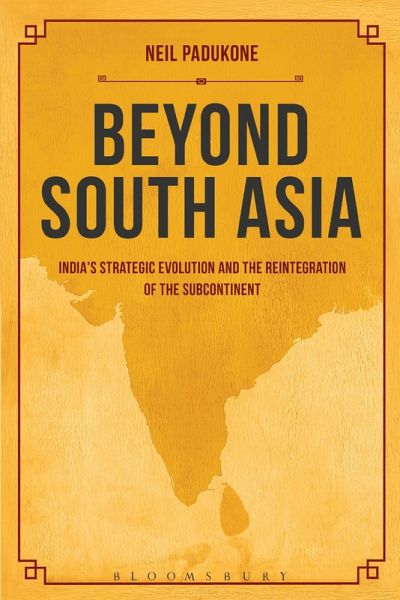
The Republic of India occupies a key geopolitical and strategic space at the center of the Indian Ocean. How it interacts with the rest of the world will have profound consequences in the 21st century. Beyond South Asia follows the evolution of India's strategic thinking since 1947, providing a comprehensive analysis of its foreign policy worldview. It begins with India's failed attempt to unite and dominate the subcontinent following independence, a strategy that resulted in conflict as its smaller neighbors invited the U.S. and China to the region, resisted intra-regional cooperation, and…mehr
The Republic of India occupies a key geopolitical and strategic space at the center of the Indian Ocean. How it interacts with the rest of the world will have profound consequences in the 21st century. Beyond South Asia follows the evolution of India's strategic thinking since 1947, providing a comprehensive analysis of its foreign policy worldview. It begins with India's failed attempt to unite and dominate the subcontinent following independence, a strategy that resulted in conflict as its smaller neighbors invited the U.S. and China to the region, resisted intra-regional cooperation, and even violently opposed New Delhi. It then explores how this worldview has shifted as India, needing markets, energy resources, and ways to balance against China, has developed economic and military ties in Central and Southeast Asia, the Middle East, Africa, the southern Indian Ocean, and beyond. To do so has required more stability in South Asia, making India more conciliatory toward other countries of the subcontinent. This is in turn leading to a lessening of tensions, enhanced cooperation, and an economic reintegration of the subcontinent, including a burgeoning détente with Pakistan. This in-depth analysis provides a comprehensive look at the domestic and regional factors that drive India, a key actor in global politics. Written in an accessible manner, it will be of use to students and specialists of Indian foreign policy, South Asian politics, international relations, and security studies and to anyone interested in the future of AfPak, the Indian Ocean region, and America's "strategic pivot."
Die Herstellerinformationen sind derzeit nicht verfügbar.
Autorenporträt
Neil Padukone is a Public Service Fellow at the Harvard University's Kennedy School of Government and a Fellow for Geopolitics at the Takshashila Institution. A former Visiting Fellow at the Observer Research Foundation in New Delhi, India, he is the author of Security in a Complex Era. His work has been published in Foreign Policy, The Atlantic, the Journal of International Affairs, The National Interest, Economic and Political Weekly, Newsweek's Daily Beast, Christian Science Monitor, and by the UK's Economic and Social Research Council (ESRC), Edward Elgar Publishing, among others. He is an alumnus of Harvard University, the London School of Economics, the George Washington University, and Stuyvesant High School.
Inhaltsangabe
ACKNOWLEDGEMENTS PART ONE: INTRODUCTION Chapter One: Introduction PART TWO: INDIA'S MONROE DOCTRINE Chapter Two: Indian Geopolitical Strategy Chapter Three: Big Brother, Little Brother: India's Small Neighbors Chapter Four: Paired Minorities: The Fraught Relationship with Pakistan Chapter Five: Extra-Regional Powers: The United States and China Chapter Six: Geographic Dislocation: The Fallout of Intraregional Conflict PART THREE: LOOKING BEYOND Chapter Seven: Economic Shift Chapter Eight: Balancing China Chapter Nine: Beyond South Asia: A New Strategic Direction Chapter Ten: "Natural Allies"? The United States and India in the 21st Century PART FOUR: SOUTH ASIAN THREAT PERCEPTION AND REGIONAL INTEGRATION Chapter Eleven: Small Neighbors Chapter Twelve: Pakistan: Mutually Assured Construction PART FIVE: CONCLUSION Chapter Thirteen: Conclusion
ACKNOWLEDGEMENTS PART ONE: INTRODUCTION Chapter One: Introduction PART TWO: INDIA'S MONROE DOCTRINE Chapter Two: Indian Geopolitical Strategy Chapter Three: Big Brother, Little Brother: India's Small Neighbors Chapter Four: Paired Minorities: The Fraught Relationship with Pakistan Chapter Five: Extra-Regional Powers: The United States and China Chapter Six: Geographic Dislocation: The Fallout of Intraregional Conflict PART THREE: LOOKING BEYOND Chapter Seven: Economic Shift Chapter Eight: Balancing China Chapter Nine: Beyond South Asia: A New Strategic Direction Chapter Ten: "Natural Allies"? The United States and India in the 21st Century PART FOUR: SOUTH ASIAN THREAT PERCEPTION AND REGIONAL INTEGRATION Chapter Eleven: Small Neighbors Chapter Twelve: Pakistan: Mutually Assured Construction PART FIVE: CONCLUSION Chapter Thirteen: Conclusion
Es gelten unsere Allgemeinen Geschäftsbedingungen: www.buecher.de/agb
Impressum
www.buecher.de ist ein Internetauftritt der buecher.de internetstores GmbH
Geschäftsführung: Monica Sawhney | Roland Kölbl | Günter Hilger
Sitz der Gesellschaft: Batheyer Straße 115 - 117, 58099 Hagen
Postanschrift: Bürgermeister-Wegele-Str. 12, 86167 Augsburg
Amtsgericht Hagen HRB 13257
Steuernummer: 321/5800/1497
USt-IdNr: DE450055826