
72,95 €
inkl. MwSt.
Sofort per Download lieferbar
36 °P sammeln

Andere Kunden interessierten sich auch für
") Beastly Blake (eBook, PDF)72,95 €
Beastly Blake (eBook, PDF)72,95 €") Mediality in the Middle Ages (eBook, PDF)118,95 €
Mediality in the Middle Ages (eBook, PDF)118,95 €") Spectres of Antiquity (eBook, PDF)33,95 €
Spectres of Antiquity (eBook, PDF)33,95 €") Blake, Myth, and Enlightenment (eBook, PDF)72,95 €
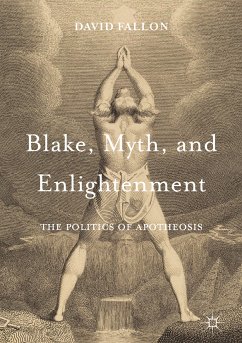
Blake, Myth, and Enlightenment (eBook, PDF)72,95 €") Allegorical Form and Theory in Hildegard of Bingen's Books of Visions (eBook, PDF)88,95 €
Allegorical Form and Theory in Hildegard of Bingen's Books of Visions (eBook, PDF)88,95 €") Coleridge's Political Poetics (eBook, PDF)96,95 €
Coleridge's Political Poetics (eBook, PDF)96,95 €") The Oresteia (eBook, PDF)10,95 €
The Oresteia (eBook, PDF)10,95 €



This book demonstrates the way in which William Blake aligned his idiosyncratic concept of the Selfhood - the lens through which the despiritualised subject beholds the material world - with the atomistic materialism of the Epicurean school as it was transmitted through the first-century BC Roman poet and philosopher Lucretius' De Rerum Natura. By addressing this philosophical debt, this study sets out a threefold re-evaluation of Blake's work: to clarify the classical stream of Blake's philosophical heritage through Lucretius; to return Blake to his historical moment, a thirty-year period from 1790 to 1820 which has been described as the second Lucretian moment in England; and to employ a new exegetical model for understanding the phenomenological parameters and epistemological frameworks of Blake's mythopoeia. Accordingly, it is revealed that Blake was not only aware of classical atomistic cosmogony and sense-based epistemology but that he systematically mapped postlapsarian existence onto an Epicurean framework.
Dieser Download kann aus rechtlichen Gründen nur mit Rechnungsadresse in A, B, BG, CY, CZ, D, DK, EW, E, FIN, F, GR, HR, H, IRL, I, LT, L, LR, M, NL, PL, P, R, S, SLO, SK ausgeliefert werden.